How to Build Habits With ADHD (When Routines Never Stick)
Why standard habit advice breaks for ADHD, and a habit system built around cues, tiny starts, novelty, other people and restarting fast after a miss.
You’ve started the morning routine, the journaling habit, the workout plan. Each one went well for a week or two, then quietly disappeared. Meanwhile, people around you seem to set up a habit once and keep it for years.
If you have ADHD, that pattern is common, and it’s not a character flaw. Standard habit advice assumes things that ADHD makes harder: remembering to do the habit, starting it without strong interest, doing it the same way every day, and getting straight back on track after a miss.
This guide covers why habits are harder with ADHD and a way of building them that works with your brain.
Note: this is general information, not medical advice. ADHD treatment, coaching and therapy can make habit-building much easier; talk to a clinician about what’s right for you.
Why habits are harder with ADHD
A habit is a behavior that becomes automatic because it’s repeated in the same context. Researchers who tracked people forming new daily habits found it took anywhere from a few weeks to many months for a behavior to feel automatic, with a typical figure around two months (how long it takes to form a habit). That means you need to repeat the habit consistently long after it stops being new.
ADHD makes several parts of that harder:
- Remembering. Until a habit is automatic, you have to remember it. Working memory and time awareness are often affected by ADHD.
- Starting without interest. Novelty fades after a week or two. Then the habit relies on importance alone, a weak signal for ADHD brains.
- Consistency of context. Habits form fastest when the cue is stable, but many people with ADHD have irregular days.
- Recovery after a miss. A missed day can trigger an all-or-nothing reaction: “I’ve ruined it.”
1. Tie the habit to a cue you can’t miss
Don’t rely on remembering. Attach the habit to something that already happens every day, or to a reminder outside your head.
- Anchor it to an existing routine: “After I pour my coffee, I take my medication.” This is habit stacking.
- Put a physical cue in the way: the book on your pillow, running shoes by the door, the vitamin bottle next to the kettle.
- Use a time with other people: a booked session or a class starts whether you remember or not.
2. Start absurdly small
The smaller the habit, the less it depends on motivation. Start with a version you could do on your worst day:
- One push-up, not a workout.
- One sentence in the journal, not a page.
- Put on running shoes and step outside, not a 5K.
You can do more when you feel like it. The two-minute rule explains why tiny starts work.
3. Plan for novelty to wear off
Many ADHD habits fail around week two or three, when the new thing stops being exciting. Expect it, and build in ways to refresh the habit without changing its core:
- Rotate the details: different running routes, different journaling prompts, a new playlist.
- Keep the cue and the time the same, and let the content vary.
- Set short challenges: “This week, ten minutes outside instead of five.”
4. Do it with other people
Other people are one of the strongest motivators for many people with ADHD. Habits that involve someone else, even silently, tend to last longer.
- A friend doing the same habit at the same time.
- An ADHD accountability buddy you check in with.
- A shared session where others are doing their own habits at the same time. That’s body doubling.
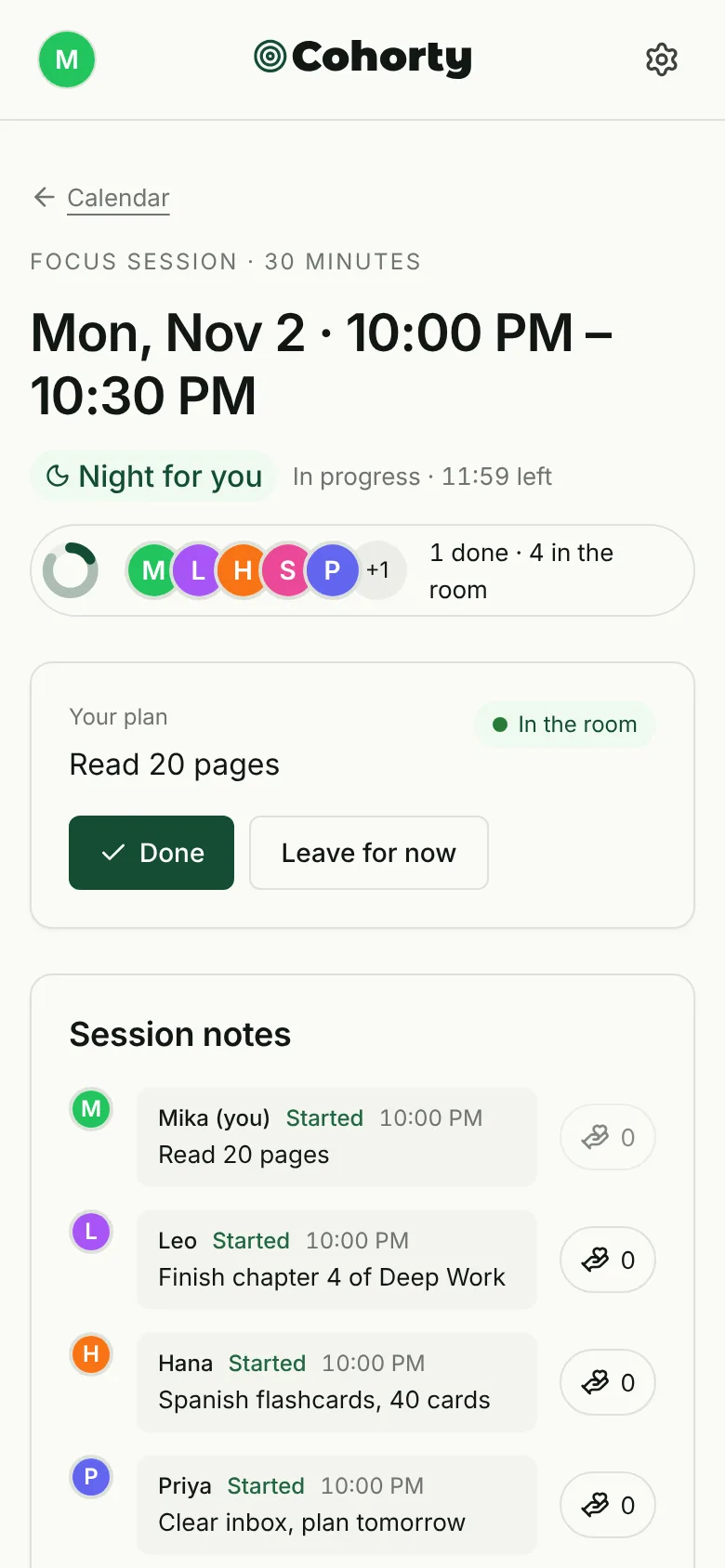
Disclosure: Cohorty publishes this journal. In Cohorty you book a 30-minute session for your habit, enter the room when it starts, and do it alongside whoever booked the same time, with no camera or chat. There are no streaks, and missing a session doesn’t reset anything. See ADHD-friendly focus sessions.
5. Make missing a day cheap
The research on habit formation is reassuring here: missing a single day doesn’t seem to derail the process in any meaningful way. What derails it is giving up after the miss.
- Never miss twice. One missed day is normal. Aim to do the next one. See the never-miss-twice rule.
- Avoid trackers that reset to zero. If a broken streak makes you quit, use a habit tracker without streaks.
- Keep a minimum version for bad days, and count it.
6. Build one habit at a time
ADHD enthusiasm often leads to starting five habits at once. Most of them end together.
- Pick one habit. Run it until it feels easy, usually several weeks.
- Then add the next, ideally stacked on the first.
- If you must do more, see building multiple habits without overwhelm.
7. Track what you did, not what you missed
A record helps, but the wrong kind of record discourages you. Track completions only, look at weeks rather than days, and celebrate “four out of seven” as a good week.
A simple ADHD habit plan
| Step | Example |
|---|---|
| Habit | Read before bed |
| Tiny version | Read one page |
| Cue | Book on the pillow when I make the bed |
| Time | 10 PM, same as the session I booked |
| With others | A shared 30-minute session, or a partner reading too |
| Minimum on bad days | Open the book, read one paragraph |
| After a miss | Read one page the next night, no catching up |
Common questions
Can people with ADHD build habits?
Yes. It often takes more external structure: clear cues, small starts, other people and a plan for missed days. Many people with ADHD keep habits for years once those pieces are in place.
Why do my habits only last two weeks?
Often because novelty has worn off and the habit relied on excitement. Keep the cue and time fixed, start smaller, vary the details and add other people.
How long does it take to form a habit with ADHD?
There’s no ADHD-specific figure. In general, habits take weeks to months to feel automatic, so plan for consistency over a couple of months, not 21 days.
Should I use a habit tracker with ADHD?
If it helps you, yes, but pick one that doesn’t punish misses. Simple completion tracking or a tracker without streaks tends to work better than streak counters.