ADHD-Friendly Focus Sessions: Book 30 Minutes, No Guilt
Plan your day as a few 30-minute slots, start each with one tap, and miss one without a broken streak. How Cohorty sessions fit an ADHD brain.
Most planning advice for ADHD fails at the same two points. Starting a task costs more than the plan assumed, and the first missed day turns the whole system into evidence that you “can’t stick to anything.”
Cohorty is built around a smaller unit than a habit streak: a 30-minute session at a set time, shared with whoever booked the same time. You pick a few half hours in your day, give each one a single small task, and start each one with a tap. If you don’t show up, nothing resets and nobody messages you.
This guide walks through that loop with screenshots, and is honest about where it won’t fit. For the general walkthrough, see how to use Cohorty.
Disclosure: Cohorty publishes this journal. The people in the screenshots are fictional sample data. Details as of November 2026.
Why half hours suit an ADHD day
Three ADHD struggles show up again and again in habit apps:
- Time blindness. “Later today” has no edge, so it slides into tomorrow. A booked time on a calendar is an edge you can see, the same idea behind most time blindness strategies and if-then plans (“at 3:30, I pay the bill”).
- The cost of starting. A two-hour block for “taxes” is hard to begin. Thirty minutes for “page 1 of the tax form” is not. Shrinking the task is the cheapest way out of ADHD paralysis.
- Shame after a miss. A streak counter that drops to zero tells you the last three weeks didn’t count. Many people with ADHD quit the app at that moment, not because the habit failed. (If that’s where you are now, see what to do after you break a streak.)
A half-hour slot addresses all three. It has a visible start, it caps the task at a size you can begin, and each one stands alone: missing 3 PM says nothing about 10 PM.
Step 1: Pick your slots for the day
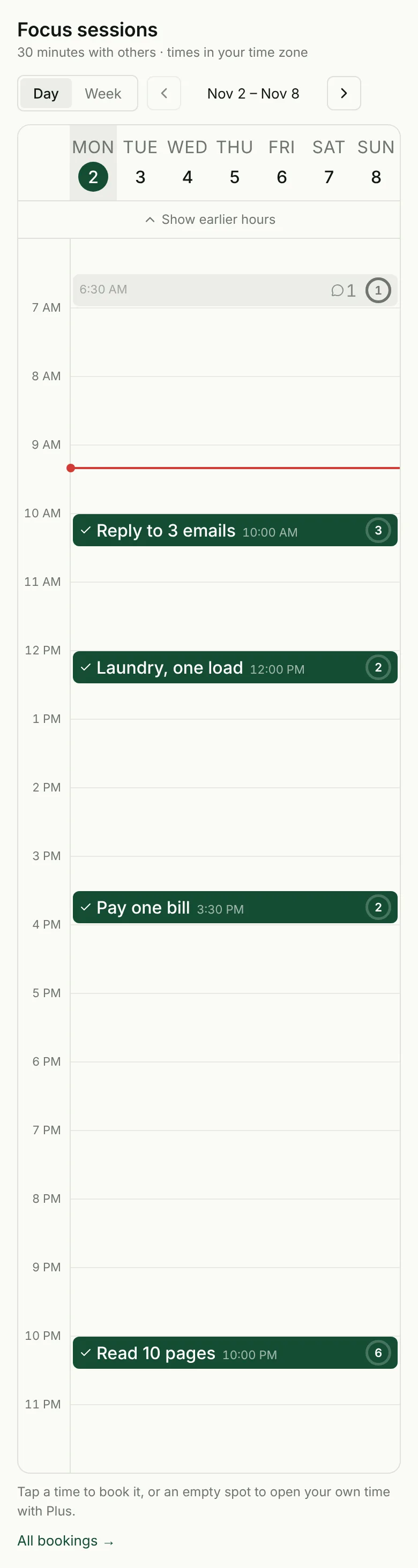
Open the calendar, switch to Day, and look at what’s already on. Every booked session shows its time and how many people booked it. Tap a time, and you’re choosing one half hour, not committing to a routine.
A few ways people with ADHD use this:
- One slot per stuck task. The email you’ve been avoiding, the laundry, the bill. Each gets its own half hour instead of one vague “admin afternoon.” The same works for housework; see ADHD cleaning in 30-minute slots.
- Spread them out. Gaps between slots are fine, and on a remote workday they act as anchors (see working from home with ADHD). You don’t need back-to-back sessions to make the day count.
- Book fewer than you think. Two slots you keep beat six you dread. You can always book another later in the day.
Sessions can’t overlap, so you can’t accidentally book yourself into two rooms at once. You can book up to 14 days ahead, but for ADHD brains, booking today and tomorrow is often enough.
Step 2: Book in two taps
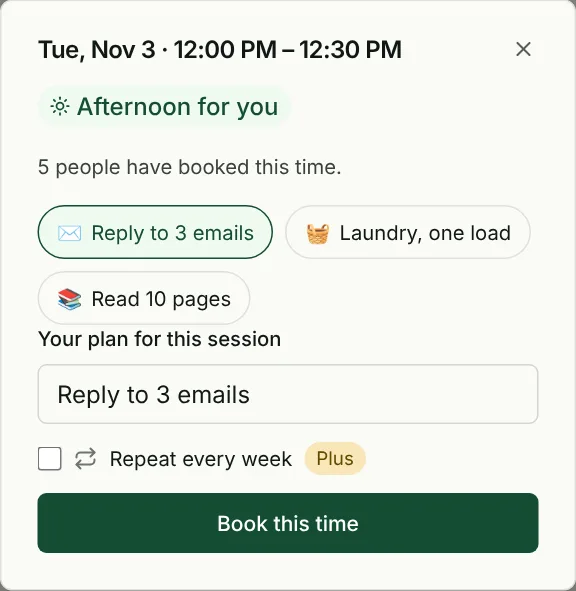
Tap a time, then tap Book this time. Your plan is filled in from your newest habit, and your other habits sit above it as chips, so choosing a different task is one more tap rather than typing. You can still edit the line if today’s version needs to be smaller (“Reply to 1 email” counts).
Keep the plan small enough to start without thinking. “Laundry, one load” works. “Sort out the house” doesn’t.
Step 3: Start with one tap
Entry opens 5 minutes before the start. Tap Start, enter the room and your plan is posted as your first line in the session notes. That’s your start report, done without typing.
There’s no camera, no microphone and no chat. You don’t need to look presentable or make small talk, which is often exactly what stops people from trying body doubling in the first place. You just see who else is in the room and what they’re working on.
If you get distracted halfway, Leave for now steps you out and you can re-enter while entry is open. Leaving isn’t cancelling; you still count as having shown up.
When the task is done, tap Done. If you finish in 12 minutes, tap it at 12 minutes. The minute-by-minute guide covers notes, applause and the room log in detail.
Step 4: Missing a slot is allowed
This is the part that matters most for ADHD. Here is what happens when a slot doesn’t go to plan.
If you can tell before it starts, tap Cancel booking on the session page. It’s gone, and nobody is told why.
If you showed up but didn’t finish, you still get credit for showing up. After the session ends, the page says so plainly and offers a way to mark it done if you did finish but forgot to tap.
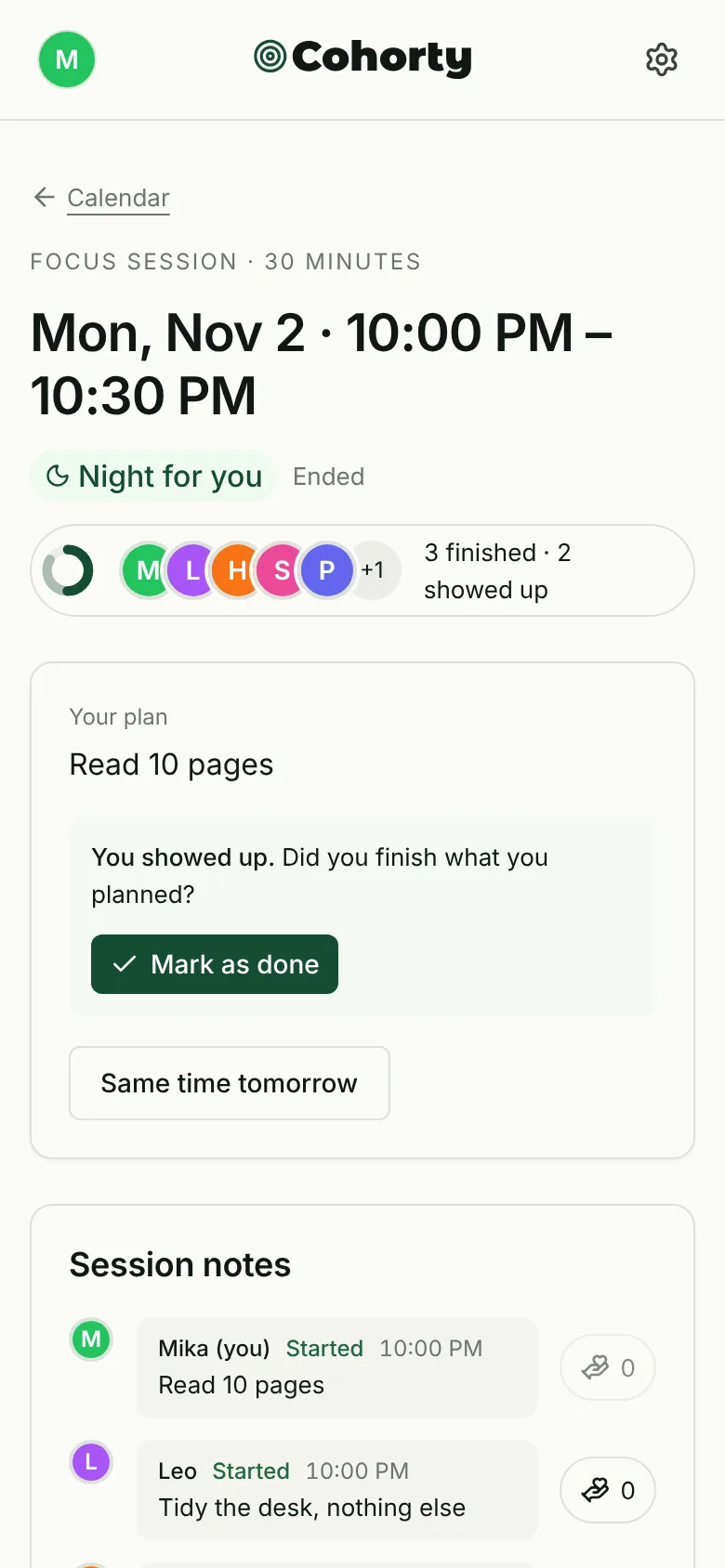
If you didn’t show up at all, here is the full list of consequences:
- No email or notification about the missed session.
- No streak to break. Cohorty doesn’t count streaks.
- No limit on booking again. Missing a session never blocks your next booking.
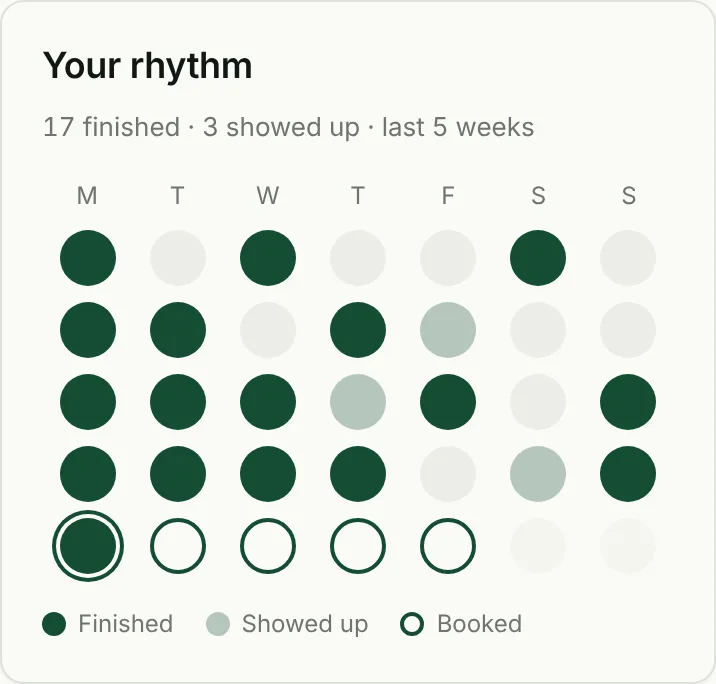
- On your private page, that day looks the same as a day you didn’t book. Only finished and showed-up days get a dot.
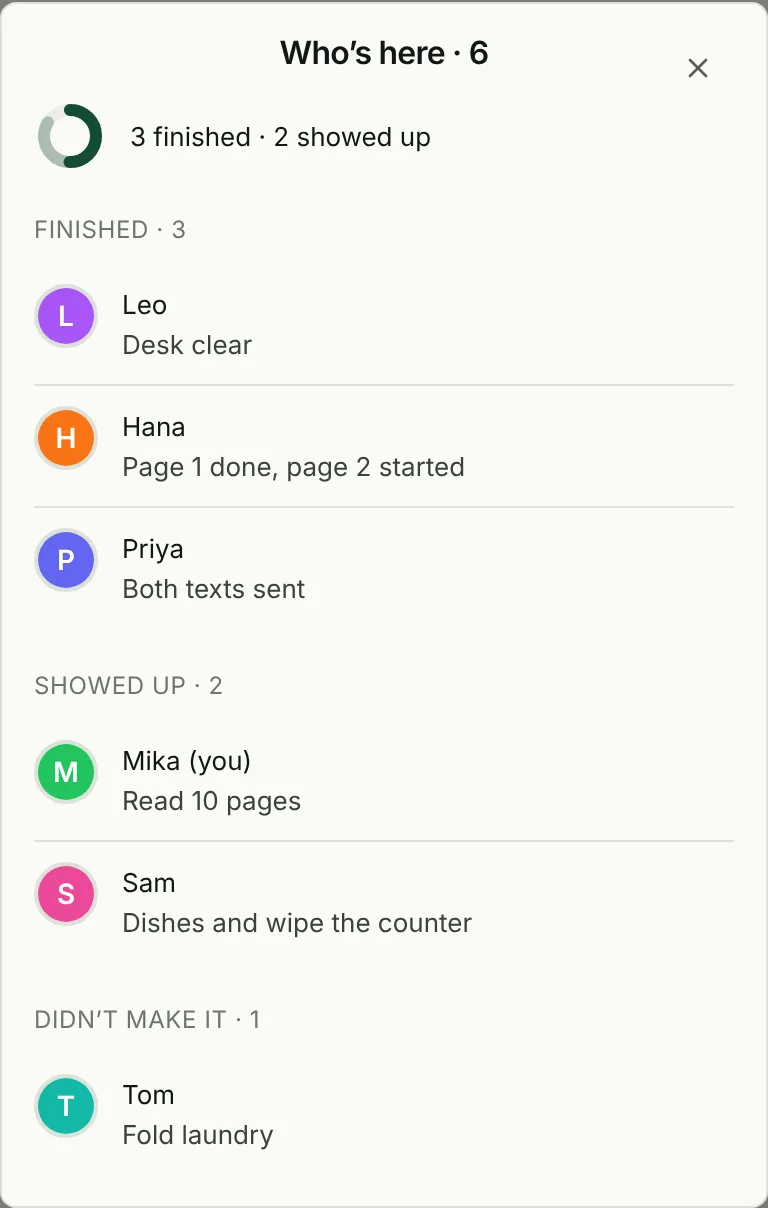
One honest caveat: people who booked the same session can see your nickname under Didn’t make it once it ends. It’s the same list everyone lands on when life gets in the way, and there is no way to reply to it or comment on it. If you’d rather not appear there, cancel before the start.
Step 5: Keep the next slot one tap away
When a session ends, Same time tomorrow books the next day’s session with the same plan in a single tap. For ADHD, that’s the whole routine-building trick: deciding the next slot while you’re already in motion, instead of relying on remembering tomorrow.
If a fixed time works for you, Cohorty Plus can repeat a booking on the weekdays you choose so it books itself. It’s optional; joining sessions stays free. See Cohorty Free vs Plus before deciding.
Where this won’t fit
- If the daily times don’t match your day. On the free plan you join the daily session times and times other members opened. If none of those land when you can actually work, you’d need Plus to open your own half hour, or a different tool.
- If you need a person to talk to. A silent room isn’t a coach or a friend checking in. If you need conversation, a one-to-one ADHD accountability buddy or a video format may suit you better.
- If seeing other people is what keeps you going. Without a camera, presence is a list of names, plans and notes. Some people find that too light; compare formats in our virtual body doubling guide.
- If you hyperfocus past 30 minutes. The session ends on time, but your work doesn’t have to. Book the next slot if you want company for the next stretch.
Cohorty isn’t a treatment for ADHD, and none of this replaces support from a clinician. It’s a way to give one small task a time and a room.
A first day to try
- Write down two tasks you’ve been avoiding, each shrunk to something you can start in 30 seconds.
- Book one slot this afternoon and one this evening.
- In each, tap Start, do the small version, tap Done.
- If you miss one, don’t reschedule it in your head. Book the next real slot and move on.
- At the end of the day, tap Same time tomorrow on the one that went best.
Common questions
How many sessions can I book in a day?
There’s no daily cap. Sessions just can’t overlap, and you can book up to 14 days ahead.
Will anyone contact me if I miss a session?
No. Cohorty doesn’t send missed-session messages. Email confirmations and reminders are optional and off unless you turn them on under All bookings.
Do I lose anything if I don’t show up?
No streak, points or booking privileges. The only trace is your nickname under “Didn’t make it” for the people who booked that same session.
Can I join a session that has already started?
Yes, until 5 minutes before the end. The session still ends at its scheduled time.