Working From Home With ADHD: How to Stay on Track
Remote work removes the structure ADHD brains rely on. How to rebuild it at home: start and end times, short blocks, a work spot, coworking and quiet check-ins.
Working from home can be great with ADHD: no commute, fewer interruptions from colleagues, freedom to move, and control over noise and light. It can also be very hard. The office quietly provided structure your brain relied on, and at home it’s gone.
No one sees when you start. Nothing marks the end of the day. The laundry, the fridge and the phone are always right there. And without other people around, it’s easy to drift for hours.
This guide covers how to rebuild that structure on purpose, with small changes that don’t depend on willpower.
What the office was doing for you
It helps to name what’s missing, because each piece has a replacement:
| The office gave you | At home, replace it with |
|---|---|
| A commute that marked the start | A fixed start time and a short start ritual |
| Colleagues visibly working | Coworking, in person or online |
| A desk that only meant work | A work spot, even a small one |
| Meetings that broke up the day | Short scheduled blocks |
| Leaving the building | A shutdown routine and a hard end time |
| Someone noticing if you vanished | Light check-ins with a colleague or buddy |
1. Start at a set time, with a start ritual
At home, the start of the workday can slide by an hour without anyone noticing, least of all you.
- Pick a fixed start time and treat it like a meeting.
- Use a short start ritual to replace the commute: make coffee, walk around the block, change out of pajamas. The same actions in the same order every day tell your brain work is starting.
- Decide the first task the night before. Write it on a sticky note on your laptop, so the first block has nothing to decide.
A shared start time is even stronger than a private one. If you know others are starting at 9:00, 9:00 feels real.
2. Work in short blocks, not a whole day
“Work today” is too big to start and too easy to lose. Break it into blocks with one task each.
- 30-minute blocks are a good default: long enough to make progress, short enough to begin. The Pomodoro for ADHD guide covers adapting block length and breaks.
- Plan three to five important blocks a day, not a full schedule. For longer focus stretches, see deep work habits. Meetings and small tasks fill the rest.
- Write the next block before ending the current one. Momentum is easier than restarting.
3. Give work its own spot
You don’t need a home office, but you do need a place that means “work.”
- One spot, used only for work if possible. A particular chair, a corner of the table, even a specific placemat for your laptop.
- Clear the line of sight of chores and distractions. Laundry in view is a task waiting to interrupt you.
- Keep the phone out of reach during focused blocks. Another room if you can.
For a full desk checklist, see workspace setup for productivity. If your attention needs variety, plan it: a morning spot and an afternoon spot, or a café for one block a day.
4. Bring back other people
For many people with ADHD, the biggest loss in remote work is other people working nearby. You can recreate it.
- Cowork with a friend or colleague, on a video call with cameras on or off, each working on your own tasks.
- Work from a library or café for a block or two.
- Join scheduled online sessions where strangers work alongside each other. This is virtual body doubling, and formats range from one-to-one video to camera-free group rooms.
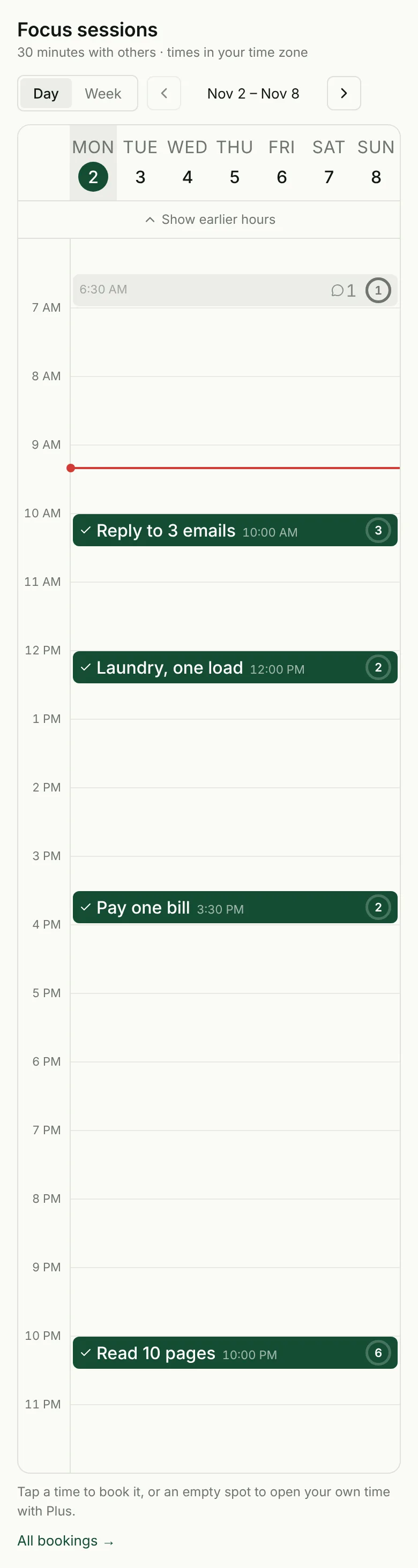
Disclosure: Cohorty publishes this journal. Cohorty runs 30-minute sessions at set times: you write one line about your task and work alongside whoever booked the same time, with no camera or chat, so it works even in a shared flat or on a messy day. Booking a few sessions spread across a workday gives it fixed anchors. See ADHD-friendly focus sessions for how to plan a day that way, and Cohorty vs Focusmate if you’re deciding between camera-free and video coworking.
5. Handle household distractions on purpose
Email is the other big home-office distraction; inbox zero shows how to check it at set times.
Home is full of tasks that seem more urgent than work once you’re bored.
- Keep a “later” list next to your laptop. When you think “I should put the laundry on,” write it down instead of doing it.
- Give chores their own blocks, at lunch or after work. Our guide to ADHD cleaning in 30-minute slots shows how to make them small.
- Use chores as breaks, but only ones that end on their own: put a load in, empty the dishwasher. Not “tidy the kitchen.”
6. End the day on purpose
A full version of this is in how to decompress after work.
Without leaving the building, the workday can leak into the evening, or you can feel guilty all evening about the work you didn’t do.
- Set an end time, with a labelled alarm 15 minutes before.
- Use a shutdown routine: write tomorrow’s first task, close every tab, put the laptop away or cover it.
- Mark the transition with a walk, a change of clothes or a specific song.
7. Add light check-ins
Accountability doesn’t have to mean a manager watching you. Light check-ins help many people with ADHD:
- Send a colleague your top three tasks in the morning, and a one-line update at the end of the day.
- Pair up with an online accountability partner for a short daily message.
- Use a shared session where your plan is visible to others while you work.
Keep check-ins short and positive. Their job is to make the day real, not to report failures.
When remote work isn’t working
Some people with ADHD do much better in an office, or with a hybrid setup. If you’ve tried structure and still struggle:
- Ask about a few office days a week, or a coworking space.
- Talk to your manager about adjustments that help, such as written priorities or fixed check-in times.
- Talk to a clinician if focus problems are affecting your job. Treatment and ADHD coaching can help.
Common questions
Is working from home good or bad for ADHD?
It depends on the person and the setup. Home removes some distractions and adds others, and it removes structure like start times and colleagues nearby. Rebuilding that structure makes the biggest difference.
How do I focus at home with ADHD?
Use a fixed start time, short blocks with one task each, a dedicated work spot, a phone out of reach, and some form of working alongside others. More in how to focus with ADHD.
What is virtual coworking?
Working at the same time as other people online, each on your own tasks. It can be a video call with friends, a one-to-one session with a stranger, or a camera-free group session at a set time.
How do I stop doing chores during work hours?
Write chore ideas on a “later” list instead of doing them, and give chores their own scheduled blocks outside focused work time.