Cohorty vs Focusmate: Camera-Free Rooms or 1:1 Video?
Cohorty vs Focusmate compared: one-to-one video with a matched partner, or a camera-free shared room at a set time. Format, price and who each suits.
Focusmate and Cohorty both help you start a task by booking a time to do it alongside someone else. The difference is the format. Focusmate pairs you with one partner on a video call. Cohorty puts everyone who booked the same time into one shared room, with no camera, no audio and no chat.
If being seen on camera helps you focus, Focusmate’s one-to-one format is hard to beat. If the camera, the small talk or the risk of being stood up is what stops you from booking, Cohorty removes those. This page compares the two honestly, including where Cohorty is the weaker choice.
Disclosure: Cohorty publishes this journal. Focusmate details come from its public pages as of October 2026, as summarized in our Focusmate alternatives guide. Prices and rules change, so check Focusmate’s site before deciding.
At a glance
| Focusmate | Cohorty | |
|---|---|---|
| Format | 1:1 with a matched partner | Shared room for everyone who booked the time |
| Camera | On | None, there is no video |
| Talking | Brief spoken check-in with your partner | None; one-line written notes |
| Start time | Booked slot | Booked slot: daily times, or any half hour with Plus |
| Session length | Several lengths | 30 minutes |
| If someone doesn’t show | Your session depends on one partner | The room continues with whoever entered |
| Free | 3 sessions per week | Daily times, every day |
| Paid | Plus: $8/month billed annually, or $12/month | Plus: $3/month |
| Best for | People who focus better when seen | People who want presence without being on camera |
How a Focusmate session works
You pick a slot on Focusmate’s calendar and are matched with one partner. At the start you join a video call, each say what you’ll work on, work with cameras on, and briefly check in at the end. The person on the other side is the accountability: you’ve told a real human what you’ll do, and they can see whether you’re doing it.
That format is effective for many people, especially for deep work blocks. It is also demanding: you need a camera, a presentable space, and comfort with a stranger watching you work.
How a Cohorty session works
You book a 30-minute session at one of the daily times (or, with Plus, at a half hour you open yourself). When it starts, you enter a shared room. Your plan is posted as your first line, you see who else is there and what they’re working on, and you tap Done when you finish.
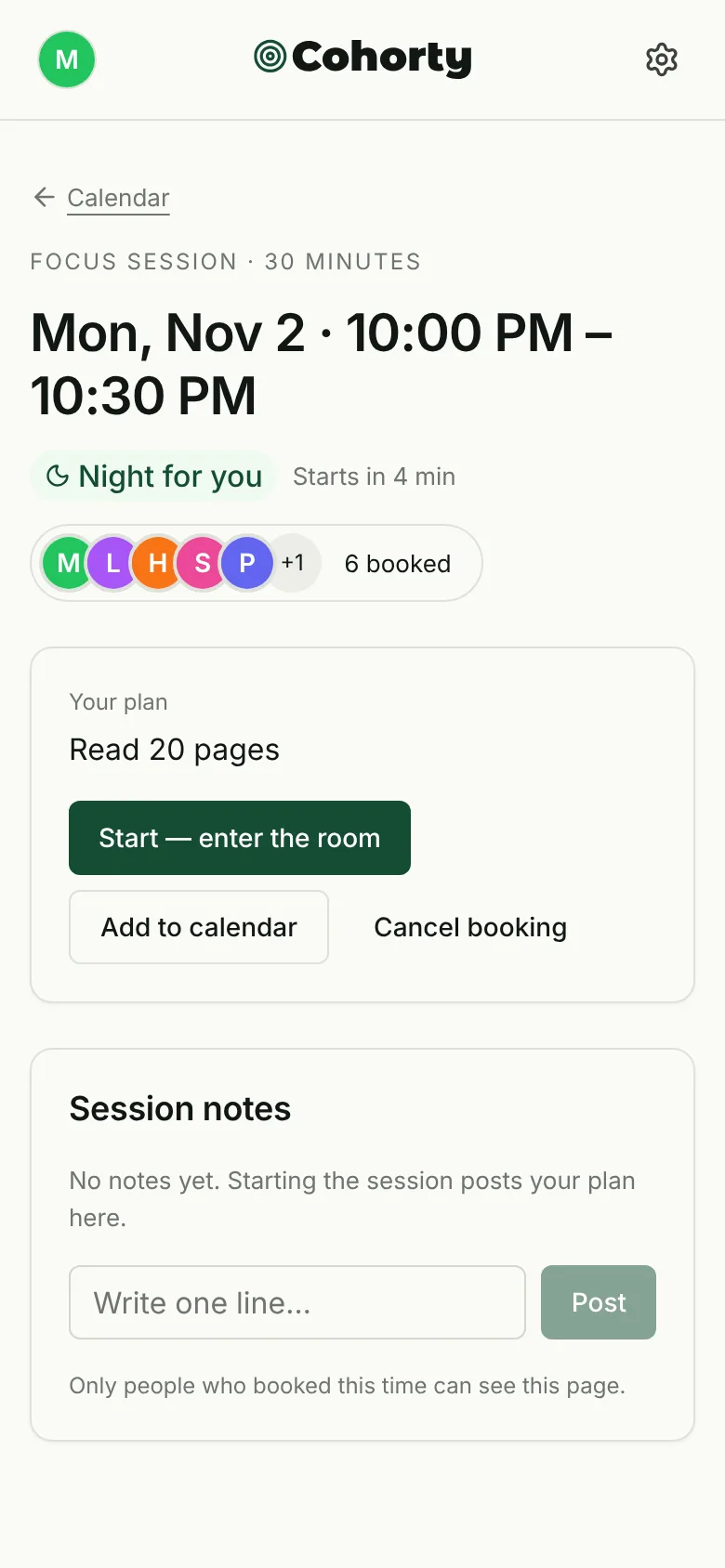
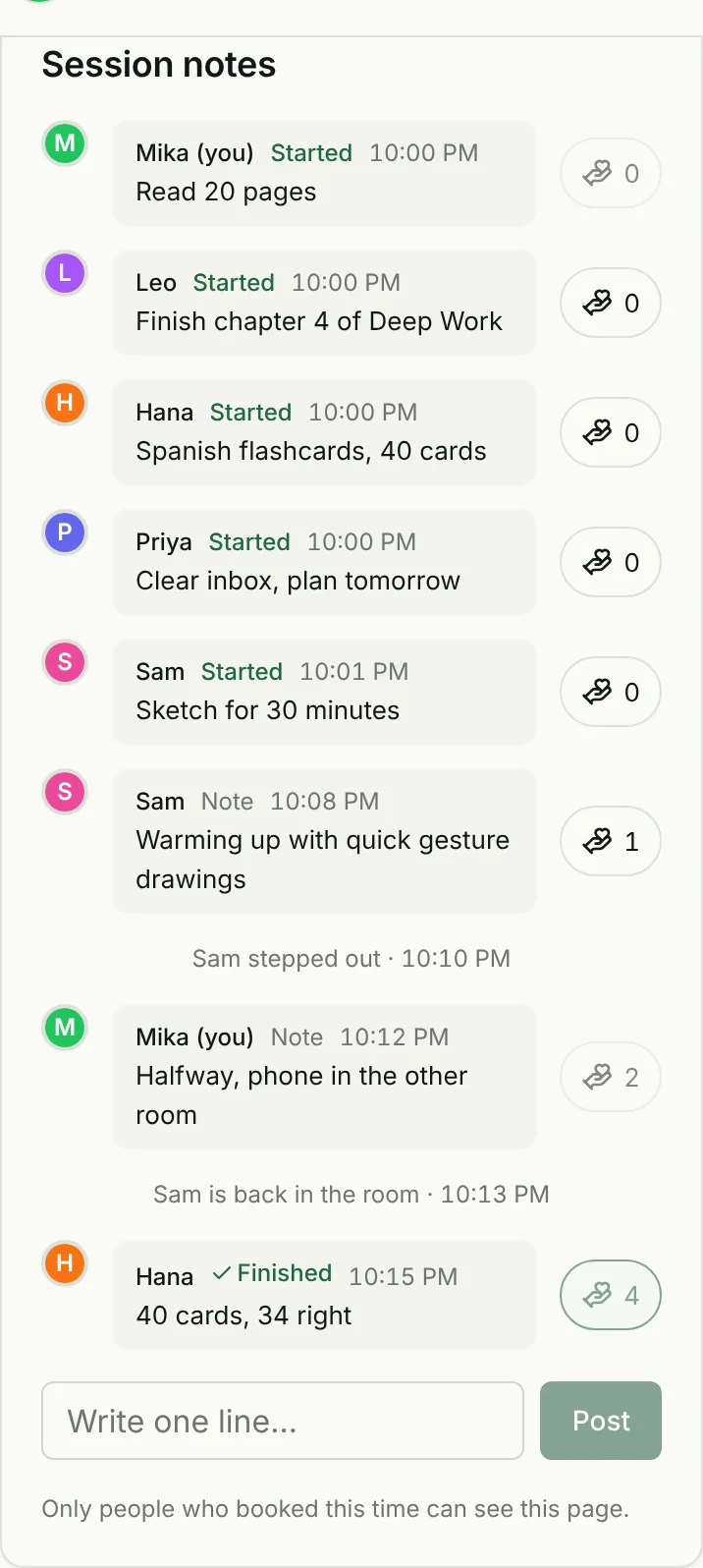
Nobody sees you, and nobody talks. Instead of a spoken check-in, you get a written plan at the start and a visible Finished, Showed up or Didn’t make it at the end. The full walkthrough is in how Cohorty sessions work.
Where Focusmate is the better choice
- You need to be seen. For some people, a camera is the whole point. A real person watching keeps them in the chair in a way a written note won’t.
- You want longer blocks. Cohorty sessions are always 30 minutes. If you work in long deep-work blocks, Focusmate’s longer session options fit better.
- You want company at almost any hour. Focusmate is long established, so finding a partner is generally easier at more times of day. Cohorty’s community is still small, so some times are quiet, especially outside the daily times.
- You like a short conversation. Saying your goal out loud to a person can be motivating in a way typing it isn’t.
Where Cohorty is the better choice
- The camera is what stops you. No video means no tidying the room, no worrying about how you look, and you can join from a phone in a library or a kitchen.
- You’d rather not talk. No small talk, no spoken check-in. This suits introverts and anyone who finds conversation pulls them out of focus.
- You want to build a daily habit, not just get work done. Cohorty is built around one habit at the same time every day: a private record of finished days, and repeating bookings that keep the time fixed.
- You don’t want to depend on one person. In a shared room, one person not showing up doesn’t cancel your session.
- Price. Joining the daily times is free every day, and Plus is $3/month.
Can you use both?
Yes, and some people do: Focusmate for long work blocks where being seen helps, and Cohorty for a daily habit such as reading, writing or practice where a camera feels like too much. They solve slightly different problems.
Try a quick test
If you’re not sure which suits you, notice what you avoid:
- You avoid booking video sessions even though you know they help. Try Cohorty for a week of daily sessions.
- You book Cohorty sessions but drift off without someone watching. Try Focusmate, where the camera adds more pressure.
- Neither is the problem; the time is. Choose the tool that lets you book the time your habit actually fits.
For more formats, including hosted groups and free study rooms, see our Focusmate alternatives comparison and our guide to virtual body doubling.
Common questions
Is Cohorty a Focusmate alternative?
Yes, for people who want to work alongside others without a camera. The format is different: a shared, silent room at a set time instead of a one-to-one video call.
Is there a free Focusmate alternative without video?
Cohorty is free to join at its daily session times and has no video at all. Study-with-me videos and Discord study servers are also free, but don’t have booked start times; see ways to study with others online.
Does Cohorty match me with a partner?
No. Everyone who booked the same time shares one room. You can see their plans and applaud their notes, but you aren’t paired with one person.
Which is better for ADHD?
It depends on what helps you. Some people with ADHD find a camera-on partner keeps them on task; others find the camera and conversation overwhelming. Our article on body doubling for ADHD covers what the early research does and doesn’t show.