Focusmate Alternatives: 8 Body Doubling Options Compared
Compare 8 Focusmate alternatives for body doubling: hosted groups, camera-free sessions, free study rooms, and more, with pricing and camera rules.
Focusmate made virtual body doubling mainstream: book a slot, get matched with one partner, and work with cameras on. It works well for many people. But it is not the only way to work alongside someone online, and its format is not for everyone: some people avoid being on camera with a stranger, need more than the free weekly sessions, or want a group rather than a partner.
This guide compares eight alternatives by format, camera expectations, structure, and cost, and helps you choose based on what actually stops you from working. If body doubling is new to you, start with our guide to virtual body doubling.
Disclosure: Cohorty publishes this journal and appears in this list, so we have a commercial interest in one option. Product details below come from each provider’s public pages as of October 2026. Prices and rules change, so check the provider’s site before you pay.
Quick comparison
| Option | Format | Camera | Fixed start time | Cost (as listed) |
|---|---|---|---|---|
| Focusmate (baseline) | 1:1 matched partner | On | Yes | Free: 3 sessions/week; Plus: $8/mo billed annually or $12/mo monthly |
| Flow Club | Hosted groups of up to 9 | Encouraged, can be off | Yes | $40/month or $400/year; 50% off for students and non-profit workers |
| Caveday | Guide-led group sessions on Zoom | Encouraged; everyone muted | Yes | Starter Pass $105 per 3 months; 14-day free trial |
| Cohorty | Camera-free booked sessions in one shared room | No camera | Yes | Free to join sessions; Plus $3/month |
| FLOWN | Facilitated deep-work sessions | Varies by session | Yes | Paid plans; check current pricing |
| StudyStream | Always-open live focus rooms (app and Discord) | Optional | No | Free access; paid features vary |
| Discord study servers | Drop-in voice/video channels | Optional | No | Free |
| Study-with-me videos | Recorded or live streams | None | No | Free |
How to choose in 30 seconds
- You want what Focusmate does, with more structure: Flow Club or Caveday.
- You avoid sessions because of the camera: Cohorty, or a Discord server with cameras off.
- You need it free and daily: Cohorty (free sessions), or drop-in rooms if you can start without a fixed time.
- You want a group, not a single partner: Flow Club, Caveday, or Cohorty.
- You only need ambient company: study-with-me videos.
Camera is the dealbreaker? Cohorty’s sessions have no video at all, and joining is free: book 30 minutes, write your plan, and work alongside everyone who booked that time. Book a free session or see how it works. (Cohorty publishes this journal.)
1. Flow Club: hosted groups with a ritual
How it works: Sessions are run by volunteer hosts from the community and hold up to nine people. Lengths range from 30 minutes to three hours, with one hour the most popular. Video is encouraged, but you can turn it off, and there are non-verbal, chat-only options.
Why choose it over Focusmate: a group instead of a stranger one-on-one, a host who opens and closes the session, and a wide range of session lengths.
Trade-offs: at $40 a month (or $400 a year), it is one of the more expensive options; discounts are available for students and non-profit workers.
Best for: people who like a facilitated ritual and will use sessions most days, which makes the membership worth it.
2. Caveday: guided deep-work “Caves”
How it works: Human guides lead live sessions on Zoom, seven days a week, in 30-minute, one-hour, and three-hour formats. You share your focus with a small group, then alternate deep-work sprints and short breaks. Cameras are encouraged and everyone is muted.
Why choose it over Focusmate: more structure and coaching-style guidance, plus weekly planning workshops and an always-open focus lounge.
Trade-offs: sessions close 10 minutes after the start, and the Starter Pass costs $105 per three months after a 14-day trial.
Best for: knowledge workers who want long, structured deep-work blocks and like being guided.
3. Cohorty: body doubling without a camera
 cohorty.app
How it works: You book a 30-minute session at one of a few fixed times each day. Everyone who booked the same time is in one shared room. You write one line about what you will do, do it, and leave one line about how it went. There is no video and no chat, and everyone uses a nickname. You can applaud someone with one tap when they finish.
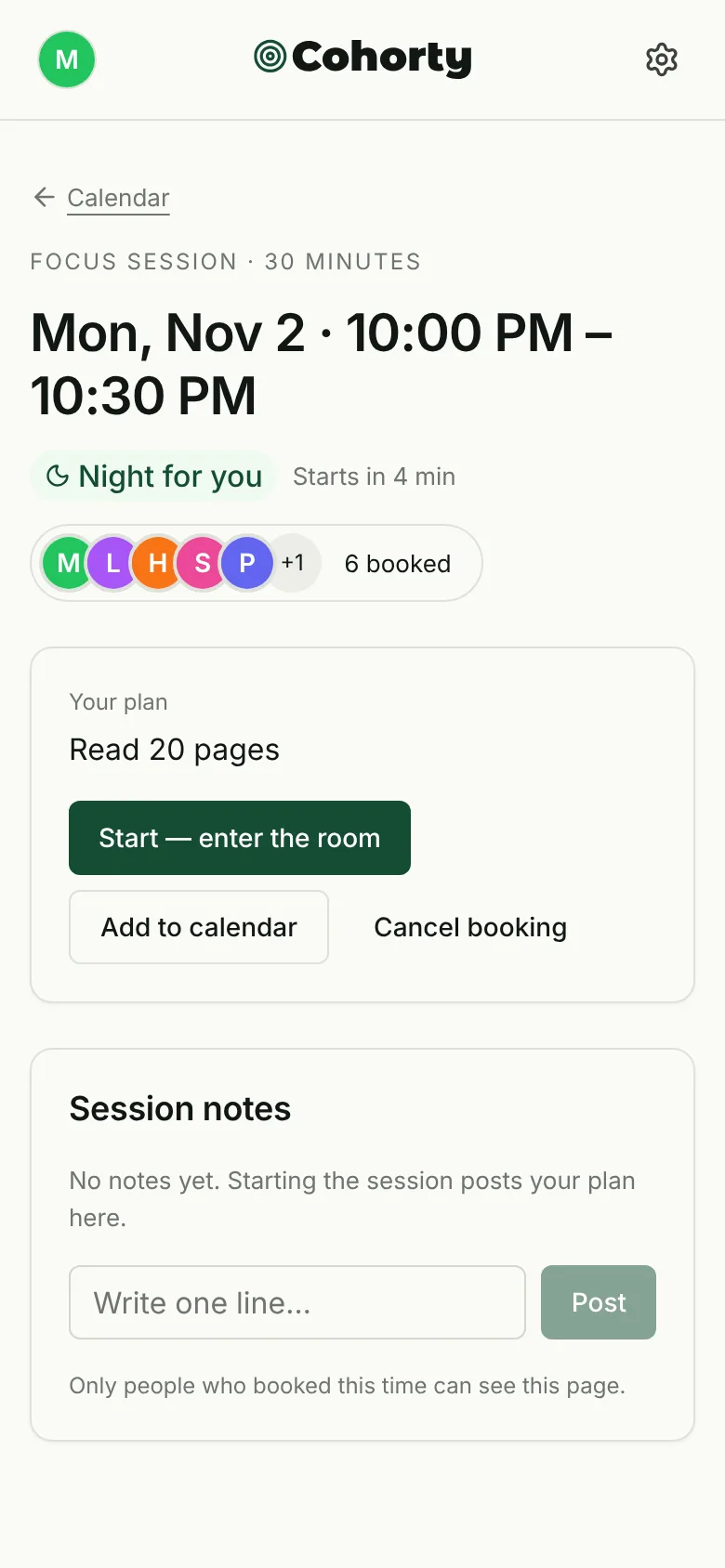
Why choose it over Focusmate: no camera at all, so you can join from a phone, a library, or a kitchen; no single partner to match with or be stood up by; and joining sessions is free.
Trade-offs: sessions run at a few set times unless you have Plus ($3/month), which lets you open your own times at any half hour and repeat bookings. The community is still small, so some times are quiet; you can still start on your own. Without video, the social pressure is lighter than a 1:1 call.
Best for: introverts, people who dislike being on camera, and anyone building a daily habit (study, writing, practice, a home workout) who benefits from a fixed time. For a side-by-side look, read Cohorty vs Focusmate.
4. FLOWN: facilitated focus sessions
How it works: FLOWN offers facilitated deep-work sessions and focus tools aimed at professionals and teams.
Why choose it over Focusmate: a facilitator and a calmer, more programmed experience than a matched 1:1 call.
Trade-offs: paid plans; compare current pricing, free access, and camera expectations on its site before committing.
Best for: professionals who want facilitated sessions and are willing to pay for them.
5. StudyStream: always-open study rooms
How it works: StudyStream runs live focus rooms through its app and a Discord server, with a large global community online around the clock.
Why choose it over Focusmate: no scheduling and no single partner; join whenever you sit down to work.
Trade-offs: no fixed start time, so it helps you stay more than it helps you start. Check which features are free and which are paid in the app.
Best for: students who already sit down to study but want company to stay on task.
6. Discord study servers
 discord.com
How it works: Public Discord servers run voice and video channels where people work together, often with Pomodoro bots and leaderboards.
Why choose it over Focusmate: free, always open, camera optional.
Trade-offs: quality varies by server, chat can distract, and nobody notices if you do not show up.
Best for: people comfortable on Discord who want free, informal company.
7. Study-with-me and work-with-me videos
 Search "study with me" on YouTube
How it works: Recorded or live videos of someone working, usually with a timer and background sound.
Why choose it over Focusmate: zero setup and zero social exposure.
Trade-offs: it is ambient company, not accountability; the video can become its own distraction.
Best for: low-stakes tasks and days when any interaction feels like too much. More options in our guide to studying with others online.
8. A friend on a video or voice call
How it works: Agree on a start time, a one-sentence goal each, and an end time. Mute and work.
Why choose it over Focusmate: free, flexible, and with someone you trust.
Trade-offs: depends on both schedules, and it is easy to slip into chatting. Our accountability partner check-in templates help keep it focused.
Best for: pairs of friends or colleagues with overlapping free time.
What to compare before you sign up
- Camera expectations. Will you actually join a session that requires video? Be honest; the format you avoid does not help.
- Fixed start time. If starting is your problem, prefer scheduled sessions over drop-in rooms.
- Free-plan limits. For a daily habit, three free sessions a week runs out by Wednesday.
- Session length. Shorter sessions (25 to 30 minutes) are easier to fit into busy days; longer blocks suit deep work.
- Privacy and moderation. Check whether you can use a nickname, block or report people, and what others can see.
- Where you work. If you want to body double while cooking, exercising, or studying in a library, a camera-free or phone-friendly option matters.
Frequently asked questions
What is the best free Focusmate alternative?
For scheduled sessions, Cohorty is free to join and needs no camera. For unscheduled company, Discord study servers, StudyStream’s free access, and study-with-me videos cost nothing. Focusmate itself also has a free plan with three sessions a week.
Is there a Focusmate alternative without a camera?
Yes. Cohorty has no video at all. Discord servers and StudyStream let you keep your camera off, and Flow Club offers chat-only options. Study-with-me videos involve no camera.
Which option is best for ADHD?
The one that reliably gets you to start. Many people with ADHD benefit most from a fixed start time and low social demand. See body doubling for ADHD for a closer look at the evidence and a session plan.
Are group sessions better than one-to-one?
Not necessarily. One-to-one sessions create a stronger sense that someone specific expects you; groups are more forgiving when someone cancels and feel less intense. Try one of each for a week and keep the one you actually attend.
Can these apps help me build a habit, not just finish work?
Yes, if you book the same time each day. A recurring session works like an if-then plan for your habit. Pair it with a simple habit tracker if you want a longer-term record.