Pomodoro Technique for ADHD: How to Adapt It
Why the classic 25/5 Pomodoro often breaks for ADHD and how to adapt it: flexible lengths, breaks with an exit, hyperfocus rules and starting with others.
The Pomodoro Technique sounds made for ADHD: work for 25 minutes, take a 5-minute break, repeat. Short blocks, built-in breaks, a timer you can see.
In practice, many people with ADHD find it breaks in predictable places. The timer goes off just as they finally got into the task. The 5-minute break becomes 45 minutes. Or they never start the first block at all.
The method is still useful. It just needs adjusting. This guide covers where the classic version goes wrong for ADHD and how to fix each part. For the original method in detail, see our complete Pomodoro guide; for other ways to concentrate, see how to focus with ADHD.
The classic Pomodoro in one paragraph
Pick a task, set a timer for 25 minutes, and work only on that task until it rings. Take a 5-minute break. After four rounds, take a longer break of 15 to 30 minutes. The point is to make work feel finite and to separate focused time from breaks.
Where it breaks for ADHD
| Problem | What happens | Fix below |
|---|---|---|
| Starting | The timer is ready but you never press start | Add a start time and other people |
| Wrong length | 25 minutes feels endless on some days, too short on others | Choose the length by task and energy |
| Interrupted flow | The bell rings just as focus arrives | A “finish the sentence” rule |
| Breaks that sprawl | 5 minutes of phone becomes an hour | Breaks with an exit |
| Hyperfocus | You ignore the timer for three hours | Hard stops for what matters |
Fix 1: Give the first block a start time
The hardest Pomodoro is the first one. A timer doesn’t make you press start.
- Schedule the first block at a specific time: “10:00, start the report.” A time is easier to act on than “soon.” This is the logic of if-then plans.
- Make the first task tiny. “Open the document and write the headings.” If you’re frozen, see ADHD paralysis.
- Start with someone else. Many people with ADHD find it easier to begin when others begin at the same moment. That’s body doubling.
Fix 2: Choose the length by task and energy
There’s nothing special about 25 minutes. Pick a length that’s short enough to start and long enough to finish something visible.
- 10 to 15 minutes for dreaded tasks or low-energy days.
- 25 to 30 minutes for most work. Thirty is easy to plan with: two blocks to an hour.
- 45 to 50 minutes for tasks you enjoy or that take a while to get into.
Match the block to a single finish line: “reply to three emails,” “draft the introduction.” When the task fits the block, the timer feels like an ally instead of an interruption.
Fix 3: Don’t let the bell break flow
If you’re finally focused when the timer rings, stopping dead can feel like a waste. Use a simple rule:
- Finish the sentence, not the chapter. Complete the current small action, write one line about what’s next, then break.
- Or skip the break on purpose. If it’s going well, decide consciously to run another block, and set the timer again. Deciding keeps you in control; drifting doesn’t.
Fix 4: Breaks with an exit
ADHD breaks often fail because they have an entrance but no exit. Scrolling has no natural end.
- Pick break activities that end on their own: refill water, stretch, step outside, put a load in the washing machine, one song.
- Keep the phone out of breaks if it regularly swallows them. Or allow it only with a timer.
- Set the break timer before the break starts, not when you remember.
- Stay near the desk. Breaks in another room make the return harder.
Fix 5: Plan for hyperfocus
Hyperfocus can make you ignore the timer entirely. That’s fine sometimes, but not when it costs meals, sleep or appointments.
- Use a stop you can’t ignore for things that matter: an alarm across the room, a calendar alert with a sound, or a person.
- Start absorbing tasks when nothing important follows.
- At each block end, ask one question: “Is there anything I’ll regret missing if I keep going?” If not, go on, deliberately.
Fix 6: Count blocks, not hours
Hours feel abstract, and “I worked all day” is hard to verify. Blocks are concrete.
- Plan your day as a number of blocks. Three focused blocks is a good day for many people with ADHD.
- Record blocks done, not blocks missed. A list of finished blocks shows progress. A list of failures shows only what went wrong.
- Avoid tools that punish a missed day. If a broken streak makes you quit, choose a tracker without one; see habit trackers without streaks.
Doing Pomodoros with other people
Solo timers rely on you to start and to come back. A shared block does part of that for you: the start time is set, and you can see that other people are working too.
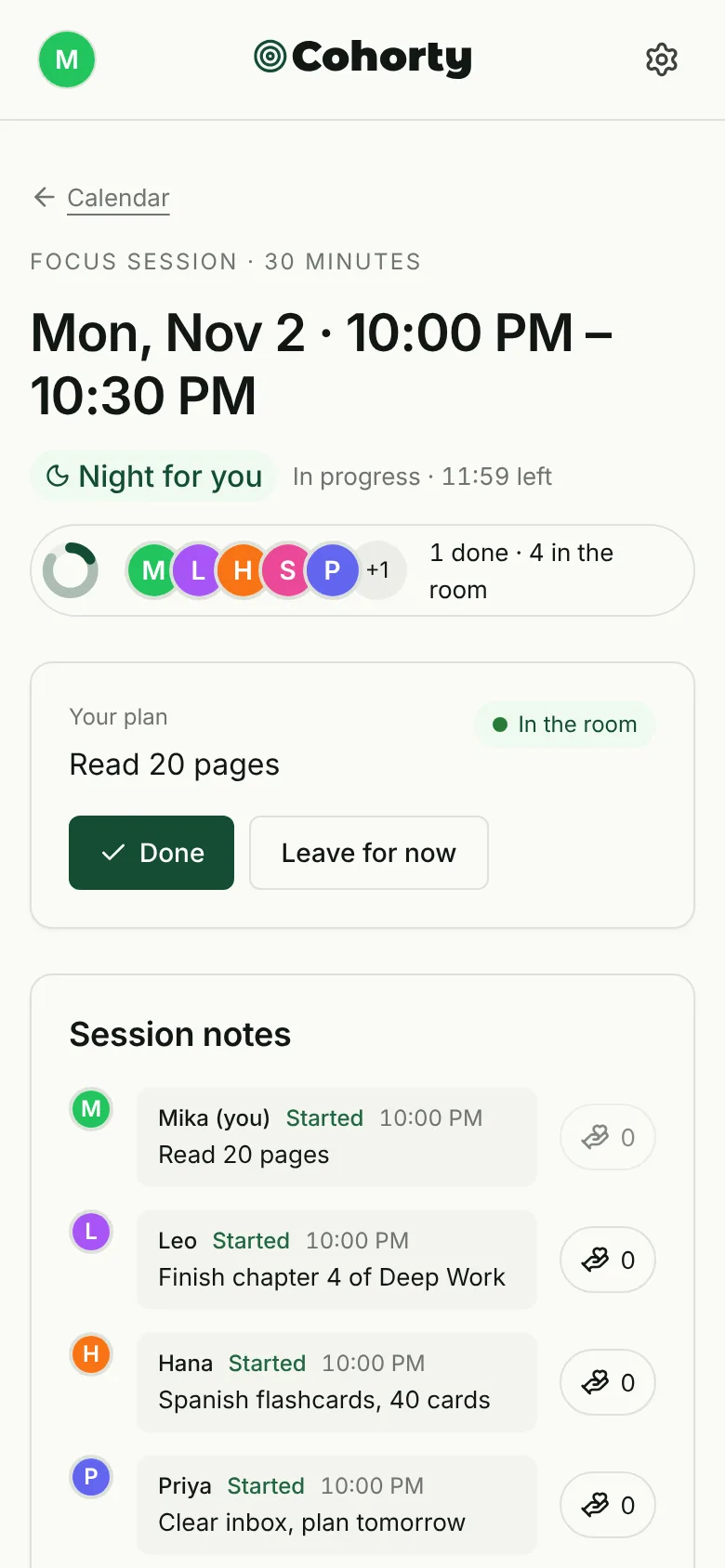
Disclosure: Cohorty publishes this journal. Cohorty sessions work like a shared 30-minute Pomodoro: you book a set time, write the task in one line, see a countdown and who else is working, and tap Done. There’s no camera or chat, and Leave for now lets you take a break and re-enter. You can book several sessions in a day; see ADHD-friendly focus sessions.
A sample ADHD Pomodoro morning
| Time | Block | Task |
|---|---|---|
| 9:30 | 15 min | Dreaded email: open and draft the first line |
| 9:45 | Break | Water and stretch |
| 9:50 | 30 min | Report introduction |
| 10:20 | Break | Step outside, one song |
| 10:30 | 30 min | Report section 2 |
| 11:00 | Longer break | Snack, no phone for the first 10 minutes |
Common questions
Does the Pomodoro Technique work for ADHD?
It can, especially once it’s adapted. Short blocks make tasks feel finite and timers make time visible. Most problems come from rigid lengths, unstructured breaks and getting the first block started.
What’s the best Pomodoro length for ADHD?
There’s no single best length. Many people use 25 to 30 minutes for normal work, shorter blocks for dreaded tasks and longer ones for absorbing work.
What should I do during Pomodoro breaks?
Choose activities that end on their own, such as stretching, refilling water or one song, and keep the phone out if it tends to stretch breaks.
What if I hyperfocus and ignore the timer?
Use an alarm you can’t silence from your chair for anything time-sensitive, and decide at the end of each block whether to keep going rather than drifting on.