
ADHD Paralysis: How to Start a Task When You're Stuck
You know what to do and still can't start. What ADHD paralysis is, the three common kinds, and small ways to get moving within the next few minutes.
You know exactly what you need to do. You might even want to do it. And yet you’ve been sitting on the couch for forty minutes, phone in hand, feeling worse by the minute.
Many people with ADHD call this ADHD paralysis (or task paralysis): being stuck at the point of starting, even when the task matters. It’s not a formal diagnosis, but it describes a very common experience of problems with task initiation, one of the executive functions ADHD affects.
This guide covers why it happens and practical ways to get unstuck, starting with things you can do in the next five minutes.
Note: this is general information, not medical advice. If being stuck is affecting your work, health or relationships, talk to an ADHD-informed clinician.
Why starting is the hard part
For most people, knowing a task is important creates enough pull to begin. With ADHD, importance alone often isn’t enough. Interest, urgency, novelty, or another person being involved tend to work better than “I should.”
When none of those are present, the gap between intending and starting can feel impossible to cross. Then guilt adds weight: the longer you wait, the bigger the task feels, and the harder it gets to begin.
The way out is rarely more willpower. It’s making the start smaller, clearer or more social.
The three common kinds of stuck
It helps to name which kind of stuck you’re in, because each has a different fix.
| Kind | What it feels like | What usually helps |
|---|---|---|
| Too big | ”I don’t know where to start.” | Shrink the first step until it’s obvious |
| Too many | ”Everything is urgent, so I do nothing.” | Pick one thing on purpose, hide the rest |
| Too uncomfortable | ”I know the first step, I just can’t.” | Lower the stakes, add company, add a time |
If the task is too big: shrink the first step
“Do my taxes” isn’t a task. It’s a project, and projects don’t have a place to start. Break off a first step so small that it’s almost silly:
- “Open the tax website and log in.”
- “Find last year’s form and put it on the desk.”
- “Write the subject line of the email.”
The test: could you start it within 30 seconds, without deciding anything? If not, shrink it again. (For a countdown trick to get moving, see the 5 Second Rule.)
This is the idea behind the two-minute rule: starting is the bottleneck, so make starting tiny. You’re allowed to stop after the first step. Most of the time, you won’t.
If there are too many tasks: choose one and hide the rest
A long to-do list can freeze you as effectively as one huge task, because every item is competing.
- Write everything down so your brain stops holding it.
- Pick one task for the next half hour. Not the most important one, just one you can start.
- Cover, close or fold away the rest of the list.
If choosing is the problem, use a rule so you don’t have to decide: the oldest item, the quickest item, or the item with someone waiting on it. Ask someone else to pick for you if that’s easier.
If it’s uncomfortable: lower the stakes
Some tasks are stuck because of what they bring up: a difficult email, an overdue bill, a form that might reveal a mistake. Avoidance makes sense here; it’s just expensive.
- Rename the goal. Not “sort out the bill,” but “look at the bill for two minutes.” Looking is allowed to be the whole task.
- Do a bad first version. Write the worst possible draft of the email. You can fix it later; you can’t fix a blank page.
- Pair it with something pleasant. A favorite drink, music, or doing it somewhere you like.
Add a time and other people
When the first step is clear but you still can’t begin, adding a start time and other people often does what willpower can’t.
A start time. “At 3:30 I open the bill” is easier to act on than “sometime this afternoon,” because the decision is already made. That’s the idea behind if-then plans.
Other people. Working alongside someone, even silently, is called body doubling. Many people with ADHD find that someone else starting at the same time makes it easier to start too. Research on it is still early, but it’s cheap to test.
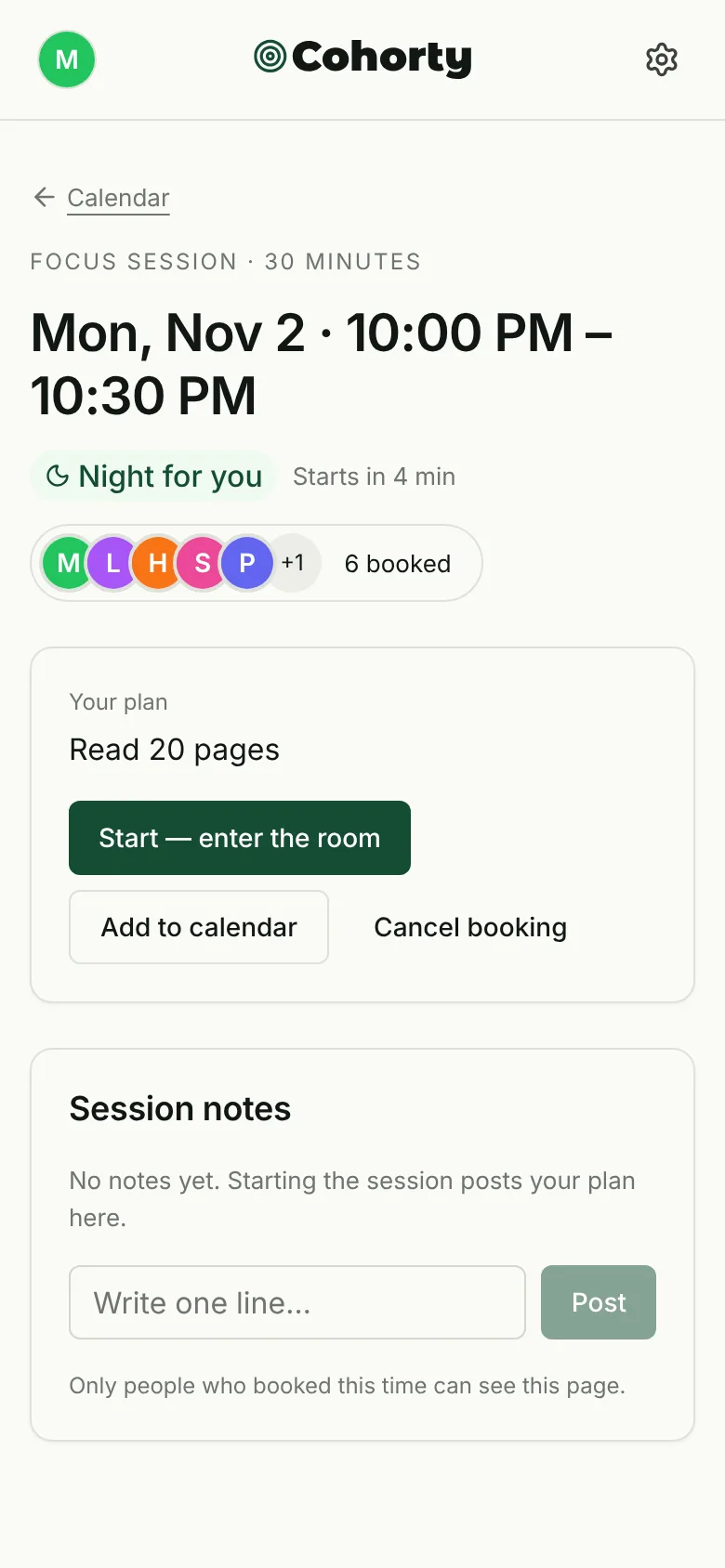
Disclosure: Cohorty publishes this journal. In Cohorty you book a 30-minute session at a set time, write one line about the first step, and tap once to start alongside whoever booked the same time. There’s no camera or chat, and missing a session doesn’t break anything. See ADHD-friendly focus sessions for the full walkthrough, or compare other formats in the virtual body doubling guide.
Change your body’s state first
Sometimes you can’t think your way out because your body is stuck in “couch mode.” A small physical change can break the loop:
- Stand up. Just stand. Then walk to where the task happens.
- Change rooms. If you’ve been stuck in one spot, move.
- Cold water on your face or hands, or a short walk outside.
- Set a visible timer. If time blindness makes “a few minutes” stretch into an hour, a timer you can see helps.
- Put the phone in another room for the first ten minutes. Leaving it face down on the desk is often not enough.
None of these do the task. They make the next step a little easier.
A five-minute unstick routine
When you notice you’re stuck, try this in order:
- Name it: “I’m stuck because it’s too big / too many / too uncomfortable.”
- Write the first step so small you could start it in 30 seconds.
- Stand up and go to where it happens.
- Set a timer for 10 minutes, or join someone who’s starting now.
- Do only the first step. Decide whether to continue after the timer.
If it still doesn’t work, that’s information, not failure. The task may need a different time of day, some help, or a conversation about whether it’s yours to do.
After you’ve been stuck
The shame after a lost afternoon can make tomorrow’s paralysis worse. A few things help:
- Don’t make up for it tonight. Pushing late usually costs tomorrow.
- Write down what you were stuck on and the first step you’d try. Tomorrow-you starts from there.
- Book a specific time to try again, ideally with someone else.
If losing time to being stuck is frequent, keep a simple note of when it happens. Patterns (time of day, type of task, after certain apps) are useful for you and for a clinician.
Common questions
Is ADHD paralysis a real thing?
“ADHD paralysis” is an informal term, but the difficulty it describes, starting tasks despite intending to, is a well-recognized part of ADHD’s effect on executive function.
Is ADHD paralysis the same as procrastination?
They overlap; see ADHD procrastination for the broader pattern. Procrastination often involves choosing something more pleasant instead. ADHD paralysis often feels like wanting to start and being unable to, sometimes without doing anything enjoyable instead.
Can body doubling help with ADHD paralysis?
Many people with ADHD say having someone else working at the same time makes starting easier. Evidence is still limited, so treat it as an experiment: try a few sessions and see whether you start more often.
What should I do if I’m stuck every day?
Talk to a doctor or ADHD-informed clinician. Daily paralysis can be a sign that your current support isn’t enough, and there are treatment and coaching options that address task initiation directly.


