ADHD Procrastination: Why It Happens and What Helps
Why ADHD procrastination isn't laziness, the four things that get an ADHD brain moving, and how to build them into your week instead of waiting for a deadline.
“Just start. Break it into steps. Use a planner.”
If you have ADHD, you’ve heard it all, and you may have tried most of it. The advice isn’t wrong. It just assumes that knowing a task matters is enough to get you moving. For many ADHD brains, it isn’t.
This guide looks at why ADHD procrastination works differently, then at how to deliberately create the conditions that do get you moving, so you’re not stuck waiting for a deadline to panic you into action.
Note: this is general information, not medical advice. If procrastination is seriously affecting your work, studies or relationships, an ADHD-informed clinician can help.
ADHD procrastination isn’t laziness
Everyone procrastinates sometimes (our general guide on how to stop procrastinating covers the common causes). With ADHD, it tends to be more frequent, more costly and more confusing, because it often happens with things you genuinely want to do.
The key difference is what gets you moving. ADHD affects executive functions such as starting tasks, holding goals in mind and regulating effort. Importance and long-term consequences (“this will matter in a month”) are weak signals for these systems. Things that are happening now are strong signals.
That’s why the same person can miss a simple form for weeks and then produce excellent work in a frantic night before a deadline. It isn’t inconsistency of character. It’s the deadline finally creating the “now” that was missing.
What actually gets an ADHD brain moving
Many clinicians and ADHD writers describe a handful of conditions that make starting much easier for people with ADHD. You’ll see them described with different names, but four come up again and again:
| Driver | What it looks like | Why it works |
|---|---|---|
| Interest | The task is novel, curious or fun | Attention follows interest without effort |
| Urgency | A deadline is close enough to feel | The task becomes “now” |
| Challenge | It’s a puzzle, a race, a competition | Engagement replaces boredom |
| Other people | Someone is waiting, watching or working alongside | Social presence makes the moment real |
Waiting for these to show up by chance is the procrastination cycle. The strategy is to add them on purpose.
1. Create urgency without the panic
Real deadlines work, but they arrive too late and bring stress. You can create smaller, earlier ones.
- Set a start time, not just a due date. “Start the report Tuesday at 10:00” puts the “now” much earlier than “due Friday.” Our guide to ADHD time blindness explains why start times work better than deadlines.
- Make mini-deadlines with consequences you feel. Tell a colleague you’ll send a draft by 3 PM. A specific person expecting something at a specific time is more motivating than a calendar entry.
- Use short timed blocks. A 30-minute timer makes urgency small and frequent: there’s always a “now” coming up, and it ends soon.
2. Add interest to boring tasks
You can’t make every task interesting, but you can make the experience of doing it less dull.
- Change the setting. A café, a library, a different room. (For students, how to study with ADHD has more on making revision less dull.)
- Pair it with something you enjoy. A specific playlist, podcast or drink you only allow during the task.
- Make it a question. “How many of these can I clear in 20 minutes?” turns a list into a challenge.
- Start with the most interesting part. There’s no rule that says you must do a project in order.
3. Add other people
For many people with ADHD, other people are the most reliable driver. There are different strengths of “other people”:
- Someone working alongside you (in person or online). This is body doubling: no one checks your work, they’re just there.
- A shared start time with others, so the start isn’t only your decision.
- Someone expecting a result, like an ADHD accountability buddy you report to.
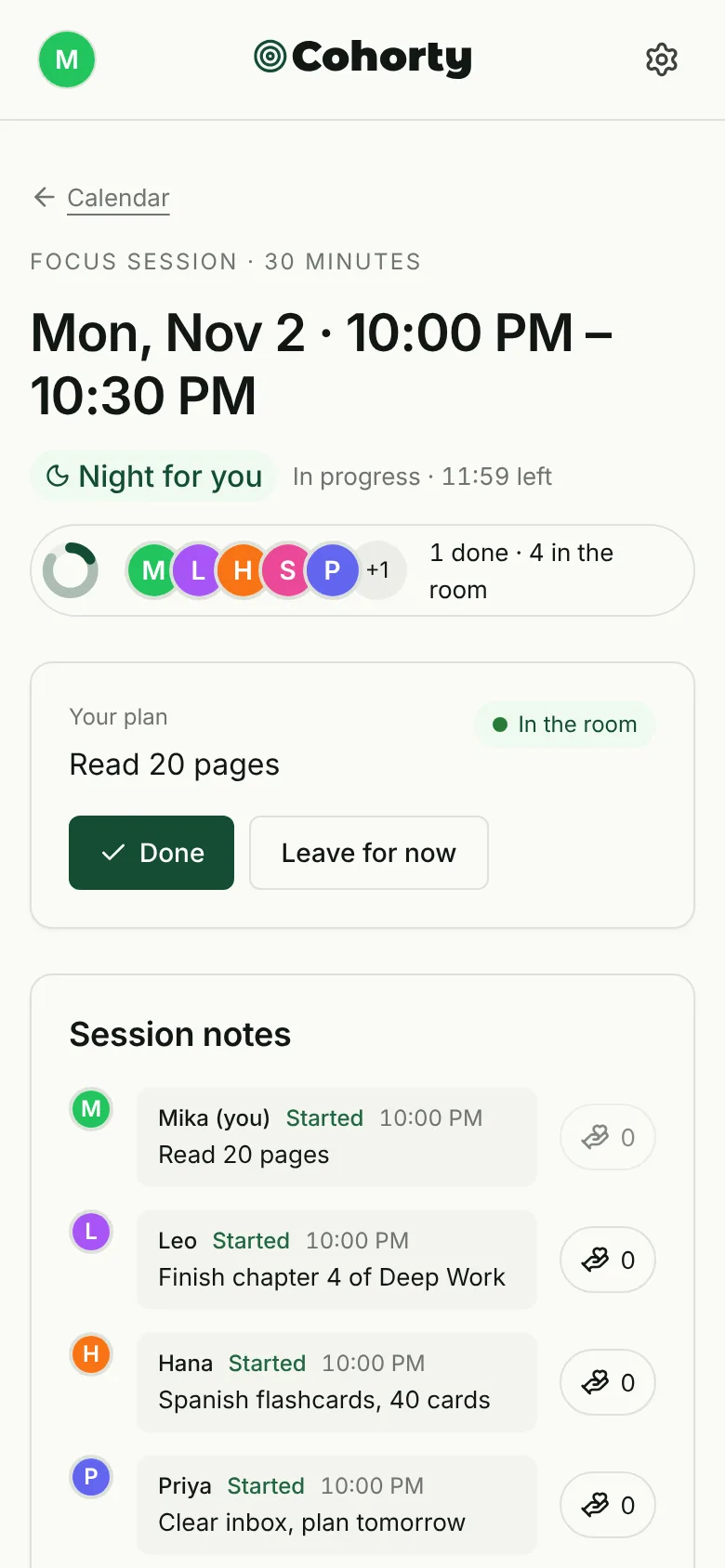
Disclosure: Cohorty publishes this journal. Cohorty combines a start time and other people: you book a 30-minute session, write one line about what you’ll do, and work alongside whoever booked the same time, with no camera or chat. Missing a session doesn’t reset anything. See ADHD-friendly focus sessions for how that works.
4. Make the first step embarrassingly small
When a task is vague or large, there’s nowhere to start, so you don’t. Shrink the first step until you could do it in 30 seconds without deciding anything: “open the document and write the title,” not “write the report.” If you’re frozen even with a small first step, see ADHD paralysis for in-the-moment ways to get unstuck.
5. Notice the feeling you’re avoiding
A lot of ADHD procrastination isn’t about the task at all. It’s about a feeling: dread of a difficult email, fear of seeing a bank balance, worry the work won’t be good enough. Years of being told you’re “not trying” can make that worse.
- Name the feeling. “I’m avoiding this because I’m afraid it’ll be bad.” Naming it often makes it smaller.
- Separate looking from doing. “Open the bill and look at it” is a complete task.
- Allow a bad first draft. Perfectionism and procrastination feed each other.
- Be kind about the past. Self-criticism about last week’s procrastination is fuel for this week’s.
If avoidance comes with persistent anxiety or low mood, mention it to a clinician. ADHD often comes with anxiety and depression, and treating those can make starting easier.
6. Build a week that does the starting for you
Willpower runs out. Structure doesn’t. A few structural changes reduce how often you need to fight procrastination at all:
- Same time, same task. Recurring blocks (“Tuesday 10:00 is admin”) remove the daily decision of when. This is a form of if-then planning.
- Book the next session before leaving this one. Deciding while you’re already in motion is easier than deciding from a standstill.
- Plan one or two important blocks a day, not ten. An overloaded list is itself a reason to procrastinate.
- Avoid systems that punish misses. If a broken streak makes you abandon an app, use one that doesn’t track streaks; see habit trackers without streaks.
When procrastination is a sign you need more support
Strategies help, but they don’t replace treatment. Consider talking to a doctor or ADHD specialist if:
- You regularly miss important deadlines despite trying hard.
- Procrastination is affecting your job, studies, finances or relationships.
- You feel constant guilt, anxiety or low mood about undone tasks.
ADHD treatment, coaching and therapy approaches designed for adults with ADHD can all address procrastination directly.
Common questions
Why do I procrastinate on things I want to do?
With ADHD, wanting to do something often isn’t enough to start it. Starting depends more on interest, urgency, challenge or other people. Adding one of those usually helps more than trying harder.
Why do I only work well under deadline pressure?
A close deadline creates urgency, one of the strongest drivers for ADHD brains. You can create smaller, earlier “deadlines” with start times, mini-commitments to other people and short timed blocks.
Is ADHD procrastination the same as ADHD paralysis?
They overlap. Procrastination is the broader pattern of delaying tasks. ADHD paralysis describes the specific experience of wanting to start and feeling unable to.
Does body doubling help with procrastination?
Many people with ADHD find it easier to start when someone else is working at the same time. Evidence is still limited, so treat it as an experiment and see whether it changes how often you start.