How to Stop Procrastinating: A Habit-Based Guide
How to stop procrastinating: why it happens, quick fixes for today, and habits (start times, tiny first steps, other people) that prevent it next week.
If you’re reading this instead of doing something else, you’re in good company. Almost everyone procrastinates sometimes, and for many people it’s a daily pattern that costs sleep, money and peace of mind.
This guide explains how to stop procrastinating in two layers: what to do right now to get started on today’s task, and which habits make procrastination less likely next week. It’s the starting point for our procrastination guides; each section links to a deeper article.
What procrastination is (and isn’t)
Procrastination is delaying something you intended to do, even though you expect to be worse off for the delay. It’s not the same as resting, prioritizing or waiting for good reasons. If you decide the report can wait because something more urgent came up, that’s planning. If you keep meaning to start and don’t, that’s procrastination.
Why we procrastinate
Research on procrastination has moved away from the idea that it’s laziness or poor time management. Two findings come up again and again:
- It’s about feelings. We delay tasks that feel unpleasant: boring, difficult, uncertain or threatening to our self-image. Procrastinating gives short-term relief from that feeling. Psychologists often describe it as a way of regulating mood.
- The future is easy to discount. A reward or a cost that’s weeks away feels much smaller than one that’s here now. So the immediate discomfort of starting wins over the distant benefit of finishing.
That’s why advice like “just be more disciplined” rarely works. It doesn’t address the feeling or the timing. For the full picture, read why we procrastinate.
How to stop procrastinating today
When you’re stuck on something right now, try these in order.
1. Make the first step tiny
(If you tend to do everything except the one task, you can even put that to use: see structured procrastination.)
Shrink the task until the first step is obvious and takes less than two minutes: open the document, write the subject line, put on your shoes. Starting is the hardest part, and a tiny step lowers the barrier. See the two-minute rule.
2. Name the feeling
Ask: “What am I avoiding feeling?” Boredom, confusion, fear of doing it badly? Naming it often takes away some of its power. If the answer is “fear it won’t be good enough,” read perfectionism and procrastination.
3. Set a short timer
Commit to 10 or 25 minutes, with permission to stop after. A visible end makes starting less daunting, and most people keep going once they’ve begun. See the Pomodoro guide.
4. Remove the escape route
Put your phone in another room, close the tabs you drift to, and leave only what the task needs on screen. Procrastination is easier when the alternative is one tap away.
5. Start with someone else
Many people find it much easier to start when someone else is starting at the same moment: a colleague, a friend on a call, or a shared online session. That’s the idea behind body doubling.
If you need a quick push to get off the couch, the 5-second rule is a simple countdown technique some people find useful.
Habits that prevent procrastination
Quick fixes help today. These habits reduce how often you need them.
Give tasks start times, not just deadlines
“Finish the proposal by Friday” invites waiting until Thursday night. “Start the proposal Tuesday at 10:00” puts the decision in advance. Plans in the form “When X happens, I will do Y” are known as implementation intentions, and they’re one of the best-supported techniques for acting on intentions.
Plan your day in blocks
An open day invites drift. A few planned blocks, each with one task, give your day edges. See time blocking for a simple way to do it.
Design your environment
Make the task easy to start and distractions hard to reach: the laptop open on the right document, the phone in a drawer, a dedicated place for focused work. See environment design.
Use other people
A specific person expecting something at a specific time is more motivating than a private plan. Options include an accountability partner, a regular coworking slot with a friend, or a booked session with others.
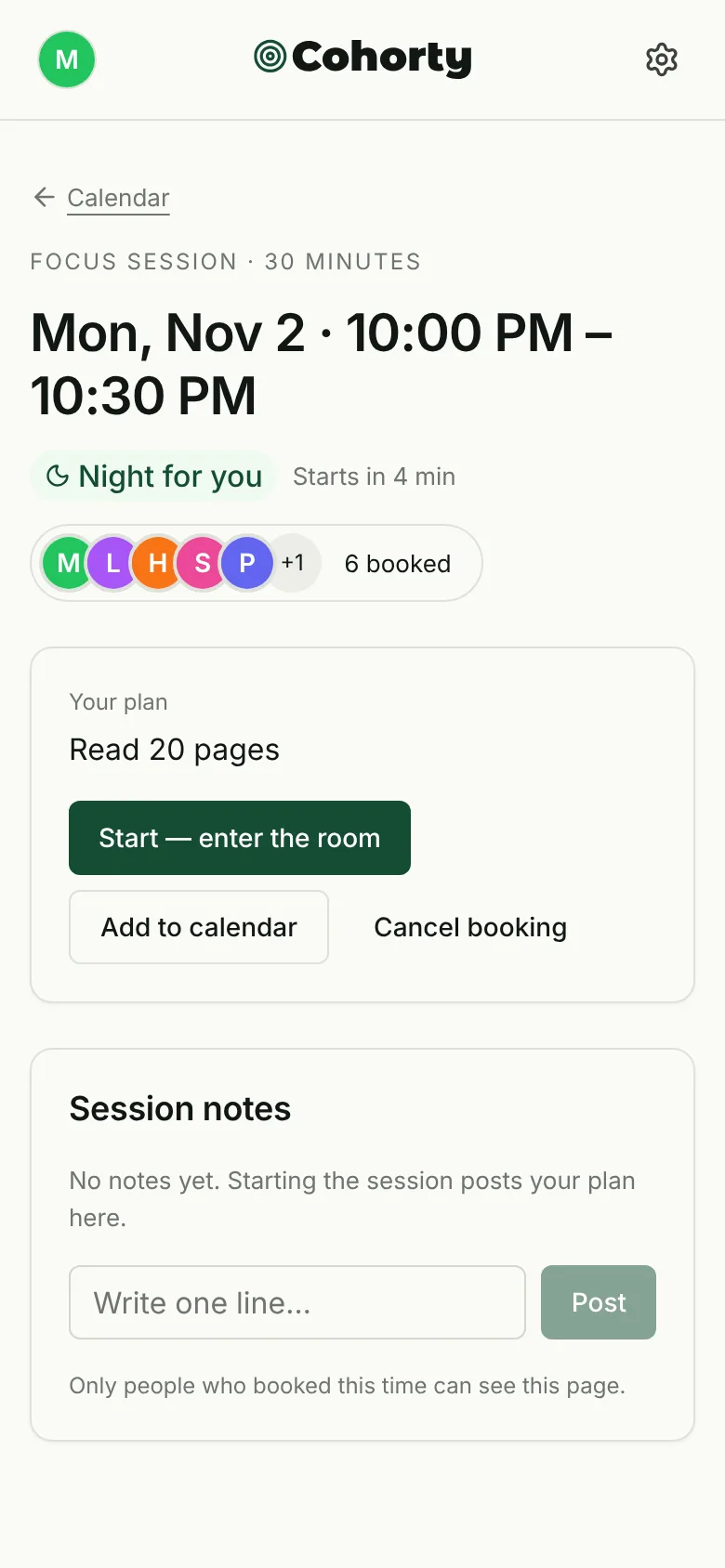
Disclosure: Cohorty publishes this journal. In Cohorty you book a 30-minute session at a set time, write one line about the task, and start alongside whoever booked the same time, with no camera or chat. Missing one doesn’t reset anything. See how to use Cohorty.
Be kind to yourself after you procrastinate
It sounds soft, but it’s practical. In one study, students who forgave themselves for procrastinating on a first exam procrastinated less when studying for the next one. Harsh self-criticism adds to the bad feeling that drives avoidance in the first place.
Types of procrastination and what helps
| If you mostly… | It may be | Start with |
|---|---|---|
| Avoid tasks you might do badly | Perfectionism | Perfectionism and procrastination |
| Can’t start even when you want to | Task paralysis, often with ADHD | ADHD paralysis |
| Only work under deadline pressure | Discounting the future | Start times and mini-deadlines (above) |
| Delay boring admin | Low interest | Tiny steps, timers, doing it with others |
| Have ADHD | Different drivers of motivation | ADHD procrastination |
When procrastination is a bigger problem
Sometimes procrastination is a sign of something else: ADHD, depression, anxiety or burnout. Consider talking to a doctor or therapist if:
- It’s affecting your job, studies, finances or relationships.
- You feel stuck most days despite trying many strategies.
- It comes with persistent low mood, anxiety or exhaustion.
Common questions
How do I stop procrastinating right now?
Shrink the first step to under two minutes, set a short timer, put your phone out of reach and start. If possible, start at the same time as someone else.
Why do I procrastinate even when I want to do something?
Wanting the result isn’t the same as wanting the process. If the task feels boring, hard or uncertain, the urge to avoid that feeling can win in the moment.
Is procrastination a sign of laziness?
No. Procrastination is mostly about managing unpleasant feelings and discounting future rewards, not about a lack of effort or character.
What’s the best habit to stop procrastinating?
Giving tasks specific start times (not just deadlines) is one of the most effective. Combine it with tiny first steps and, where possible, other people.