
What Is an Accountability Partner? How to Find and Keep One
What an accountability partner is, the main types, where to find one online, and how to set up check-ins that last. Includes templates and evidence notes.
An accountability partner is someone who agrees to check in with you regularly about a specific commitment, usually while you do the same for them. They do not coach you or do the work with you. Their role is to make your plan visible to another person and to ask what happened, which makes it easier to follow through and to restart after a miss.
Accountability partners work best when three things are explicit: the action (what you will do and when), the check-in (how and how often you report), and the response (what your partner does when you miss). Most partnerships that fail skip one of these.
This guide covers whether you need a partner at all, the main types of accountability, where to find a partner, how to set up the first two weeks, how to fix the usual problems, and what research does and does not show. If you only need the practical steps, jump to how to find an accountability partner online or copy an accountability partner agreement.
What an accountability partner does (and doesn’t)
The word “accountability” covers several different kinds of support. Knowing which one you need saves you from asking a partner for something a partner can’t give.
| Role | What they do | What you ask for | Learn more |
|---|---|---|---|
| Accountability partner | Checks in on an agreed schedule, usually both ways | ”Ask me on Sunday whether I did my three runs.” | This guide |
| Coach | Gives expertise and a plan, usually paid | ”Tell me what to do and why.” | Partner vs life coach |
| Body double | Is present while you do the task, without reporting later | ”Be here while I start.” | Virtual body doubling |
| Group | Shares the commitment across several people | ”Let’s all post our check-ins here.” | Small group accountability apps |
A good partner is closer to a witness than a supervisor. They don’t need to be stricter than you, more disciplined than you, or an expert in your goal. They need to show up at the agreed time and ask an honest question.
Do you need a partner? A quick self-check
Start from what usually goes wrong, not from the tool.
| If your main problem is… | Start with | Why |
|---|---|---|
| You forget or drift for days without noticing | A weekly check-in partner | Someone else notices the gap |
| You know what to do but can’t make yourself start | A set-time session or body double | Presence at the start matters more than a report later |
| Partners have ghosted you before | A group or accountability without a partner | No single person can end it |
| Regular check-ins feel like pressure | Quiet group accountability | Visibility without conversation |
| You have ADHD and long check-ins fall apart | An ADHD-friendly partner or body doubling | Shorter, more immediate support |
| A goal with a deadline and clear yes/no outcome | A partner plus stakes | Stakes help with deadlines |
Goal-specific guides: workout partners, study buddy apps, weight-loss accountability apps, and accountability for couples.
The main types of accountability
| Type | Good for | Watch out for | Cost |
|---|---|---|---|
| 1:1 partner | A specific goal over weeks or months; personal, two-way support | Depends on one person staying motivated | Free |
| Small group | Daily habits; one quiet member doesn’t end it | Chat can turn into scrolling; harder to set up | Free to low |
| Set-time sessions (co-working, body doubling) | Starting tasks you postpone | You need to be free at the session times | Free to paid |
| Coach | Expertise and structure | Price; you may rely on them instead of building the habit | Paid |
| Solo with public tracking | Habits you can do at any time | No one notices a quiet week unless you share | Free |
Most people do best with two layers: something that gets them started on the day (a session, a body double, a fixed time) and something that looks back each week (a partner, a group post, a review). Our comparison of accountability apps by type covers tools for each layer.
Why accountability can work: what the evidence supports
Accountability is often sold with confident statistics. Some of the most quoted, like the claim that an accountability appointment raises success to “95%”, have no primary source we could find; see what the evidence actually supports. Here is what research does support:
- Monitoring progress helps, especially when it’s shared. A meta-analysis by Harkin and colleagues found that interventions prompting people to monitor their progress improved goal attainment on average, with larger effects when progress was reported to others or physically recorded. A partner check-in is a simple way to do both.
- Specific plans beat general intentions. Gollwitzer and Sheeran’s 2006 meta-analysis found that “if-then” plans (when X happens, I will do Y) improved goal attainment compared with goal intentions alone. Telling a partner when and where you’ll act turns a vague promise into one of these plans. See implementation intentions.
- Other people change how we act. Research on social facilitation, summarized in Bond and Titus’s 1983 meta-analysis, found that the presence of others tends to speed up simple, well-practiced tasks. That’s one reason working alongside someone can help you start.
What research does not show is that any particular format (1:1, group, app) is reliably better for everyone, or that accountability guarantees a success rate. Treat the first month as an experiment and keep what works for you. For a deeper look, read the psychology of accountability.
Where to find an accountability partner
The quickest free routes:
- Partner-finding communities such as r/GetMotivatedBuddies on Reddit, or goal-specific subreddits. See Reddit and alternatives.
- Discord servers for your goal, with check-in channels and voice rooms.
- Co-working or body-doubling sessions, where someone is present at a set time.
- Goal-specific clubs and forums: running clubs, writing groups, language exchanges.
- People you already know with an overlapping schedule.
Our step-by-step guide to finding an accountability partner online includes a “partner wanted” post template and screening questions. Once you’ve matched, working with an online accountability partner covers the first two weeks.
How to set up a partnership that lasts
Make three things explicit
- The action. Specific and small enough to do on a bad day: “Write 300 words before 9 AM on weekdays,” not “work on the book.”
- The check-in. Channel, frequency and deadline: “A one-line message by 9 PM each weekday, a 10-minute call on Sundays.” Choose the rhythm with daily vs weekly vs monthly check-ins.
- The response. What happens after a miss: “Ask what got in the way and what the plan is for tomorrow. No lectures.”
Write these down. Our accountability partner agreement has a copyable version, and the check-in templates give you ready-made daily, weekly and missed-day messages.
Run a one-week trial
Agree to seven days before committing to thirty. At the end, ask:
- Did check-ins happen without reminders?
- Is the format quick enough for a busy day?
- Is it working both ways, or is one person carrying it?
Then continue, adjust the format, or part ways politely. Ending a mismatched partnership early is a success, not a failure.
Review every month
Once a month, spend ten minutes on three questions: what’s working, what’s getting in the way, and whether the goal or the check-in rhythm should change. Partnerships that never adjust tend to fade around the time the original goal stops feeling new.
How to be a good accountability partner
The full version is in how to be a good accountability partner, with 50 questions to ask at each stage.
- Ask, don’t judge. “What got in the way?” helps more than “You said you would.”
- Keep check-ins short. “Done / not done + one line” is sustainable; long reports aren’t.
- Respond to misses the same way every time, with the agreed question and a plan for the next attempt.
- Celebrate the process, not just results. Showing up on a hard day deserves acknowledgement.
- Keep your own side. A partnership where only one person reports turns into supervision.
- Be honest about your capacity. If you can’t keep up, say so and change the format before going quiet.
When accountability goes wrong
| Problem | What usually helps |
|---|---|
| Your partner went quiet or ghosted | Send one friendly check-in, then keep the habit going with a fallback and look for a new partner. See how to restart after a partner ghosts. |
| You’re embarrassed to report a miss | Agree in advance that misses are reported in one line with the next plan. Shame grows when misses go unreported. |
| You both keep failing together | Make the action smaller, and add one thing outside the pair: a group, a session or a public tracker. |
| Your partner is too harsh | Revisit “the response” in your agreement. If it doesn’t change, end it kindly. |
| It worked for a month, then faded | Change something: the time, the format, or the goal. Novelty fades; structure has to carry it. |
| You broke a long run of days | Return at the next opportunity rather than restarting from zero. See what to do after a broken streak. |
Accountability without a partner
If finding and keeping one person is the hard part, you can get the same ingredients elsewhere: a commitment others can see, a set time, and a moment when the result is recorded. Accountability without a partner compares five ways to do that.
One of them is a booked session at a set time. Cohorty works this way: you book 30 minutes, enter a shared room when it starts, your plan is posted as your first line, and you tap Done when you finish. There’s no camera and no chat, and nobody has to agree a schedule with you. (Cohorty publishes this journal.)
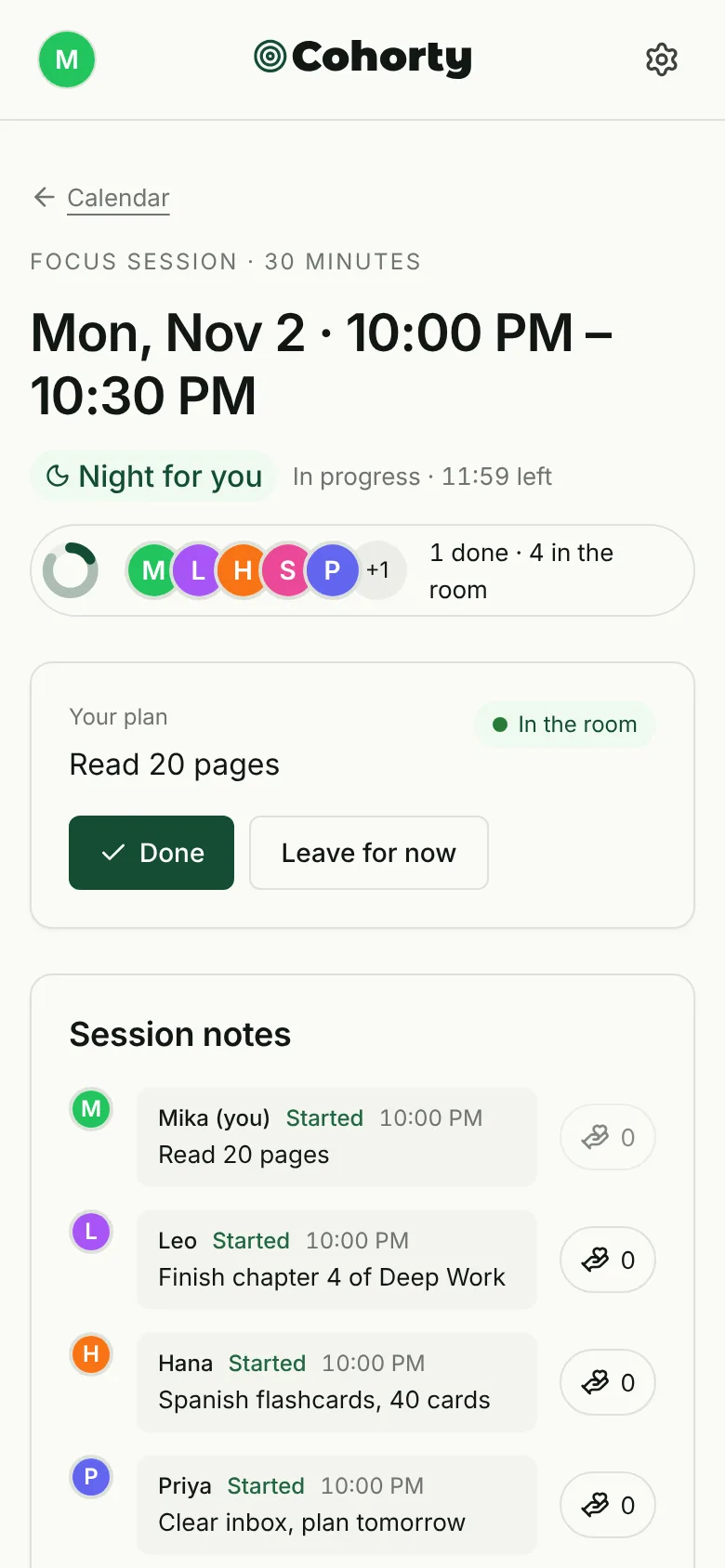
Joining sessions is free. How to use Cohorty walks through it with screenshots, and Cohorty vs Focusmate compares it with one-to-one video sessions. Many people use both layers: a partner for the weekly look back, and a session for actually starting.
Frequently asked questions
Do accountability partners really work?
They can. Research supports the mechanisms they rely on, such as monitoring progress, sharing it with someone, and making specific plans, but no study shows a guaranteed success rate. Whether a partnership works depends mostly on the setup: a specific action, a check-in you can keep up, and an agreed response to misses.
How do I find an accountability partner for free?
Post in a partner-finding community such as r/GetMotivatedBuddies, join a Discord server for your goal, try a free co-working session, or ask someone you already know. See how to find an accountability partner online for a post template and screening questions.
How often should we check in?
Daily one-line check-ins suit habits; weekly calls suit bigger goals; many pairs combine both. See daily vs weekly vs monthly check-ins.
Should we have the same goal?
It helps but isn’t required. Matching check-in rhythm, time zone and expectations matters more than matching goals.
Should I choose a partner or a group?
A partner suits a specific goal and personal, two-way support. A group is more resilient, because one quiet member doesn’t end it, and suits daily habits. If partners have ghosted you before, try a group or a set-time session first. For the trade-offs of different sizes, see how group size affects habit success.
What if I’m an introvert and hate social pressure?
Choose quiet formats: short written check-ins, or a session where others are present but nobody talks. See quiet group accountability.
What if I have ADHD?
Shorter, more immediate support tends to work better than long weekly reports: a body double at the start of a task, or very short check-ins. See ADHD accountability buddies.
Should we sign a contract?
A short written agreement helps, mainly because it forces you to decide the action, check-in and response up front. Copy our free accountability partner agreement.
How long should a partnership last?
Start with a one-week trial, then commit to about a month and review. Some partnerships last years; others do their job in one season. Both are fine.
Can I use an app instead of a person?
Yes. Apps can supply visibility, a set time or a record, which covers much of what a partner does. Compare options in accountability apps by type.