Best Accountability Apps: 10 Picks by Type (Free & Paid)
Compare 10 accountability apps by how they keep you on track: partners, groups, co-working sessions, and money on the line. Free options for each type.
“Accountability app” covers very different tools. Some match you with a person, some put you in a group, some keep you company while you work, and some take your money if you fail. The best one depends on what usually stops you: forgetting, starting, or quitting when nobody notices.
This guide groups 10 accountability apps by how they create accountability, with what each costs and who it suits. Details come from each provider’s public information as of October 2026; check current pricing before you pay.
Disclosure: Cohorty publishes this journal and appears in this list, so we have a commercial interest in one option.
Quick picks
| If your problem is… | Try | Why |
|---|---|---|
| Starting tasks you keep postponing | Focusmate, Cohorty, Flow Club | Someone is present at a fixed time |
| Following through when nobody checks | stickK, Beeminder | A referee or money on the line |
| Staying consistent with friends | HabitShare, Habitica | Friends see your progress |
| Finding a partner at all | Reddit and Discord communities | Large pools of people looking |
| Wanting a guided routine | Caveday, Flow Club | A host runs the session |
Want to try the camera-free option today? Book a free 30-minute Cohorty session, write one line about your plan, and do it alongside everyone who booked the same time. No camera, no chat, no partner to find. (Cohorty publishes this journal.)
How accountability apps work: four types
- Co-working and body doubling apps give you a time and other people present while you do the task. They help most with starting. See virtual body doubling.
- Commitment contract apps make a missed goal cost something: money, or a report to a referee. They help most when you know what to do but keep letting it slide.
- Social habit trackers let friends or a group see your check-ins. They help most when you already have people to do it with.
- Communities help you find a human partner. They help most when you want a long-term 1:1 relationship; see how to find an accountability partner online.
Co-working and body doubling apps
1. Focusmate: one-to-one video sessions
How it works: Book a 25-, 50-, or 75-minute slot and get matched with one partner. You share your goal, work with cameras on, and report back at the end.
Cost: Free plan with 3 sessions a week; Plus at $8/month billed annually or $12/month billed monthly.
Best for: work and study tasks, people who respond to being seen by one specific person.
Watch for: cameras are expected; the free plan runs out fast for daily use.
2. Cohorty: camera-free sessions at fixed times
 cohorty.app
How it works: Book a 30-minute session at one of a few fixed times each day. Everyone who booked the time is in one shared room. You write one line about what you will do, do it, and leave one line about how it went. No video, no chat; nicknames only.
Cost: Joining sessions is free. Plus is $3/month for opening your own times and repeating bookings.
Best for: daily habits (study, writing, practice, home workouts), introverts, and anyone who avoids video calls.
Watch for: the community is still small, so some times are quiet; social pressure is lighter than a 1:1 video call.
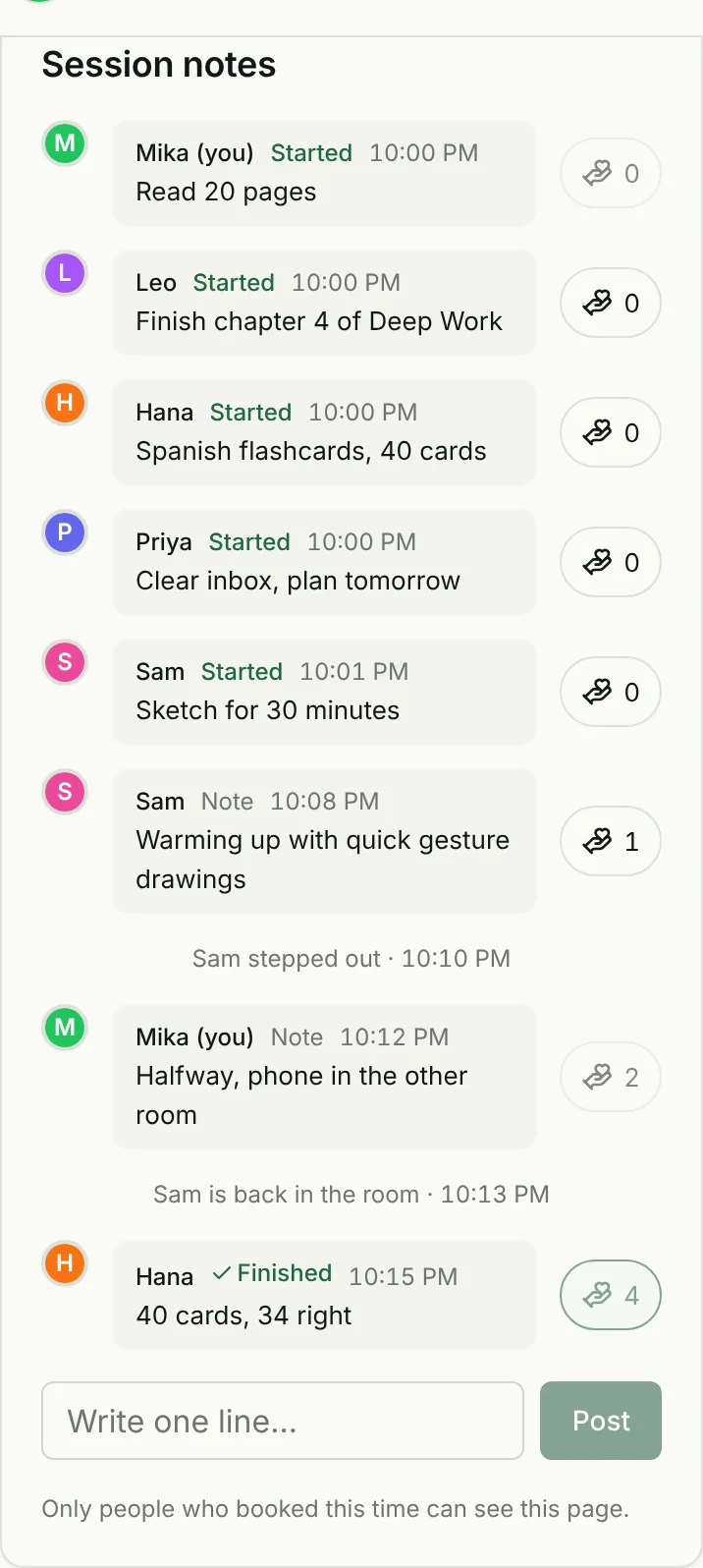
See how to use Cohorty for a walkthrough with screenshots.
3. Flow Club: hosted group sessions
How it works: Volunteer hosts run sessions of up to nine people, from 30 minutes to three hours. Video is encouraged but optional, and there are chat-only options.
Cost: $40/month or $400/year, with discounts for students and non-profit workers.
Best for: people who like a facilitated ritual and will use it most days.
4. Caveday: guided deep-work sessions
How it works: Human guides lead Zoom sessions of 30 minutes, one hour, or three hours, every day. Everyone is muted; cameras are encouraged.
Cost: Starter Pass at $105 per three months, after a 14-day free trial.
Best for: knowledge workers who want long, structured focus blocks.
For more options in this category, see Focusmate alternatives compared.
Commitment contract apps
5. stickK: commitment contracts with a referee
How it works: You write a commitment contract, set a reporting schedule, and choose a referee who confirms your reports. You can add money at stake; if you fail, it goes to a person, a charity, or an “anti-charity” you would hate to support. You can also use a referee without money.
Cost: Free to use; you only pay the stakes you choose if you miss.
Best for: goals with a clear yes/no outcome where a real consequence helps. Compare it with social approaches in Cohorty vs stickK.
6. Beeminder: data tracking with escalating pledges
How it works: You set a quantified goal (pages, minutes, workouts) and log data, manually or through integrations. If you fall behind your line, you “derail” and pay your pledge. Pledges can start at $0 for the first week, then $5, and rise after each derailment.
Cost: A free core plan with a limit on the number of goals; paid plans add more goals and features.
Best for: people who like numbers and want a strong, automatic consequence.
Watch for: it can feel punishing; set conservative goals at first.
Social habit trackers
7. HabitShare: share habits with friends
How it works: Track habits and choose which friends can see each one, so you can share exercise with one friend and keep other habits private. Friends see your progress and can send encouragement.
Cost: Free to use; some features may be paid, so check the current app listing.
Best for: friends or couples who already want to do this together. See habit tracking apps with friends.
8. Habitica: a role-playing game for habits
How it works: Your habits and to-dos power a game character. Join a party with other players and take on quests together; missing your dailies can affect the party.
Cost: Free to start, with optional paid extras.
Best for: people motivated by game mechanics and teamwork.
Watch for: the game can become the point instead of the habit.
Communities for finding a partner
9. Reddit communities
 reddit.com
r/GetMotivatedBuddies is the largest subreddit for finding a one-to-one accountability partner; smaller ones include r/accountability and r/Accountabilibuddies. Free, with a huge pool of people, but you coordinate everything yourself. See our Reddit accountability buddy guide.
10. Discord servers
 discord.com
Study and productivity servers run voice channels for working together and channels for daily check-ins. Free and always open, but quality varies and chat can distract.
How to choose an accountability app
- Name the failure point. Not starting → co-working. Not following through → commitment contract. Losing interest alone → social tracker or group.
- Decide how visible you want to be. Video, nickname-only, or private with a referee.
- Check the free tier against your frequency. A daily habit needs a plan that covers daily use.
- Try one for two weeks. Judge it by what you did, not how motivated you felt.
- Combine if needed. For example, a weekly accountability partner for direction plus a daily session for doing the work.
Accountability apps for specific goals
- Fitness and weight loss: see weight loss accountability apps.
- Studying: see study buddy apps.
- Small groups and teams: see small group accountability apps.
- Founders: see accountability apps for entrepreneurs.
- ADHD: see habit apps for ADHD.
Frequently asked questions
What is the best free accountability app?
It depends on the type you need. For co-working, Cohorty’s sessions are free to join and Focusmate has a free plan with three sessions a week. For commitment contracts, stickK is free to use if you only rely on a referee. For tracking with friends, HabitShare is free to start.
Is there an app that finds an accountability partner for you?
Focusmate matches you with a partner for each session, and Cohorty puts you in a room with everyone who booked the same time. Neither assigns a long-term personal partner; for that, communities such as r/GetMotivatedBuddies remain the usual route.
What is the best accountability app with friends?
HabitShare and Habitica are built for friends tracking habits together. If you want to actually do the habit at the same time, book the same co-working session.
Do accountability apps work?
Monitoring progress and sharing it tends to help people follow through on average, according to a large meta-analysis. No app guarantees a result; the right one is the one you keep using.
Should I pay for an accountability app?
Start free. Pay when you hit a limit you actually feel, such as running out of free sessions or needing more goals.