Best Habit Apps for ADHD (No Overwhelm, No Gamification)
Simple habit apps for ADHD brains that reduce executive function load instead of adding to it. No complex setups, no points, no overwhelming dashboards.
You’ve downloaded the habit tracker app. It has beautiful graphs, achievements to unlock, streak counters, detailed analytics, and a leveling system. For the first three days, you’re obsessed. You check it constantly, admire your perfect streak, and feel like you’ve finally found The System.
By day seven, you’ve forgotten it exists.
Sound familiar?
Here’s what most habit apps get wrong about ADHD: they assume that more features, more gamification, and more tracking will increase motivation. For ADHD brains, it’s the opposite. Complexity adds executive function load. Gamification becomes another source of dopamine chasing. Detailed analytics turn into shame when you inevitably miss days.
What ADHD brains actually need are habit apps that remove friction, not add it. If you have ADHD, you already know that building habits requires different strategies than neurotypical advice suggests.
What You’ll Learn
- Why most popular habit apps fail ADHD brains (and what to look for instead)
- The critical features that make habit apps ADHD-friendly
- Reviews of 8 habit apps specifically evaluated for neurodivergent users
- Red flags that signal an app will become another abandoned system
- How to choose the right app for your specific ADHD challenges
Why Most Habit Apps Fail for ADHD
Before we look at which apps work, let’s understand why so many don’t.
Problem 1: Too many features create decision paralysis
ADHD brains struggle with executive function—the cognitive processes that help you plan, organize, and execute tasks. When an app presents you with fifteen different tracking options, custom categories, detailed settings, and multiple view modes, you’re asking an ADHD brain to make numerous decisions before even starting.
Result: You spend thirty minutes setting up the perfect system and never actually track a habit.
Problem 2: Gamification backfires
Habitica, Streaks, and similar apps use game mechanics to increase engagement. For some ADHD brains, this works initially. But there’s a problem: your dopamine-hungry brain starts chasing the game rewards instead of the actual habit.
You complete easy habits to maintain your streak, avoiding the harder habits you actually need to build. Or you get so focused on the game elements that when the novelty wears off (usually within 2-3 weeks), motivation crashes completely. Traditional gamification can backfire—see how gamification affects habit formation for the research.
Problem 3: Perfectionism triggers and shame spirals
Many habit apps emphasize streaks—consecutive days of habit completion. Miss one day, and your streak resets to zero. For ADHD brains that already struggle with shame around inconsistency, this feature is devastating.
Instead of “I’ve completed this habit 23 out of 30 days” (76% success rate!), you see “Streak: 0 days” and feel like a failure. The app that was supposed to help becomes a source of negative reinforcement.
Problem 4: Requires too much daily maintenance
Some apps want you to review your goals weekly, adjust your tracking methods, analyze your progress graphs, and engage with community features. Each of these activities requires executive function—the exact resource that ADHD brains are short on.
The app becomes another task you can’t complete, adding to your cognitive load instead of reducing it.
Problem 5: No accommodation for ADHD-specific challenges
Most habit apps are built for neurotypical brains. They assume you’ll remember to check the app, have consistent routines, and can reliably estimate your time and capacity. None of these assumptions hold true for ADHD brains struggling with time blindness, inconsistent schedules, and variable energy levels. Pair your app with ADHD time blindness strategies that make time visible outside the app.
What ADHD-Friendly Habit Apps Look Like
Based on these challenges, here’s what actually works for neurodivergent brains:
Quick input: One tap to log a habit. Not multiple screens, not detailed notes, not category selection. Just: tap, done.
Flexible scheduling: Option to track habits “most days” or “X times per week” rather than rigid daily requirements. Your ADHD brain needs permission to be imperfect.
Forgiving metrics: Focus on overall completion percentage rather than consecutive-day streaks (compare options in habit trackers without streaks). Celebrate “completed 18 out of 30 days” instead of punishing you for breaking a streak.
Minimal setup: Out-of-box functionality without requiring extensive configuration. You should be able to start tracking within 30 seconds of downloading the app.
Low maintenance: Doesn’t require weekly reviews, system updates, or constant engagement to remain useful.
Visual simplicity: Clean interface without overwhelming data visualizations, badges, levels, or competing features.
Optional social features: Accountability should be available but not required. Some ADHD brains benefit from social pressure; others find it exhausting. Silent support and body doubling work better than points and badges for ADHD brains.
No notification spam: Reminders when helpful, but not so many that you start ignoring them or feeling nagged.
Now let’s look at specific apps through this lens.
The Best Habit Apps for ADHD (Honest Reviews)
1. Habitica: For ADHD Brains That Love Games (When It Works)
Best for: ADHD users who respond well to gamification and want a more entertaining approach
The concept: Turn your habits into a role-playing game. Complete habits to level up your avatar, join quests with friends, collect items, and battle monsters. It’s explicitly designed to make habit tracking fun rather than clinical.
Why it might work for ADHD:
Gamification provides external motivation when internal motivation is low. Your dopamine-seeking brain gets rewards from both completing the habit AND from game progression.
Social features allow for party quests and accountability through multiplayer elements. Some ADHD brains thrive on this type of engagement.
Highly customizable. You can set up daily habits, to-dos, and rewards in ways that match your goals.
Why it often fails for ADHD:
The game becomes more important than the habits. You might start focusing on optimizing your character rather than actually building meaningful habits.
Too many features create overwhelm. Between quests, parties, guilds, challenges, items, and pets, there’s a lot to manage. For some ADHD brains, this is too much executive function load.
Punishment mechanics can backfire. If you don’t complete habits, your avatar takes damage. For ADHD brains prone to shame, this negative reinforcement often leads to abandoning the app entirely.
The verdict: Habitica works beautifully for a subset of ADHD users—particularly those who love games and can maintain interest in the RPG elements long-term. But many find it overwhelming or that the game novelty wears off, leading to another abandoned system.
Pricing: Free with premium options
Platforms: Web, iOS, Android
2. Streaks: Simple Tracking for iOS Users
Best for: iPhone users who want dead-simple tracking and don’t mind streak-based metrics
The concept: Track up to 12 habits. The app shows you how many consecutive days you’ve maintained each habit. Ultra-minimal interface. That’s it.
Why it works for ADHD:
Extremely simple. Open app, tap habit, done. No setup complexity, no feature overload.
iOS widget support means you can log habits from your home screen without even opening the app. This removes a friction point.
Clean, uncluttered interface doesn’t overwhelm your visual processing.
Why it might not work for ADHD:
Streak-focused metrics can trigger shame. If you struggle with perfectionism or self-criticism, seeing “0 days” after missing a habit might feel devastating rather than motivating.
Limited to 12 habits. For some, this is freeing (forces prioritization). For others, it’s constraining.
No social features. You’re completely on your own, which means no external accountability.
The verdict: Streaks is great if you respond well to streak metrics and want something simple. But the streak emphasis makes it risky for ADHD brains prone to all-or-nothing thinking or shame spirals.
Pricing: One-time purchase (~$5)
Platforms: iOS only
3. Loop Habit Tracker: Free, No-Frills, Android-First
Best for: Android users who want simple habit tracking without any bells and whistles
The concept: Open-source, completely free habit tracker focused on doing one thing well: showing you whether you did your habits or not. No gamification, no social features, no premium upsells.
Why it works for ADHD:
Completely free removes decision paralysis around whether to pay for premium features.
Simple interface with minimal cognitive load. Track habits, view history, done.
Flexible scheduling allows “X times per week” tracking rather than only daily habits.
Privacy-focused (data stays on your device) removes concerns about tracking being shared or analyzed.
Why it might not work for ADHD:
Zero accountability features. You’re completely solo, which might not provide enough external motivation for ADHD brains that need social structure.
Basic UI isn’t particularly beautiful or engaging. If you need some visual appeal to maintain interest, Loop might feel too clinical.
Android-only currently limits accessibility.
The verdict: Loop is perfect for minimalists who want free, simple tracking and don’t need social accountability or visual flair. It does exactly what it claims, no more, no less.
Pricing: Free (open source)
Platforms: Android
4. Habitify: Feature-Rich But Potentially Overwhelming
Best for: ADHD users who want detailed analytics and can handle complexity without getting overwhelmed
The concept: Comprehensive habit tracking with detailed statistics, multiple view options, mood tracking, and journal integration. It’s designed for people who want to deeply analyze their habits.
**Why it might work for ADH
5. Cohorty: Camera-Free Body Doubling Sessions
Disclosure: Cohorty publishes this journal, so we have a commercial interest in it.
What it is: You book a 30-minute session at one of a few fixed times each day and do your habit alongside everyone who booked the same time, in one shared room. You write one line about what you will do, do it, and leave one line about how it went. No video, no chat; everyone uses a nickname.
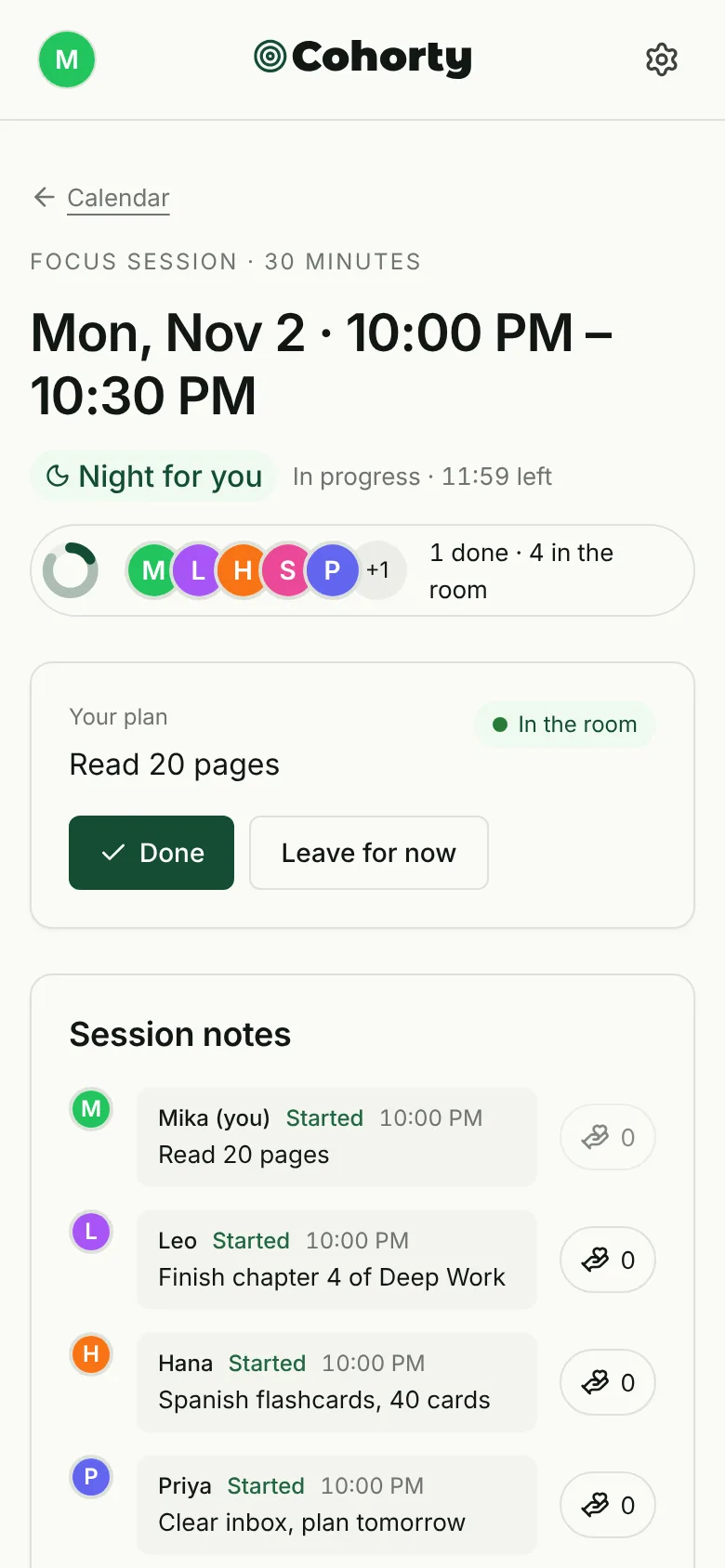
Why it fits ADHD:
- A fixed time does the initiating for you: the session starts whether or not motivation shows up
- Body doubling without a camera, chat, or small talk
- No points, badges, or leaderboards; a missed session is followed by the next booking, not a reset
- You can split a day into a few half-hour slots, one small task each (walkthrough: ADHD-friendly focus sessions)
Limitations:
- Sessions run at a few set times each day unless you open your own with Plus
- The community is still small, so some times have few people (you can still start on your own)
- It is built around sessions, not detailed logging: pair it with a tracker if you want charts of weight, pages, or reps
- Runs in the browser on desktop and phone
Pricing: Joining sessions is free. Plus is $3/month and lets you open your own times at any half hour and repeat bookings on the days you choose.
Best for: People with ADHD who start more easily when someone else is working at the same time.