
ADHD Time Blindness: Strategies That Actually Work
Why ADHD makes time hard to feel, and practical ways to make it visible: external clocks, fixed start times, half-hour blocks and if-then plans.
You sit down to answer one email at 2 PM. You look up and it’s 5:40. Or the opposite: the appointment is “ages away” right until it’s 15 minutes away and you haven’t left.
People with ADHD often call this time blindness: time doesn’t feel like a steady thing you can sense, so it’s hard to plan with it, notice it passing, or feel a deadline before it arrives. It isn’t laziness or not caring. It’s one of the most common ways ADHD shows up in daily life.
This guide explains what time blindness is, then covers strategies that work by making time visible and external, so you don’t have to feel it.
Note: this is general information, not medical advice. If time problems are affecting your work, health or relationships, an ADHD-informed clinician can help with assessment and treatment options.
What time blindness is (and isn’t)
“Time blindness” isn’t a formal diagnosis. It’s an everyday name for a cluster of difficulties that ADHD researchers have described for decades. Psychologist Russell Barkley, for example, describes ADHD as a problem of self-regulation across time: knowing what to do is less of an issue than doing it at the right moment. That’s why his central advice is to put time and reminders outside your head, at the point where the work happens.
In practice, time blindness tends to show up as:
- Now vs. not now. Things are either happening right now or vaguely “later.” Next Tuesday and next month feel similar.
- Shaky estimates. “This will take 10 minutes” turns into an hour, or a 20-minute job gets avoided because it feels enormous.
- Losing track during a task. Especially during hyperfocus, when the outside world fades.
- Transitions. Stopping one thing to start the next at a set time is hard, so everything after it slips.
- Deadline-driven bursts. Work only becomes real when the deadline is close enough to feel. (More on this in ADHD procrastination.)
None of these are character flaws. They’re reasons to stop relying on an internal clock and build an external one.
The principle: don’t feel time, see it
Every strategy below follows one idea: move time out of your head and into your surroundings. If you can’t sense how much time is left, put it somewhere you’ll see it. If you can’t remember to start, attach the start to something outside you.
1. Make time visible
Use an analog or visual timer. A clock with hands, or a timer that shows a shrinking colored disc, lets you see how much is left at a glance. Digital numbers (“14:32”) require reading and calculating, which is exactly what’s hard.
Put clocks where you work. One in the kitchen, one by the desk, one in the bathroom if mornings are where you lose time. Your phone doesn’t count; checking it often leads somewhere else.
Show the length of a task, not just the end. Before you start, set a timer for the time you’ve decided to give the task. You’re not racing it; you’re making the block visible.
2. Give tasks a start time, not a deadline
Deadlines are where time blindness hurts most: “by Friday” doesn’t feel real until Thursday night. A start time is easier because it’s a single moment you can put in a calendar and get reminded of.
Swap “do the expense report this week” for “start the expense report Tuesday at 10:00.” You don’t have to finish it then. You just have to begin.
This is the same idea as if-then plans, also called implementation intentions: “If it’s 10:00 on Tuesday, then I open the expense spreadsheet.” Research on implementation intentions across many studies has found they reliably help people act on goals they already have, because the decision about when is made ahead of time.
3. Work in half-hour blocks
Long open-ended blocks (“this afternoon I’ll catch up on admin”) are where time disappears. Short, fixed blocks put edges on the day.
Thirty minutes is a useful size:
- Long enough to make real progress on one thing.
- Short enough that starting doesn’t feel like a big commitment.
- Easy to count: a two-hour job is “four blocks,” which is more concrete than “a couple of hours.”
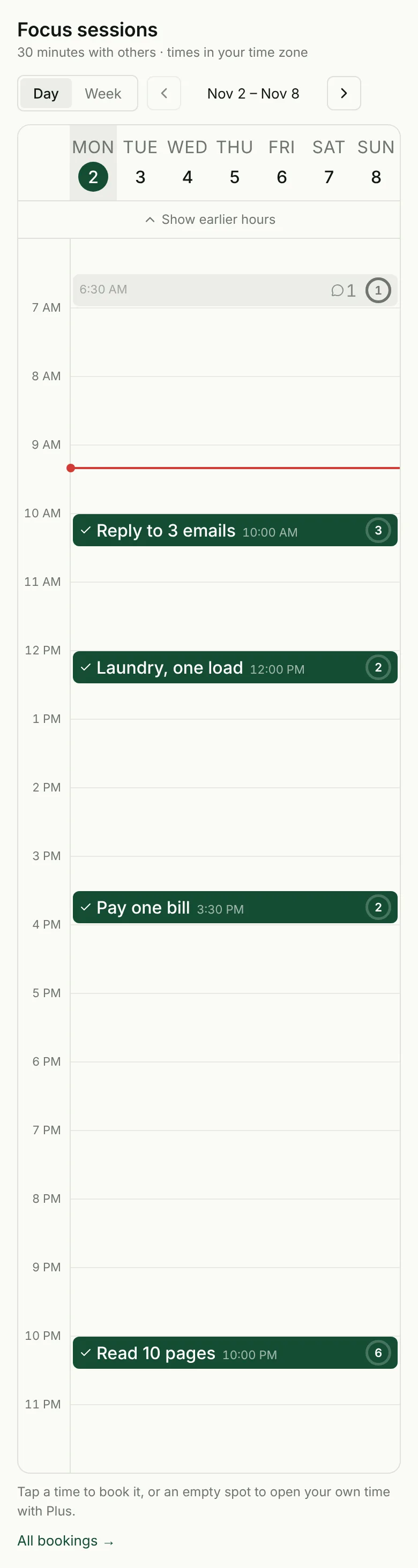
Give each block one task with a visible finish: “reply to three emails,” not “email.” Then write the next block into your calendar before the current one ends.
If you plan blocks but never start them, the next strategy matters more than the plan.
4. Borrow a start time from other people
A block on your own calendar is easy to slide. A block that other people are also starting at the same time is harder to ignore. That’s part of why body doubling helps many people with ADHD: someone else’s presence turns “sometime” into “now.”
Options, from most to least social:
- A friend or partner working alongside you at a set time, in person or on a call.
- A one-to-one video session with a stranger, booked in advance.
- A camera-free shared session at a fixed time, where you see who else is working without being on camera.
Disclosure: Cohorty publishes this journal. Cohorty is the third kind: 30-minute sessions at set times, no camera and no chat. You can book several half hours in a day, and if you miss one, nothing resets. Our guide to ADHD-friendly focus sessions shows how that works step by step. For other formats, see the virtual body doubling guide.
5. Estimate with evidence, not feelings
If your sense of duration is unreliable, use records instead.
- Pick three tasks you do often: getting ready in the morning, a load of laundry, a weekly report.
- Next time you do each, write the start and end time. Don’t try to go faster.
- Use those numbers when you plan. If “getting ready” took 55 minutes, it takes 55 minutes, whatever it feels like.
Add a buffer to anything new. There’s no magic percentage; a simple rule is to plan for roughly half again as long as your first guess, then adjust when you have real numbers.
6. Protect transitions
Many lost hours happen between tasks: “I’ll just check something” after finishing one thing, before starting the next.
- Set a warning, not just an end. A five-minute warning before you need to stop gives your brain time to wrap up.
- Decide the next action before stopping. Write it on a sticky note: “Next: shoes on, keys, out.”
- Leave for appointments at a time, not when you feel ready. Put the leave by time in the reminder, not the appointment time. Mornings are where this matters most; see the ADHD morning routine.
7. Plan around hyperfocus instead of against it
Hyperfocus can be productive, but it also swallows meals, meetings and sleep.
- Put a hard stop in a place you can’t miss: an alarm across the room, or a person who’ll check in.
- Start absorbing tasks when there’s nothing important right after them.
- Use a block’s end as a checkpoint: “Do I continue, or is there something I’d regret missing?” If continuing is fine, book or set another block on purpose.
8. Expect some days to slip
Every system fails on some days. Time blindness doesn’t go away because you made a calendar. What matters is how quickly you pick it up again.
- Avoid tools that turn a missed day into a red mark or a reset streak. They punish exactly the days you most need to restart. (More on this in the psychology of streaks.)
- When a block is missed, don’t reschedule it in your head. Put the next real block in the calendar.
- Keep a record of what you did, not what you missed.
A starter routine
If you try only one thing this week:
- Pick one task you’ve been putting off.
- Shrink it to something you can start in under a minute.
- Give it a 30-minute block with a start time tomorrow, ideally alongside someone else.
- Put a visible timer on when the block starts.
- Before the block ends, put the next one in your calendar.
Common questions
Is time blindness a real ADHD symptom?
The term is informal, but the difficulties it describes (estimating time, sensing deadlines, managing transitions) are widely described in ADHD research and clinical practice. If you recognize them in yourself, mention them to a clinician; they’re relevant to assessment and treatment.
Do timers really help with ADHD time blindness?
Many people with ADHD find visual timers useful because they show time passing instead of asking you to track it. They work best combined with a clear task and a start time.
What’s the best block length for ADHD?
There’s no single answer. Thirty minutes works for many people because it’s short enough to start and long enough to finish a small task. Some prefer 15 or 25 minutes; Pomodoro for ADHD covers how to adapt block lengths.
How do I stop being late with ADHD?
Plan the leave by time, not the arrival time, set a warning before it, and use records of how long getting ready actually takes rather than your estimate.