How to Focus With ADHD: 9 Habits That Help
Practical focus habits for ADHD: one task at a time, fewer distractions, short blocks, movement, interest, other people, and the basics of sleep and treatment.
ADHD isn’t really a lack of attention. Many people with ADHD can focus intensely on things that interest them, sometimes for hours. The problem is directing attention: getting it onto the thing you need to do, and keeping it there when it isn’t interesting.
That’s why “just concentrate” doesn’t help. What helps is changing the conditions around the task so focus is easier to start and harder to lose.
Here are nine habits that do that. You don’t need all of them. Pick two that fit your biggest problem and start there.
Note: this is general information, not medical advice. If focus problems are affecting your work, studies or relationships, talk to an ADHD-informed clinician about assessment and treatment.
1. Decide the one task before you start
Focus often fails before it begins, because the task isn’t clear. “Work on the project” gives attention nowhere to land.
- Write the task as one line with a visible finish: “Draft the introduction,” “Reply to Sam and Priya.”
- Keep it small enough to start in under a minute. If you can’t, see ADHD paralysis for ways to shrink it.
- Write it down where you’ll see it: a sticky note on the screen works.
2. Work in short, timed blocks
Open-ended time invites drifting. A short block with a visible end makes focus easier to sustain.
- 15 to 30 minutes for most tasks. Shorter for things you dread.
- A visual timer so you can see time passing without checking a clock. Useful if time blindness is part of the problem.
- One task per block. If something else comes to mind, write it on a “later” list.
The Pomodoro for ADHD guide covers block lengths, breaks and hyperfocus.
3. Remove the biggest distraction, not every distraction
You don’t need a perfect environment. You need to remove the one thing that pulls you away most often. For most people, that’s the phone.
- Phone in another room for the block. Face down on the desk is usually not enough.
- Close tabs and apps you won’t use. Notifications off during focus blocks.
- Website blockers for the sites you open on autopilot.
Then notice what pulls you next, and handle that one.
4. Single-task on purpose
(More on the research and practical habits in single-tasking.)
Switching between tasks feels productive but costs time and attention every time you switch back. With ADHD, it’s also easy to lose the thread completely.
- One window or document visible at a time where possible.
- A “parking lot” list for ideas and tasks that come up mid-block.
- Batch similar small tasks (emails, messages) into their own block instead of answering them as they arrive.
For the bigger picture, see building habits in the age of infinite distraction.
5. Add a little interest
ADHD attention follows interest, novelty and challenge. You can add some to almost any task.
- Make it a game: “How many of these can I finish before the timer?”
- Change the setting: a different room, a café, a library.
- Pair it with something pleasant: a specific playlist or drink you only have while working.
- Start with the most interesting part of the task, then use the momentum.
6. Let your body move
Sitting still and focusing at the same time is hard for many people with ADHD. Movement can help rather than distract.
- Stand, walk or pace while thinking or reading.
- Fidget tools for your hands during calls or reading.
- A short burst of exercise before a focus block. Many people with ADHD find it helps them settle.
- Movement breaks between blocks instead of phone breaks.
7. Work alongside other people
For many people with ADHD, other people working nearby makes focus easier to start and to keep. That’s body doubling, and it doesn’t need conversation.
- A friend or colleague working next to you, or on a call.
- A library or café where everyone else is working.
- Scheduled online sessions with strangers; our virtual body doubling guide compares formats.
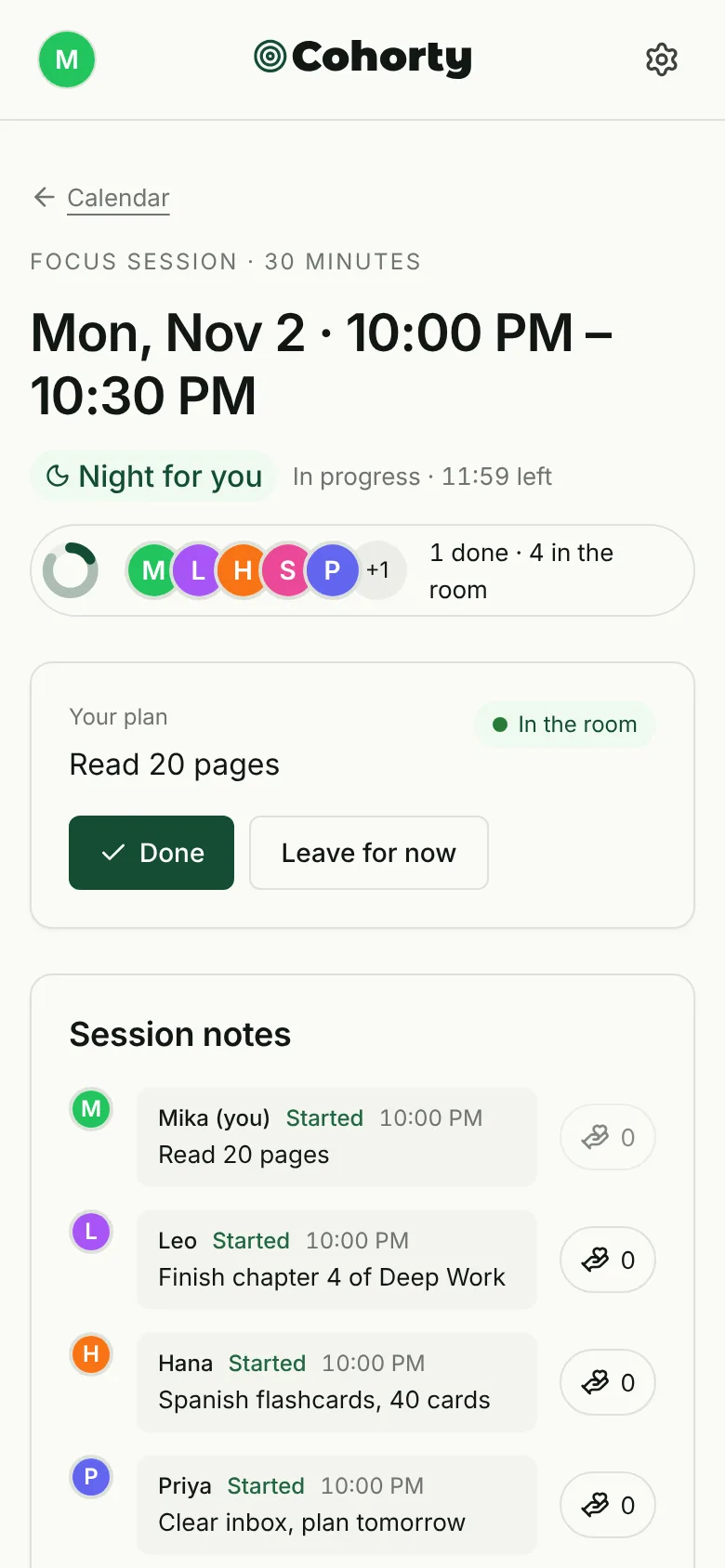
Disclosure: Cohorty publishes this journal. Cohorty runs 30-minute sessions at set times with no camera or chat. You write one line about your task and focus alongside whoever booked the same time. See ADHD-friendly focus sessions for how to plan a day of short blocks.
8. Plan focus for your best hours
Most people have times of day when focus comes more easily. With ADHD, the difference can be large, and it may also depend on medication timing.
- Notice when focus is easiest for a week: morning, afternoon, late evening.
- Put your hardest task in that window, and keep it free of meetings where you can.
- Save admin and easy tasks for low-focus times.
If you work from home, see working from home with ADHD for building structure around those hours.
9. Look after the basics
Focus habits work much better on top of the basics.
- Sleep. Poor sleep makes attention problems worse for everyone, and sleep difficulties are common with ADHD.
- Food and water. Long gaps without eating make focus harder.
- Exercise. Regular movement supports mood and attention.
- Treatment. For many adults, ADHD medication, therapy or coaching makes a substantial difference. These habits are a complement to treatment, not a replacement.
Start with two
Don’t adopt all nine at once. That’s a recipe for a system you drop in a week. Pick:
- One habit for starting (a clear one-line task, a short block, or a shared start time).
- One habit for staying (phone in another room, a parking lot list, or movement).
Run them for two weeks, then add one more. For longer, protected focus time, see deep work habits.
Common questions
Why can I focus on some things but not others with ADHD?
ADHD affects how attention is regulated. Interesting, novel or urgent tasks capture attention easily, sometimes into hyperfocus. Tasks without those qualities need more outside structure.
What helps ADHD focus without medication?
Short timed blocks, a single clear task, removing the main distraction, movement, adding interest and working alongside others all help. They work best with good sleep and, for many people, alongside treatment. Talk to a clinician about what’s right for you.
Does music help ADHD focus?
For some people, yes. Instrumental music, brown noise or café sounds can help, while lyrics may distract. Try a few options and notice which one helps you start and keep going.
How long can someone with ADHD focus?
It varies widely by person, task and day. Instead of aiming for long sessions, plan short blocks of 15 to 30 minutes and string them together with planned breaks.