
ADHD Morning Routine: A Simple, Forgiving Plan
An ADHD morning routine that runs on cues, not memory: decide the night before, keep a short fixed order, make time visible, and plan a backup for bad mornings.
You set three alarms and put the phone across the room. You swore this time would be different. And you’re still ten minutes late, without breakfast, looking for your keys.
Mornings are hard with ADHD because they stack up exactly the things ADHD makes difficult: many small steps in order, decisions made while tired, time pressure you can’t feel until it’s too late, and a phone full of distractions in your hand.
The answer usually isn’t a longer, more ambitious routine. It’s a shorter one that runs on cues instead of memory and willpower.
Note: this is general information, not medical advice. If sleep or mornings are a constant struggle, talk to a doctor; sleep problems are common with ADHD and treatable.
Why mornings go wrong
- Too many decisions. What to wear, what to eat, what to bring. Each one costs executive function you don’t have much of yet.
- Time you can’t feel. “I have loads of time” turns into “I’m late” without a clear moment in between. That’s time blindness.
- Transitions. Moving from bed to shower to kitchen to door is a chain of starts and stops, and each stop is a chance to get sidetracked.
- The phone. Checking “just one thing” in bed can quietly cost half an hour.
- Ambitious routines. A 12-step routine copied from a productivity video is easy to fail by step three.
Principle 1: Decide the night before
This is also the main remedy for decision fatigue in general.
(If you’re getting children out of the door too, the family morning routine adapts these steps for kids.)
Every decision you make in the evening is one you don’t have to make half-awake.
- Clothes out. One outfit, on a chair. No choosing.
- Bag packed by the door, with keys, wallet and badge in a single spot you always use.
- Breakfast decided. The same two or three breakfasts on rotation, ideally ones you can eat in five minutes.
- The first task of the day written down. A sticky note on your laptop: “First: reply to Sam.”
This can be a five-minute “launch pad” routine at the same time each evening. Our evening routine guide has ideas for building it in.
Principle 2: Keep the routine short and in a fixed order
A short routine you finish beats a long one you abandon. Start with three to five steps, always in the same order, each one triggering the next:
- Feet on the floor → drink the glass of water left by the bed.
- Bathroom → shower and teeth.
- Clothes from the chair.
- Kitchen → the breakfast you decided.
- Bag by the door → out.
This is habit stacking (more on why it suits ADHD in how to build habits with ADHD): each step is cued by finishing the last, so you don’t have to remember the list. Write it on a card where you’ll see it, like the bathroom mirror or the fridge.
Add steps only when the short version has been running smoothly for a few weeks. The minimal morning routine guide shows how small a routine can be and still help.
Principle 3: Make time visible
If you can’t feel time passing, put it where you’ll see it.
- A clock in every room you use in the morning, especially the bathroom.
- Checkpoint alarms, labelled: “7:30 should be dressed,” “7:50 leave.” The label matters; a bare alarm is easy to dismiss.
- A “leave by” time, not an “arrive by” time. Work backwards once, write it down, and use it every day.
- Time your routine once. Write down how long each step actually takes. Plan with those numbers, not with how long it feels like it should take.
Principle 4: Keep the phone out of the first stretch
The phone is the biggest single time leak in many ADHD mornings.
- Charge it outside the bedroom and use a separate alarm clock.
- If it has to be your alarm, put it across the room and leave it there until you’re dressed.
- Decide one thing you’re allowed to check (weather, the first meeting) and nothing else until you’re out of the door.
Principle 5: Give the first work block a start time
Once you’re at your desk (or home office), the next risky moment is starting the day’s work. The morning routine can end with a clear starting point: a first task and a time to begin it.
- Write the first task the night before so there’s nothing to decide.
- Book a start time for it, ideally alongside other people.
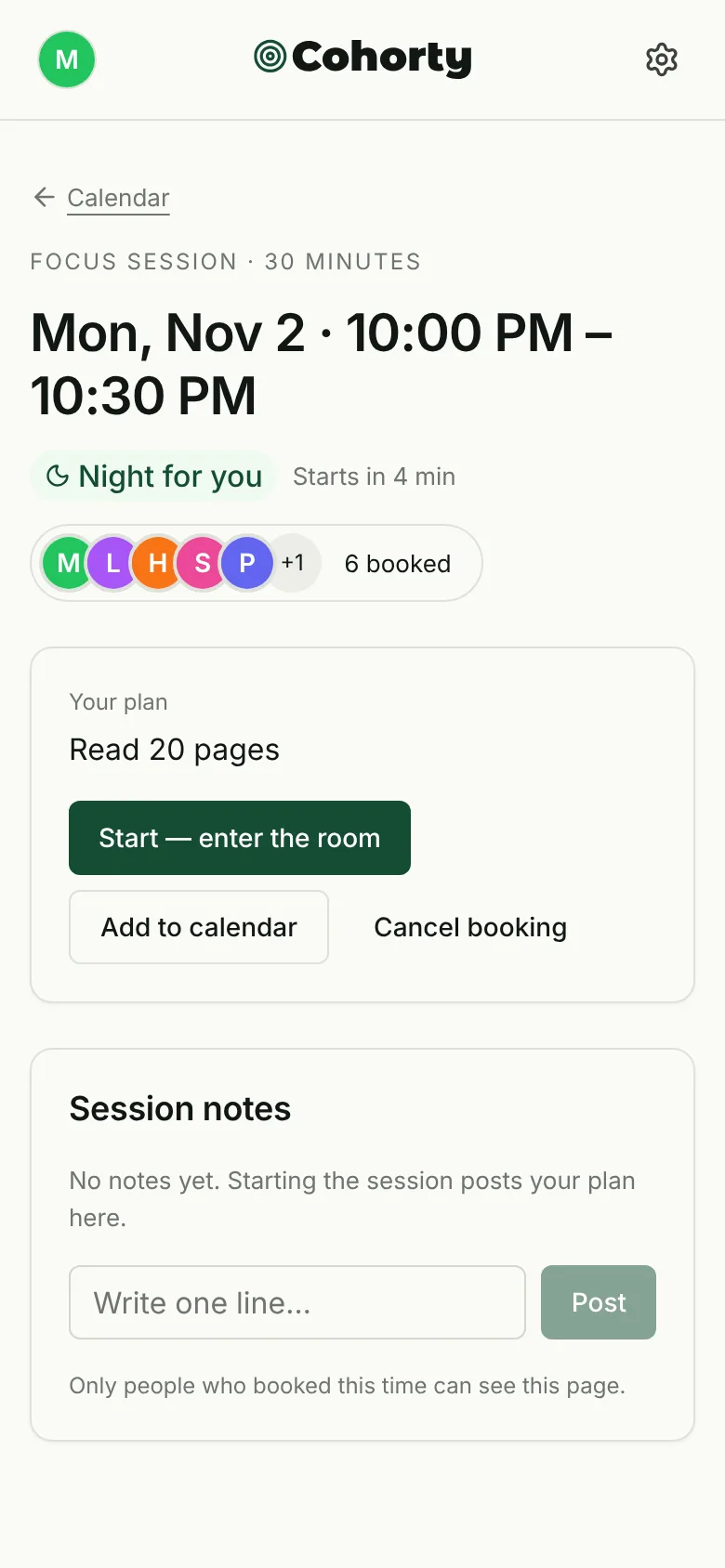
Disclosure: Cohorty publishes this journal. With Cohorty you can book a 30-minute session to start your workday alongside others, with no camera, so it doesn’t matter if you’re still in pajamas. If you miss it, nothing resets. With Plus you can repeat a morning time on weekdays so it books itself. See ADHD-friendly focus sessions for the basics.
Principle 6: Plan a backup routine for bad mornings
Some mornings will go wrong: a bad night, an early meeting, a child who won’t get dressed. Decide in advance what the minimum version looks like, so a bad morning isn’t a failed one:
- Water, teeth, clothes, keys, out.
- Breakfast you can eat on the way.
- Everything else skipped without guilt.
Having a written backup removes the all-or-nothing thinking that makes one bad morning turn into a bad week.
A sample ADHD morning routine
| Time | Step | Cue |
|---|---|---|
| Night before | Clothes out, bag by the door, first task written | Same time every evening |
| 7:00 | Water by the bed | Alarm across the room |
| 7:05 | Shower and teeth | Finished water |
| 7:25 | Clothes from the chair | Out of the shower |
| 7:35 | Breakfast from the rotation | Dressed |
| 7:50 | Leave (or start the first work block) | Labelled alarm |
Adjust the times to your real numbers, not ideal ones.
Common questions
Why are mornings so hard with ADHD?
Mornings combine many small steps, early decisions, time pressure and distractions, all of which lean on executive functions that ADHD affects. Moving decisions to the night before and making time visible helps the most.
How many steps should an ADHD morning routine have?
Start with three to five. Add more only once the short version has been working for a few weeks.
What if I don’t have a fixed start time for work?
Create one. Write the first task the night before and give it a start time, ideally with someone else starting at the same moment, so the morning has a clear end.
Should I exercise first thing in the morning?
Only if it fits. Some people with ADHD find early movement helps them focus, but adding a workout to a routine that isn’t working yet usually makes it harder to keep. Get the basics running first.