How to Find an Accountability Partner Online (8 Free Ways)
8 free ways to find an accountability partner or buddy online: same-day group sessions, Reddit, Discord and more, plus a post template and screening questions.
You can find an accountability partner online for free, and you don’t always have to wait for one. The fastest route is a booked group session, where people are already waiting at a set time. For a long-term one-to-one accountability buddy, the best pools are a partner-finding subreddit such as r/GetMotivatedBuddies, a Discord server for your goal, or a community built around it. Whichever route you take, the setup decides whether it works: a specific goal, a check-in rhythm you both agree on, and a one-week trial before committing.
This guide covers eight free places to find an accountability partner online, a “partner wanted” template you can copy, the questions to ask before you commit, and what to do when a partner goes quiet.
Quick answer: where to find an accountability partner online
| Where | Best for | How fast | What you get |
|---|---|---|---|
 Cohorty group sessions | Study, work, and daily habits | Same day | A booked time and people doing their habit alongside you |
 Reddit (r/GetMotivatedBuddies and others) | Specific personal goals | Days | A 1:1 partner you coordinate with |
 Discord servers | Ongoing community, study, coding | Days | Check-in channels and voice rooms |
| Habit apps with groups (Habitica) | Game-style motivation | Same day | A party that shares progress |
 Facebook groups | Local or identity-based goals | Days to weeks | Real-name community, possible meetups |
 LinkedIn | Career and skill goals | Weeks | Professional, public accountability |
| Forums and clubs for your goal | Running, writing, sobriety, languages | Days | People who understand the specific challenge |
| Friends, classmates, colleagues | Shared schedules | Varies | Someone who already knows your life |
If you want accountability today and don’t want to coordinate with anyone, start with a group session. If you want a long-term 1:1 partner, start with Reddit or a goal-specific community and use the screening steps below.
Want accountability today, without the search? Finding and keeping a partner takes time, and many matches fade within a couple of weeks. If what you need is to actually sit down and do the habit, a booked session works without anyone to recruit: book a free 30-minute Cohorty session, write one line about your plan, and do it alongside everyone who booked that time. No camera, no chat. See how it works, with screenshots. (Cohorty publishes this journal.)
Accountability partner, buddy, or group: which do you need?
The terms overlap, but the choice changes where you should look.
- An accountability partner is one person you check in with on an agreed schedule, usually in both directions. It works best for a clear goal over weeks or months. Our accountability partner guide covers the setup in depth.
- An accountability buddy usually means the same thing with a lighter touch: a daily “done” message rather than a weekly review.
- A group spreads the commitment across several people, so one person going quiet does not end it. See small group accountability apps.
- A body double is present while you do the task, without needing to report later. It suits tasks you postpone rather than goals you forget. See virtual body doubling.
Many people combine two: a weekly partner for direction and a daily session for doing the work.
8 free ways to find an accountability partner or buddy online
1. Group sessions: accountability the same day
cohorty.app
If your goal is doing something you keep postponing (studying, writing, admin, practicing, a home workout), you may not need a long-term partner at all. What you need is a fixed start time and other people who expect to see you there.
That is how Cohorty works. Sessions run for 30 minutes at a few fixed times each day, so the people who book a time actually meet. Everyone who booked that time works in one shared room with no camera and no chat:
- Book a time on the calendar. Times show in your own time zone.
- Write one line about what you will do (“Read 20 pages”, “Write 300 words”).
- Do the habit while everyone else does theirs, then tap Done.
- Book the next one. “Same time tomorrow” turns one session into a routine.
Joining sessions is free. (Cohorty publishes this journal.)
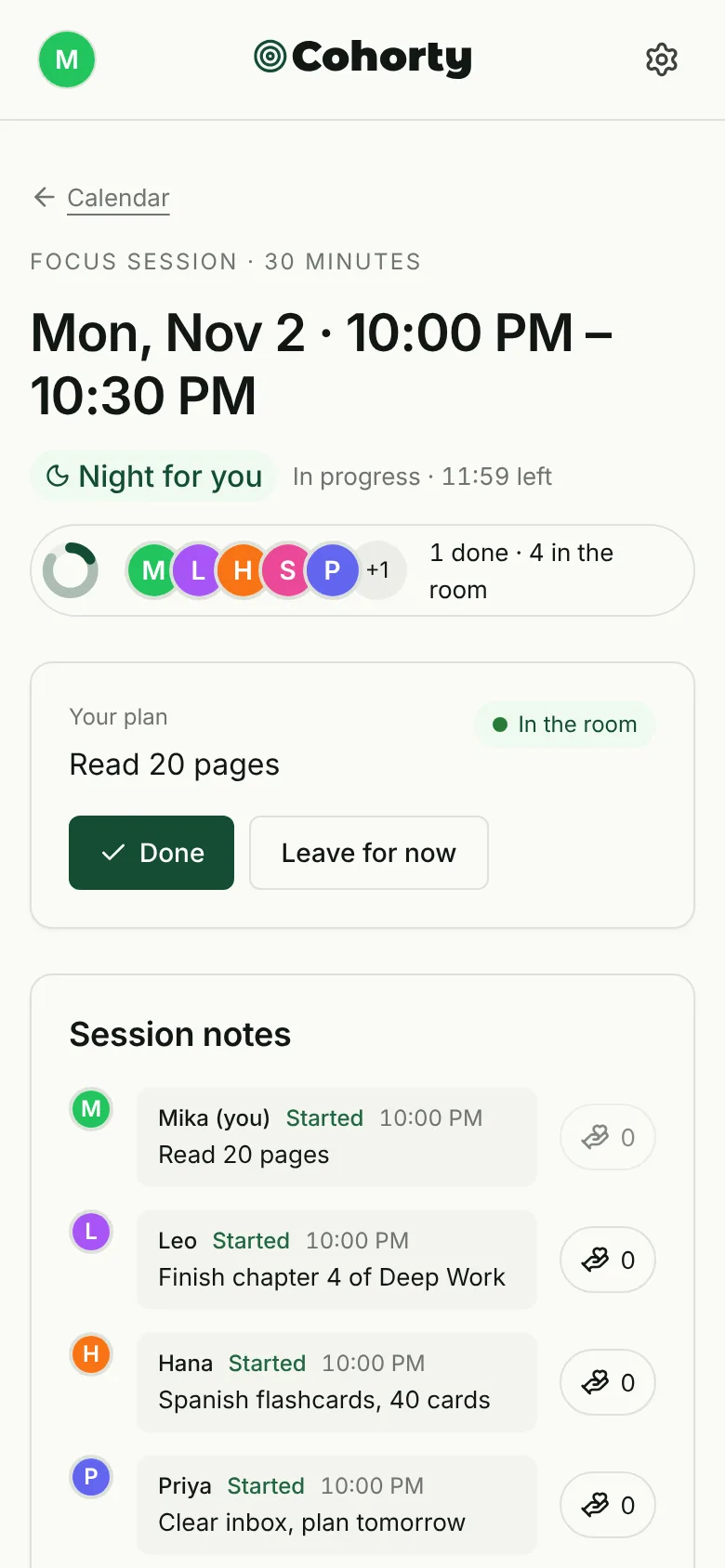
The difference from a partner: nobody has to agree to a schedule with you, and one person not showing up doesn’t cancel your session. How a Cohorty session works walks through it step by step. If you have tried one-on-one camera sessions before, Cohorty vs Focusmate compares the two formats.
2. Reddit: the largest pool of people looking right now
reddit.com/r/GetMotivatedBuddies
r/GetMotivatedBuddies is the biggest subreddit built for finding a one-to-one accountability partner, with posts for fitness, study, work, and habits. Smaller communities include r/accountability, r/Accountabilibuddies, and goal-specific subreddits (r/GetStudying for students, r/getdisciplined for general discipline, or a subreddit for your sport, language, or recovery goal).
How to use it: read the subreddit rules first, then write a specific post (template below). Reply to recent posts as well as writing your own; people who posted in the last day or two are the most likely to answer.
Watch for: many matches fade within a week or two. That is normal, not a sign you did something wrong. Treat the first week as a trial.
For more options beyond Reddit, see Reddit accountability buddy: subreddits and alternatives.
3. Discord servers: community that is always online
discord.com · server directories such as disboard.org
Discord suits people who want an ongoing community rather than a single partner. Large study servers such as Study Together run voice channels for working alongside others, and many smaller servers have daily check-in channels.
How to use it: search a server directory such as Disboard for “accountability”, “study”, or your goal. Join two or three, post in the introductions channel, and look for a partner-finding or check-in channel.
Watch for: chat can become a distraction. Mute everything except the channel you use for check-ins. For more places to join, see our list of online habit communities.
4. Habit apps with groups
Habitica turns habits into a role-playing game in which you can join a party with other players and take on quests together; missing your dailies can affect the party. It works if game mechanics motivate you and can feel distracting if they do not. For other options, see habit tracking apps you can use with friends.
5. Facebook groups
facebook.com/groups
Searching Facebook for “[your goal] accountability” turns up groups for running, weight loss, writing, early rising, and business goals. Real names can raise commitment and make local meetups possible, at the cost of privacy.
How to use it: join a few groups, participate for a week before asking, then post in a weekly partner thread if the group has one.
6. LinkedIn
linkedin.com
For career goals (learning a skill, building a side project, job searching), posting your goal publicly and inviting others on the same path can lead to a partner who also values professional reputation. It is less suited to personal habits like health or sleep.
7. Goal-specific forums and clubs
The best partner often understands your specific challenge. Running clubs with online groups, writing communities, language exchange platforms, and recovery communities all have members looking for check-in partners. A shared goal makes check-ins easier to understand and harder to dodge.
Two goals have their own guides: finding a workout accountability partner and finding an ADHD-friendly accountability partner, where the usual daily-report format often backfires.
8. People you already know
A classmate, colleague, or friend with an overlapping schedule is often the most reliable option, especially if you agree on a simple format. Our check-in templates and accountability partner agreement keep it from turning into pressure on the friendship.
How to write a “partner wanted” post (template)
Vague posts get vague replies. Specific posts attract people with the same goal and schedule.
Weak: “Looking for an accountability buddy! DM me.”
Strong: “Looking for an accountability partner for a 6 a.m. writing habit. Goal: 500 words a day for 30 days. I’d like a short daily ‘done’ message and a 10-minute call on Sundays. I’m in UTC−5. Happy to keep you accountable for your goal too.”
Copy this template:
Goal: [what, how often, by when] Duration: [7-day trial, then 30 days] Check-ins: [daily message / weekly call / both] Time zone: [yours, and whether it matters] What I need: [a reminder, honest questions, a weekly review] What I offer: [the same, in return]
While you wait for replies, keep the habit going: a booked session gives you a start time from the first day, so the search doesn’t become one more reason to postpone.
Questions to ask before you commit
A five-minute conversation saves weeks of mismatched expectations:
- What exactly is your goal, and when will you work on it?
- How often do you want to check in, and how (text, voice note, call)?
- What should I do if you miss a check-in?
- Have you had an accountability partner before? What helped or got in the way?
- Do you want encouragement, direct questions, or both?
If the answers are vague, or the rhythm you each want is very different, keep looking. Compatibility of expectations matters more than having the same goal. Once you’ve started, these 50 accountability partner questions keep check-ins useful.
Run a one-week trial
Suggest a trial week rather than an open-ended commitment: “Let’s try this for seven days. If it works for both of us, we’ll do 30.”
During the trial, check:
- Do check-ins happen without reminders?
- Is the format quick enough to keep up on busy days?
- Do you both get something out of it, or is it one-sided?
At the end of the week, decide together to continue, adjust the format, or part ways politely.
Red flags and when to move on
- Misses the first check-ins without a word
- Only wants you to check in on them
- Responds to misses with criticism rather than questions
- Constantly reschedules
It is fine to end a partnership kindly: “I don’t think our rhythms match. Good luck with your goal.” If a partner disappears mid-way, see how to restart after your accountability partner ghosts.
If this keeps happening, the partner format itself may be the problem rather than the people. A group or a set-time session doesn’t depend on one person staying motivated. Our guide to accountability without a partner compares five options, or you can try a free Cohorty session tonight and see whether a fixed time with other people is enough.
How to make an online partnership last
- Agree on the format in week one. Frequency, channel, and what happens after a missed check-in.
- Keep check-ins short. A daily “done / not done + one line” is easier to sustain than long updates. Adjust the rhythm using daily vs weekly vs monthly check-ins.
- Ask questions instead of judging. “What got in the way?” helps more than “You said you would.”
- Plan for misses. Agree that one miss means returning at the next opportunity, not quitting. See what to do after you break a streak.
- Review every 30 days. Keep, change, or end the arrangement deliberately.
Once you have a match, our guide to working with an online accountability partner covers the first two weeks in detail. For the full topic, from choosing a partner to check-in formats, see the accountability partners guide.
Common questions
Where can I find an accountability partner online for free?
For a long-term 1:1 partner, start with r/GetMotivatedBuddies on Reddit, a Discord server for your goal, or a goal-specific forum. For accountability on the same day, book a free Cohorty session. People you already know are also free and often the most reliable.
Is there an app that finds an accountability partner for you?
Most apps give you people to work alongside for a session rather than a long-term partner. In Cohorty you book a time and join a room with everyone who booked it, so there is nobody to match or schedule with. For a long-term 1:1 partner, communities like Reddit and Discord are still the most common route. See accountability apps compared for more options.
How do I find an accountability buddy for studying?
Look where students already work together: r/GetStudying, study Discord servers with voice rooms, or classmates in the same course. If you mainly need to start on time, a booked 30-minute session works as a study buddy without having to find one.
What if my accountability partner ghosts me?
It happens often, especially with strangers. Keep the habit going with a fallback (a session or a tracker), then look for a new partner using the same post. Groups are more resilient because one person going quiet does not end the arrangement.
Should we have the same goal?
It helps, but it is not required. Matching check-in rhythm, time zone, and expectations matters more than matching goals.
Do accountability partners actually work?
Commitment to another person and regular progress checks both support follow-through. A meta-analysis of progress monitoring found that monitoring goal progress helps on average, with larger effects when progress is reported or physically recorded. Be wary of exact success percentages; the often-quoted “95%” figure has no clear source.