
Accountability Without a Partner: 5 Ways That Work
No accountability partner? Five ways to get accountability on your own or with strangers, from public tracking to camera-free group sessions, and how to choose.
You can get real accountability without an accountability partner. What a partner provides is not the person so much as three ingredients: a commitment someone else can see, a set time, and a moment when you report back. Each of those can come from somewhere other than one friend who agreed to check on you.
That matters because partnerships are fragile. Finding the right person takes time, schedules drift, one of you gets busier, and after a few weeks the check-ins quietly stop. If that has happened to you, the problem may not be your discipline. It may be the format.
This guide covers five ways to build accountability without a partner, what each one is good and bad at, and how to pick one in a minute.
Disclosure: Cohorty publishes this journal and is one of the options below. Other options are described from their public pages.
Why partners are hard to keep
An accountability partner works well when both people are equally committed, have compatible schedules and are comfortable being honest with each other. That’s a lot to line up:
- Finding someone. Friends are kind but often too kind; strangers take screening. Our guide to finding an accountability buddy online shows how much work a good match takes.
- Coordinating. Two calendars, two time zones, two sets of bad weeks.
- Mismatched effort. When one person stops checking in, the other usually does too.
- Social cost. Reporting a missed day to someone you know can feel worse than missing it, which is why some people stop reporting instead of starting again.
None of this means partners don’t work. It means a partner is one way to deliver accountability, and not always the easiest.
What accountability actually needs
Strip it back and accountability has three parts:
- Visibility. Someone, or something, can see your commitment. Research on goal pursuit supports this: a meta-analysis by Harkin and colleagues found that prompting people to monitor their progress helped them reach goals, with larger effects when progress was reported publicly or physically recorded.
- A time. “Sometime this week” gives you endless chances to postpone. A specific time removes the daily decision; this is the logic of implementation intentions.
- A report. A moment when the outcome is recorded, ideally right after the attempt, not days later.
Each option below supplies these in a different way.
1. Track it where someone could see it
How it works: Keep a visible record: a paper tracker on the fridge, a shared spreadsheet, a group chat where you post a daily check mark, or a public thread.
Good for: habits you can do at any time of day, and people who are motivated by an unbroken record.
Weak spot: it supplies visibility and a report, but not a time. Many people end up checking the box at 11 PM, or not at all. Our guide to habit trackers covers the options.
2. Make a commitment with stakes
How it works: Put something on the line: money pledged to a cause you dislike, a promise to a group, or a bet with yourself enforced by an app or a referee.
Good for: a clear, measurable goal with a deadline (run a 10K, finish the draft by the 30th).
Weak spot: stakes help with a deadline, less so with a daily habit. They also add pressure, which can make a missed day feel like failure rather than a blip.
3. Join a community with check-ins
How it works: Habit forums, subreddits, Discord servers and challenge groups where members post their progress.
Good for: people who enjoy encouragement and conversation, and who have a few minutes a day to read and post.
Weak spot: a busy feed rewards posting, not doing, and it’s easy to drift from “check in” to “scroll for 40 minutes”. If you are an introvert, see our guide to group accountability without small talk.
4. Work alongside others at a set time
How it works: Book a session at a fixed time and do your task while other people do theirs. This is often called virtual body doubling. Formats range from one-to-one video calls with a matched partner, to hosted group rooms, to camera-free sessions.
Good for: habits that need you to actually sit down and start: studying, writing, practicing, admin, a home workout.
Weak spot: you need to be free at the session times, and video formats ask you to be on camera.
This is the option that supplies all three ingredients at once: other people can see that you booked (visibility), the session starts at a set minute (time), and you finish with a note or a check-in (report). Nobody has to be your partner, because the room is.
What this looks like in Cohorty
Cohorty is built around this format, without the camera. You book a 30-minute session, enter a shared room when it starts, and your plan is posted as your first line. When you finish, you tap Done.
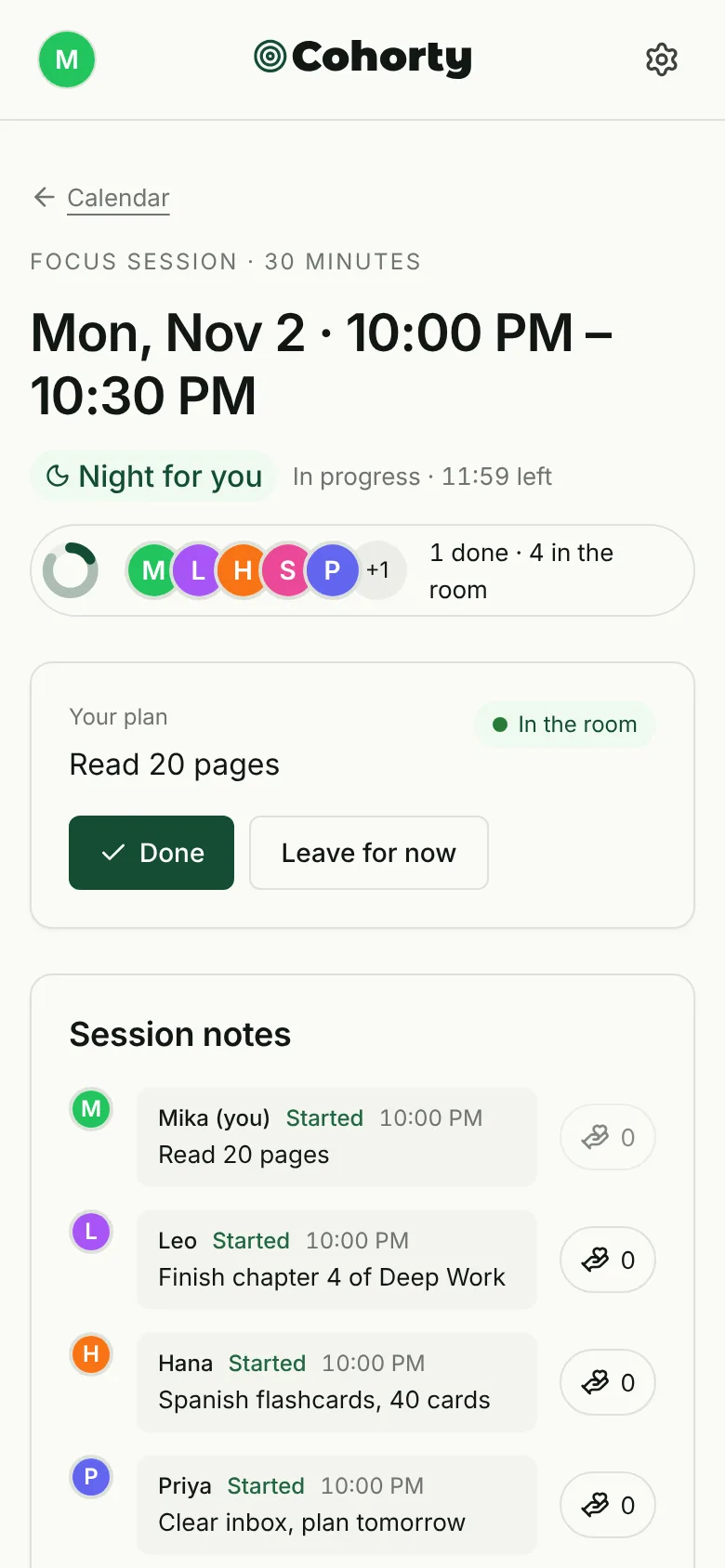
There’s no chat to keep up with and no partner to coordinate with. Everyone who booked the same time shares one room, and after the session each person is listed as Finished, Showed up or Didn’t make it. That last part is the report, and it happens automatically. How Cohorty sessions work walks through each step.
Joining sessions at the daily times is free. If none of the daily times fits, Cohorty Plus lets you open your own half hour and repeat it weekly.
5. Keep a private log with a weekly review
How it works: Record each attempt yourself, in a notebook or an app, and review it once a week: what worked, what got in the way, what you’ll change.
Good for: reflective people, and habits where the main risk is drifting without noticing.
Weak spot: no one else sees it, so it relies entirely on you keeping the log. Pair it with one of the options above if it starts slipping.
How to choose in one minute
| If your main problem is… | Try |
|---|---|
| Forgetting, or losing track of how often you do it | 1. Visible tracking |
| A big goal with a deadline | 2. Stakes |
| Feeling alone with the habit | 3. A community |
| Actually sitting down to start | 4. Sessions at a set time |
| Not noticing why it keeps slipping | 5. A weekly review |
You can combine them. A common pairing is a set-time session for starting, and a weekly review for adjusting.
If you still want a partner
Some people do best with one person who knows them. If that’s you, these will help you keep a partnership going:
- Our check-in templates for daily, weekly and missed-day messages.
- How to set up an online accountability partner once you’ve found one.
- A comparison of accountability apps by type, including partner and group options.
Common questions
Can you be accountable to yourself?
Partly. A private log and a weekly review help, but most people find it easier when something outside them can see the commitment. That something can be a group, a public tracker or a scheduled session; it doesn’t have to be a partner.
What is the best accountability app if I don’t have a partner?
It depends on what you need. For a visible record, a habit tracker. For starting at a set time, a focus-session app such as Cohorty or a body-doubling service. Our accountability apps comparison sorts ten apps by type.
Is group accountability as effective as a partner?
There is no good evidence that one format beats the other for everyone. What matters is whether the format gives you visibility, a time and a report, and whether you’ll keep using it.
Does accountability work if the other people are strangers?
It can. In a set-time session, what helps is that people expect you at that time and see whether you finished, not that they know you personally. Many people find strangers easier, because a missed day carries less social weight.