Best Habit Apps for Introverts (No Social Pressure)
Habit apps for introverts: accountability without comments, cheerleading, or video. Compare quiet options and pick one that does not drain you.
You downloaded a habit app. It’s working—you’re logging workouts, tracking reading, building streaks.
Then the notifications start:
“Sarah commented on your workout! 💪"
"5 people are cheering you on!"
"Reply to Mark’s励まし!”
Your stomach sinks. Now you owe responses. You need to comment back. You have to perform enthusiasm you don’t feel.
What started as accountability becomes social obligation. So you stop logging. You avoid the app. The habit dies.
If this sounds familiar, you’re not broken. You’re just an introvert using an extrovert’s tool.
Most habit apps are designed for people who are energized by social interaction. But introverts need a different model: presence without performance. Accountability without forced cheerleading.
This guide will show you the best habit apps for introverts—and the one psychological principle that makes them work.
What You’ll Learn
- Why most habit apps exhaust introverts (and why that’s not your fault)
- The 7 best habit apps with zero social pressure
- How to get accountability without comment threads
- The difference between “being seen” and “being social”
- Why Cohorty’s model is built specifically for introverts
Why Most Habit Apps Don’t Work for Introverts
The Social Exhaustion Problem
Extroverts: Energized by interaction. Comments, likes, and group chats feel motivating.
Introverts: Drained by interaction. Comments feel like obligations. Group chats feel exhausting.
A 2018 study from the Journal of Personality found that introverts experience social interaction as cognitively taxing—even positive interactions. Every comment you write, every response you owe, drains your mental energy.
The Trap: You download a habit app for accountability. You get social performance anxiety instead.
The Comment Thread Cycle
Day 1: You post “Did my workout! 💪“
Day 2: 5 people comment “Great job!” “You got this!” “Keep it up!”
Day 3: You feel obligated to respond to all 5
Day 4: You skip the workout. Now you feel guilty posting anything (it would be “admitting failure”)
Day 5: You avoid the app entirely
Day 6: Habit dies
Sound familiar?
The “Forced Enthusiasm” Problem
Most habit apps have this dynamic:
- Share a win → Expected to be excited, grateful, emoji-heavy
- Share a struggle → Expected to accept cheerleading, say “thanks so much!”
- Skip a day → Expected to explain why, reassure everyone you’re okay
For introverts, this feels performative. You’re not sharing progress—you’re managing other people’s emotional responses.
A 2020 study on social media and introversion found that introverts who felt pressure to respond to comments experienced 3x higher stress than those using passive social features (likes only, no comment obligation).
The Privacy Discomfort
Many habit apps are public by default:
- Your streak is visible to “friends”
- Your daily logs show up in a feed
- Your goals are searchable by others
For introverts, this feels invasive. You want accountability, not an audience.
What Introverts Actually Need
Research shows habit trackers can be highly effective, but the right type matters.
The 5 Principles of Introvert-Friendly Accountability
1. Presence Without Conversation
You want to feel seen (“someone knows I’m doing this”), but you don’t want to chat about it.
Example: Seeing “5 people checked in today” is motivating. Being asked “How was your workout? Tell us more!” is draining.
2. Asynchronous, Not Real-Time
You check in when it’s convenient—not when someone messages you demanding an immediate response.
3. Opt-In, Not Forced
Social features should be optional. Some days you want to send a heart button. Other days you just want to log and close the app.
4. Low Visibility
Your cohort sees that you checked in, but they don’t see your journal entry, your weight, your personal details—unless you choose to share.
5. No Explanation Required
Missed a day? You don’t owe anyone a reason. Just resume tomorrow.
The 7 Best Habit Apps for Introverts
1. Streaks (Best for Pure Solo Tracking)
What It Is: Minimalist habit tracker. You create habits, check them off daily. That’s it. Zero social features.
Why It’s Introvert-Friendly:
✅ Completely solo: No one sees your data, ever
✅ Clean interface: No feeds, no notifications about other people
✅ Offline-first: Works without internet, no cloud social features
✅ Simple: 6 habits max (forces focus, not overwhelm)
Best For:
- People who want zero social interaction
- Minimalists who find complex apps draining
- Anyone who’s tried social accountability and hated it
Pricing: $4.99 one-time (iOS only)
The Catch: No accountability at all. It’s 100% on you. If you thrive solo, this is perfect. If you need external motivation, skip it.
2. Done (Best for Visual Motivation Without Social)
What It Is: Habit tracker with beautiful charts, streaks, and stats. No social features, just data.
Why It’s Introvert-Friendly:
✅ No social component: Your data is yours alone
✅ Visual progress: Graphs and streaks are motivating without requiring interaction
✅ Customizable: Track any habit, any frequency
✅ Reminders: Phone notifications (not social pressure)
Best For:
- Data-driven introverts who love stats
- People motivated by visual progress (not social praise)
- Anyone who wants flexibility without social noise
Pricing: Free with in-app purchases
The Catch: Like Streaks, it’s solo. If you need some level of accountability, pair this with a weekly check-in with one friend.
3. Way of Life (Best for Binary Tracking)
What It Is: Simple yes/no habit tracker. Did you do it? Green (yes) or red (no). Track patterns over time.
Why It’s Introvert-Friendly:
✅ Binary simplicity: No journaling, no explaining—just yes or no
✅ Solo by default: No social features unless you enable them
✅ Pattern recognition: Shows trends (you missed workouts every Monday—why?)
✅ No pressure: Red days are data, not failures
Best For:
- People who want simplicity (no bells and whistles)
- Introverts who overthink journaling (“what should I write?”)
- Anyone tracking multiple habits simultaneously
Pricing: Free (limited habits), $4.99 for unlimited
4. Habitica (Best for Gamification Without Social Pressure)
What It Is: RPG-style habit tracker. Complete habits = XP, gold, level up your avatar. Optional guilds (groups), but you can play solo.
Why It’s Introvert-Friendly (If Used Correctly):
✅ Play solo: You can completely ignore guilds and parties
✅ Game mechanics replace social pressure: You’re motivated by leveling up, not comments
✅ Asynchronous: Check in whenever, no real-time demands
✅ Opt-in social: Guilds exist, but you’re never forced to join
Best For:
- Gamers and RPG fans
- Introverts motivated by systems/rewards (not social praise)
- People who want optional social features (but not required)
Pricing: Free, with optional subscription for cosmetic features
The Catch: Guilds can be chatty. If you join one, mute notifications or stay solo. The game is fully playable without social features.
Some love gamification, others find it distracting—see user data.
Apple Watch tracking can be private and convenient—see 5 best apps.
Pro Tip: Create a private party with one friend (not a guild). You get light accountability without public performance.
5. Loop Habit Tracker (Best for Open-Source, Privacy-First)
What It Is: Open-source Android habit tracker. Completely private, no cloud sync, no social features, no data collection.
Why It’s Introvert-Friendly:
✅ Zero social: No users, no accounts, no feeds
✅ Privacy-first: Your data never leaves your device
✅ Clean interface: Minimalist design, no distractions
✅ Free forever: Open-source, no premium tiers
Best For:
- Privacy-conscious introverts
- Android users who want simplicity
- Anyone burned by apps that sold their data
Pricing: Free (open-source)
The Catch: Android only. No iOS version.
6. Strides (Best for Flexible Tracking + Optional Sharing)
What It Is: Habit and goal tracker with tons of customization. Social features exist but are deeply optional.
Why It’s Introvert-Friendly:
✅ Default solo: No social features unless you explicitly enable them
✅ Flexible tracking: Daily, weekly, custom frequencies
✅ Charts and insights: Data-driven motivation (not social)
✅ Reminders: Phone notifications, not social pressure
Best For:
- Introverts who want powerful features without social noise
- People tracking complex goals (not just simple habits)
- Anyone who likes customization
Pricing: Free (limited trackers), $4.99/month or $29.99/year for unlimited
7. Cohorty (Best for Company Without Conversation)
Disclosure: Cohorty publishes this journal, so we have a commercial interest in it.
What it is: You book a 30-minute session at one of a few fixed times each day and do your habit alongside everyone who booked the same time, in one shared room. You write one line about what you will do, do it, and leave one line about how it went. No video, no chat; everyone uses a nickname.
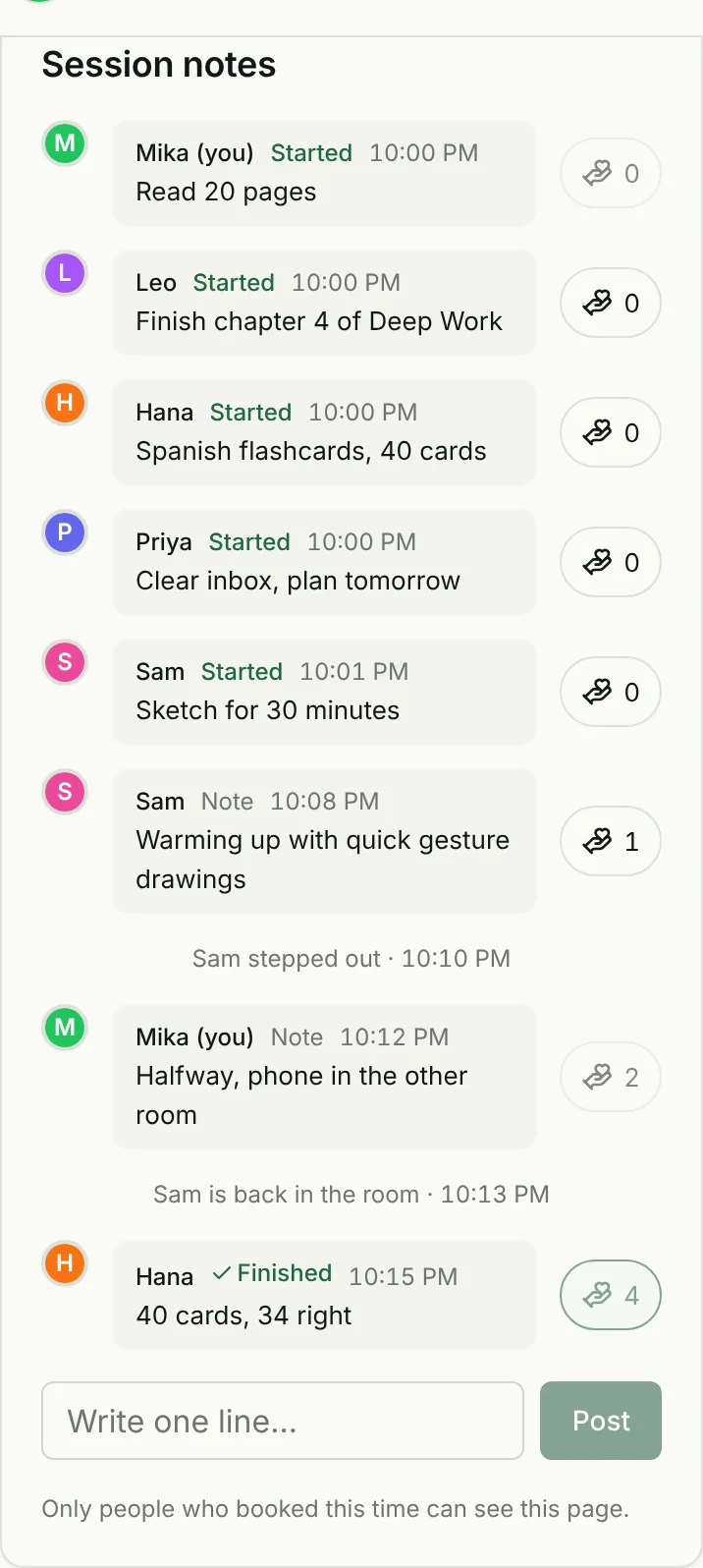
Why it fits introverts:
- No camera and no chat: you never have to speak or perform
- Nicknames only; people see your nickname, your one-line plan, and your notes
- Quiet applause is one tap and never expects a reply
- You can hide or report anyone, and you will not share a room with them again
Limitations:
- Sessions run at a few set times each day unless you open your own with Plus
- The community is still small, so some times have few people (you can still start on your own)
- It is built around sessions, not detailed logging: pair it with a tracker if you want charts of weight, pages, or reps
- Runs in the browser on desktop and phone
Pricing: Joining sessions is free. Plus is $3/month and lets you open your own times at any half hour and repeat bookings on the days you choose.
Best for: Introverts who want other people around while they work, without talking to anyone.
Comparison Table: Social Pressure Level
| App | Social Pressure | Accountability Source | Best For |
|---|---|---|---|
| Cohorty | Very Low | Shared room at a booked time; optional notes and applause | Introverts who want light accountability |
| Streaks | None | Self only | Pure solo trackers |
| Done | None | Self + data visualization | Data-driven introverts |
| Way of Life | None | Self + pattern recognition | Minimalists |
| Habitica | Low (if solo) | Game mechanics (or optional guild) | Gamers, RPG fans |
| Loop | None | Self only | Privacy-first users |
| Strides | None (default) | Self + optional sharing | Customization lovers |
Compare group accountability vs solo tracking to decide which fits your style.
For Comparison (Apps to AVOID as an Introvert):
| App | Social Pressure | Why Introverts Struggle |
|---|---|---|
| Strava | Very High | Public leaderboards, comment threads, kudos expectations |
| MyFitnessPal | High | Community features, public diaries, friend feeds |
| Noom | Medium-High | Group coaching, daily check-ins with coach and group |
| Fabulous | Medium | Journey-sharing, community challenges with comments |
The Science: Why “Quiet Accountability” Works for Introverts
The Hawthorne Effect (Being Observed Changes Behavior)
The Study: In the 1920s, researchers found that factory workers improved productivity simply because they knew they were being observed—not because of any intervention.
For Introverts: You don’t need someone to cheer you on or coach you. You just need someone to know you’re doing the thing. The awareness of being observed is enough.
A 2019 study published in Psychological Science found that introverts responded just as strongly to passive observation as extroverts did to active encouragement.
Translation: Seeing “5 people checked in today” motivates introverts as much as “5 people commented ‘Great job!’” motivates extroverts—but without the social cost.
Related: The Psychology of Accountability: Why ‘Being Watched’ Actually Works
Social Presence vs Social Interaction
Social Presence: Knowing others are doing the same thing (parallel activity)
Social Interaction: Talking, commenting, responding (active engagement)
What research supports: the presence of others can change how we work. A meta-analysis by Bond and Titus found that others’ presence tends to speed up simple, well-practiced tasks. We haven’t found good studies comparing introverts and extroverts under silent presence versus discussion, so treat claims of exact percentages with caution.
Cohorty’s Design Philosophy: We maximize social presence (you see who’s in the room and who finished) while minimizing social interaction (no chat, no forced comments).
The Spotlight Effect (You’re Not Being Judged)
Introverts often avoid social accountability because they fear judgment. But here’s the truth: people aren’t paying that much attention to you.
The Spotlight Effect (Gilovich, Medvec and Savitsky, 2000): We overestimate how much others notice us. In one study, students wearing an embarrassing T-shirt guessed that about half the room noticed it; in fact, only about a quarter did.
For Habit Apps: You think everyone’s judging your missed days. In reality, most people barely notice—they’re focused on their own habits.
Cohorty’s Advantage: Even if people notice, there’s no comment thread where someone might ask “What happened?” You just resume the next day.
How to Use Social Apps as an Introvert (If You Must)
Sometimes you’re stuck with a social-heavy app (work challenge, friend group, etc.). Here’s how to survive:
If video calls are the part you dread, compare camera-free Focusmate alternatives before ruling out working alongside others.
Strategy 1: Mute Aggressively
What to Mute:
- Push notifications for comments/likes
- Email notifications for social activity
- In-app feeds (if possible)
Check in on your terms: Open the app once a day, log your habit, close it. Don’t let it ping you 20 times.
Strategy 2: Set Boundaries
Script for Well-Meaning Friends:
“Hey, I appreciate the encouragement, but I’m doing a low-key accountability style this month—just tracking privately. I’ll let you know if I want feedback!”
Most people will respect this. If they don’t, that’s their issue.
Strategy 3: Use “View Only” Mode
Some apps let you see others’ progress without posting your own. Use this to get the social presence benefit without the performance obligation.
Strategy 4: Create a Private Group
Instead of joining a public challenge, create a private group with 1-2 introverted friends. Set the rule upfront: “We’re just checking in, no comments required.”
For group accountability, try introvert-friendly options with no small talk.
Build habits with friend accountability apps.
Strategy 5: Turn Off Public Sharing
Most apps have privacy settings. Switch from “public” to “friends only” or “private.” You’ll still get streak tracking and stats without an audience.
Why Cohorty Works for Introverts
Full disclosure: Cohorty is our product. It is designed around presence rather than interaction.
1. No camera, no chat. Nothing to tidy, nothing to perform. Your browser is enough.
2. Nicknames only. People see your nickname, your plan, and your notes. That is all.
3. One shared room. Everyone who booked the time is there with you, each doing their own thing.
4. Quiet applause. One tap when someone finishes. No feed, no likes, no leaderboard.
5. Private notes. Session notes are visible only to the people in your room, and your data is never sold.
FAQ: Habit Apps for Introverts
Q: Can introverts benefit from accountability at all?
A: Yes! Introverts need accountability just as much as extroverts—they just need a different kind. Passive observation (Hawthorne Effect) works just as well as active cheerleading, without the social cost.
Q: What if I’m shy, not introverted? Are these apps still good?
A: Yes. Shyness (social anxiety) and introversion (energy drain from interaction) are different, but both benefit from low-pressure accountability. These apps work for both.
Q: Is it okay to never interact with the group?
A: Absolutely. In a Cohorty session, for example, you can book, enter the room and tap Done without applauding anyone or writing a note. That’s by design.
Q: What if I feel guilty for not cheering others on?
A: That’s your people-pleasing instinct, not a requirement. The whole point is removing that guilt. If others want cheerleading, they can find extrovert-friendly apps. These spaces are for quiet accountability.
Q: Can I be an introvert and still want some social interaction?
A: Yes! Introversion is a spectrum. That’s why optional features (like Cohorty’s applause button or Habitica’s guilds) are great—you use them when you have the energy, skip them when you don’t.
Q: What if my friend wants to do a habit challenge together but they’re extroverted?
A: Set expectations upfront: “I’m doing low-key accountability—just check-ins, no daily texting about it. Cool?” Most friends will understand. If they need more, they can find a second accountability buddy for the social part.
The Bottom Line: What Works for You?
If you want zero social interaction:
- Streaks, Done, Loop Habit Tracker
If you want light accountability without social exhaustion:
- Cohorty (booked sessions with others, minimal interaction)
If you want gamification without social noise:
- Habitica (play solo, ignore guilds)
If you want flexibility and control:
- Strides (everything’s optional)
If you’re not sure yet:
- Book a few free Cohorty sessions. If even that feels like too much, switch to a solo tracker.
Ready to Build Habits Without Social Exhaustion?
Pick one app from this list and use it for two weeks before judging it. The right tool is the one you keep opening without dread.
One way to start today: book a 30-minute Cohorty session at a fixed time and do your habit alongside other people doing their own habit. No camera, no chat, nicknames only. Joining sessions is free.
Related Reading: