How to Build Habits When You Have No Motivation
Motivation comes and goes, so don't build on it. Seven ways to keep a habit going on low days: tiny versions, set times, cues, other people and easy restarts.
You know the habit would help. You even want to want it. But when the moment comes, there’s nothing there: no energy, no drive, just a strong preference for the sofa.
That’s normal. Motivation is a feeling, and like all feelings it rises and falls. If a habit only happens when you feel motivated, it will happen on good days and disappear on the rest.
The trick is to build habits that don’t need motivation to start. Here are seven ways to do that.
Note: if a lack of motivation lasts for weeks, comes with low mood, or affects most areas of life, it can be a sign of depression or another health issue. Please talk to a doctor.
Why “getting motivated” doesn’t work
(For the wider debate, see motivation vs discipline.)
Most advice tries to increase motivation: find your why, visualize the result, watch an inspiring video. These can help for a day. But motivation is least available exactly when you need it: when you’re tired, stressed or busy.
Habits work the other way round. Once a behavior is automatic, it happens with little motivation at all. The goal is to get from “requires effort” to “just what I do,” and to make the effortful phase as easy as possible.
1. Make the habit tiny
The less a habit asks, the less motivation it needs. Shrink it to a version you could do on your worst day:
- Not “work out,” but “put on workout clothes.”
- Not “meditate 20 minutes,” but “three slow breaths.”
- Not “read a chapter,” but “read one page.”
Often you’ll do more once you’ve started. But the deal is that the tiny version counts. See the two-minute rule.
2. Decide when and where in advance
“I’ll exercise sometime this week” relies on motivation showing up. “I’ll walk after lunch on Monday, Wednesday and Friday” doesn’t. Making the decision ahead of time, as a specific plan, is one of the best-supported techniques in behavior research. It’s called an implementation intention.
Write it as: “When [situation], I will [habit].“
3. Attach it to something you already do
An existing routine is a cue that doesn’t depend on motivation. After coffee, after brushing teeth, after closing the laptop. Put the new habit directly after it. See habit stacking examples for ideas.
4. Remove friction from starting
Low motivation plus a hassle equals skipping. Remove the hassle:
- Running shoes by the door, clothes laid out.
- The book on the pillow, the yoga mat already unrolled.
- The healthy snack at eye level, the sweets in a high cupboard.
Every step you remove between you and the habit makes it less dependent on how you feel.
5. Do it with other people
Other people are one of the most reliable substitutes for motivation. When someone else is starting at the same time, starting feels like the default.
- A friend who walks with you on set days.
- A class that starts at a fixed time.
- An accountability partner who expects a quick message.
- A shared session where others do their own habits alongside you.
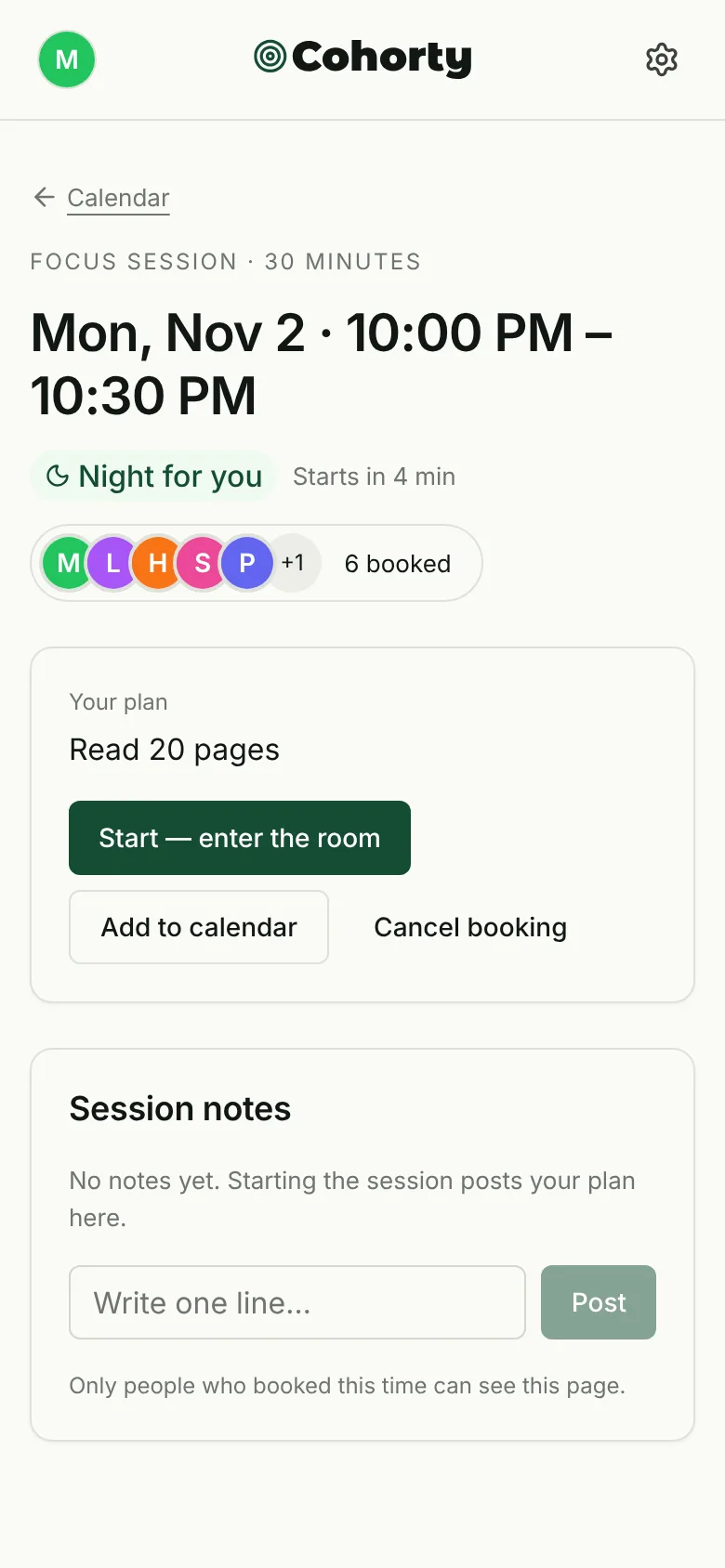
Disclosure: Cohorty publishes this journal. Cohorty lets you book a 30-minute session for your habit and do it alongside whoever booked the same time, with no camera or chat. If you don’t make it, nothing resets. See how to use Cohorty.
6. Count showing up
On low days, aim to show up, not to perform. Ten minutes of a 30-minute workout, one page instead of a chapter, a walk around the block instead of a run. Showing up keeps the habit’s cue and routine alive, which matters more for long-term habit formation than any single session’s quality.
7. Make missing a day cheap
You’ll miss days. Research following people forming new habits found that missing a single day didn’t meaningfully set back the process. What does the damage is the “I’ve ruined it” reaction that turns one miss into a month.
- Follow the never-miss-twice rule.
- Don’t make up for missed days. Just do the next one.
- If streak counters make you quit after a miss, use a tracker without streaks.
A plan for your next habit
| Question | Your answer |
|---|---|
| The habit | Walk |
| Tiny version | Shoes on and out the door for five minutes |
| When and where | After lunch, Mon/Wed/Fri, around the block |
| Cue | Closing the lunch container |
| Friction removed | Shoes and jacket by the desk |
| With others | A colleague on Wednesdays |
| After a miss | Walk at the next planned time, no catching up |
Common questions
How do I build habits when I have no motivation?
Don’t rely on motivation. Make the habit tiny, give it a set time and cue, remove friction, involve other people and treat missed days as normal.
Is discipline better than motivation?
“Discipline” is often less about willpower and more about structure: set times, small steps and environments that make the habit the easy choice.
How long until a habit doesn’t need motivation?
It varies a lot by person and habit. Many habits take a couple of months of regular repetition to feel automatic. See how long it takes to form a habit.
What if I have no motivation for anything?
If it lasts for weeks or affects much of your life, talk to a doctor. Persistent loss of motivation can be a symptom of depression or other conditions that are treatable.