Social Media Sunset: No Scrolling After 8 PM
Build a social media sunset habit that protects your sleep and evening peace. Science-backed strategies to stop nighttime scrolling and reclaim your evenings.
It’s 10:47 PM. You were supposed to be asleep an hour ago. Instead, you’re still scrolling—TikTok, Instagram, Twitter, Reddit. “Just one more minute,” you tell yourself. Again.
Sound familiar?
Scrolling in bed is common, and many people notice they fall asleep later on nights they do it. Understanding how to break bad habits helps you replace evening scrolling with better alternatives, and our guide to how to stop scrolling covers daytime triggers too. Mornings matter as much as nights; see phone-free mornings.
Even a few extra minutes awake every night adds up over weeks.
The social media sunset habit addresses this by creating a hard stop: no social media after 8 PM. Not “use less.” Not “be mindful.” Complete social media darkness from 8 PM until morning.
What You’ll Learn
- Why evening scrolling destroys sleep quality (beyond just blue light)
- The neuroscience of late-night social media addiction
- A complete protocol for building social media sunset habits
- How to handle FOMO, boredom, and habit triggers after 8 PM
- Alternatives to scrolling that actually help you wind down
The Sleep Cost of Evening Scrolling
Most people know “screens before bed are bad.” Few understand why—or how bad.
Beyond Blue Light: The Real Mechanisms
1. Circadian Disruption
Screen light can affect melatonin, but the content you scroll may matter as much as the light.
Emotionally engaging content (arguments, news, social comparison) activates your sympathetic nervous system—your “fight or flight” response. This raises cortisol and adrenaline, making sleep physiologically difficult.
Your body interprets late-night scrolling as: “The environment is stimulating and potentially threatening. Stay alert.”
2. Psychological Activation
Social media before bed can leave your mind busy at exactly the wrong time. Many people notice more of the following after late-night scrolling:
- Rumination (replaying interactions)
- Social comparison thoughts
- Negative self-evaluation
- Anxiety about tomorrow
You’re not winding down. You’re winding up.
3. Dopamine Dysregulation
Social media platforms use variable reward schedules, the same mechanism as slot machines. Each scroll might reveal something interesting, so your brain stays in “seeking mode.”
Dr. Anna Lembke, psychiatrist at Stanford and author of Dopamine Nation, writes about how constant, easy rewards can leave us restless when they stop. Late-night scrolling is a version of that pattern: your brain needs time to settle after the stimulation ends. This connects to dopamine’s role in habit formation, where reward systems drive behavior patterns.
4. Shorter Nights
Even when you do fall asleep after scrolling, it’s easy to stay up later than planned, which shortens the night you actually get.
You get less restorative sleep from the same time in bed.
The 8 PM Hard Stop Protocol
Here’s the systematic approach to eliminating evening social media use.
Phase 1: Environment Design (Do This First)
Step 1: Create a Phone Sunset Ritual
At exactly 8:00 PM every evening, your phone enters “sunset mode”:
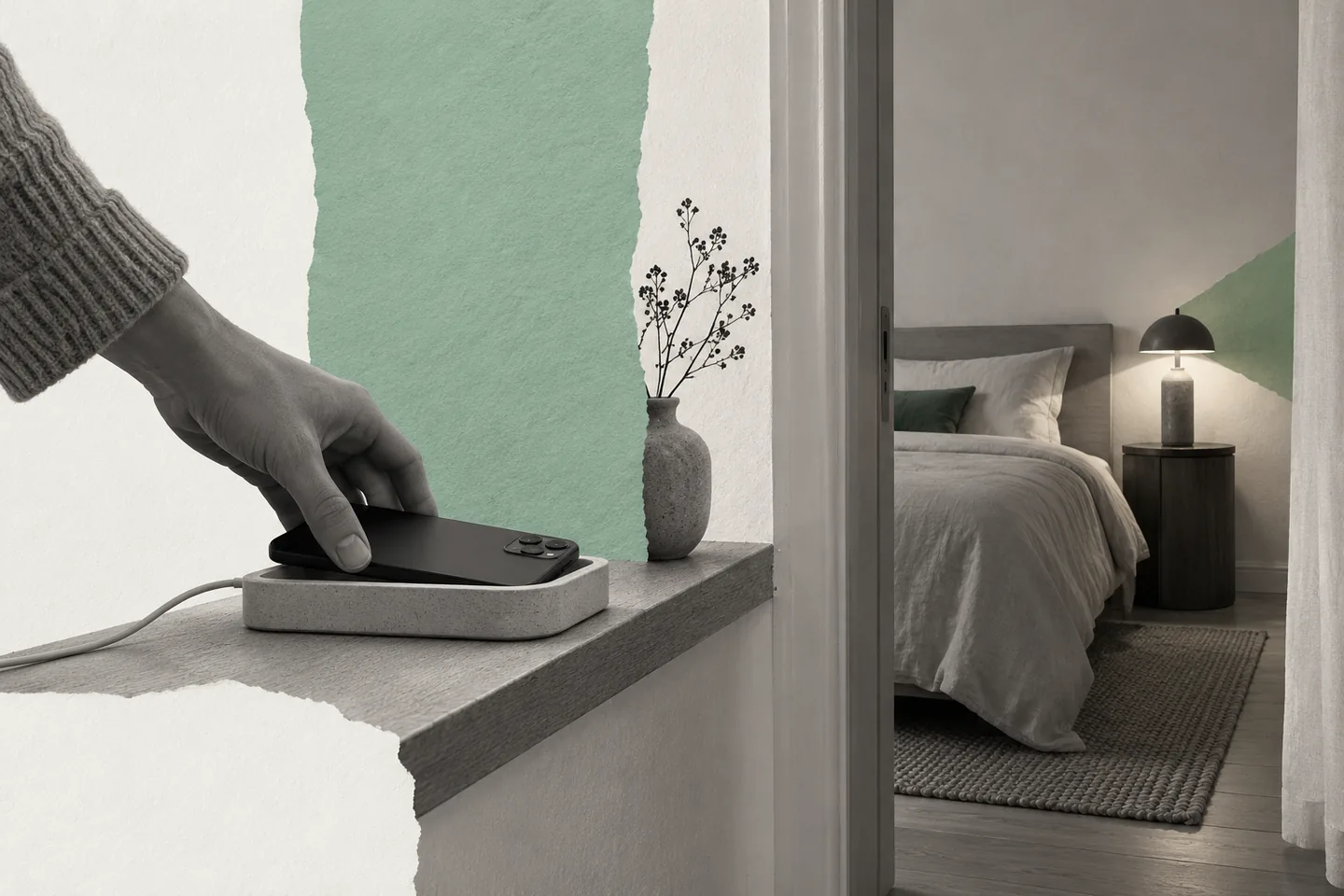
- Place phone in a designated charging station (kitchen, bathroom, home office—anywhere except bedroom)
- Enable Do Not Disturb (allow only phone calls from favorites)
- Delete social apps from phone OR log out completely
- Put phone face-down
This physical ritual signals to your brain: “Digital day is over.” This environmental design aligns with how your physical space shapes your habits, where removing triggers makes behavior change easier.
Step 2: Design Your Evening Space
Your evening environment should make non-phone activities easy and phone activities hard:
Living room/bedroom setup:
- Books within arm’s reach
- Comfortable seating for reading
- Soft lighting (not bright overhead lights)
- Journal and pen on nightstand
- No TV in bedroom if possible
Phone should be:
- Out of sight (not on coffee table)
- Out of reach (different room preferred)
- Out of hearing (silent mode)
Environment design does much of the work. Make the right choice the easy choice.
Step 3: Set Up Technical Barriers
Technology can enforce what willpower can’t:
iOS:
- Settings → Screen Time → App Limits
- Set social apps to 0 minutes from 8 PM - 6 AM
- Require passcode to ignore limit (give passcode to partner/roommate)
Android:
- Digital Wellbeing → App Timers
- Set social apps to block after 8 PM
- Use Focus Mode for evening routine
Alternative: Delete Apps
Most effective option: delete social apps from phone entirely. Access only via desktop browser, which creates natural friction.
Phase 2: The First Week (Expectation Management)
Days 1-3: Peak Discomfort
The first 2-3 evenings will feel weird. Your hand will reach for your phone unconsciously. You’ll feel:
- Boredom
- FOMO (fear of missing out)
- Anxiety about notifications
- Phantom phone vibrations
- Restlessness
This is withdrawal. Your brain is habituated to evening dopamine hits from scrolling. Expect discomfort. It passes.
Days 4-7: Adjustment
By day 4-5, the acute withdrawal eases. You’ll still think about checking, but the compulsion weakens. Key strategies:
Replace, don’t just remove:
- Instead of “don’t scroll,” think “read instead”
- Instead of “stay off Instagram,” think “call a friend”
- Instead of “avoid phone,” think “evening wind-down routine”
Use the 10-minute rule: When the urge to check social media hits, tell yourself: “I’ll wait 10 minutes. If I still want to check after 10 minutes, I can.”
Usually, the urge passes. If it doesn’t, you’ve at least created space between impulse and action.
Phase 3: Building Alternative Evening Routines
The sunset habit works best when paired with an intentional evening routine.
8:00-8:30 PM: Transition Activities
These help you shift from “day mode” to “evening mode”:
- Light cleaning (dishes, tidying)
- Shower or bath
- Change into comfortable clothes
- Prepare tomorrow’s outfit/bag
- Review tomorrow’s calendar
Physical activities with clear start/end points work best. They occupy your hands and mind during the hardest part of the evening (right after the 8 PM cutoff).
8:30-9:30 PM: Wind-Down Activities
Choose 1-2 activities that genuinely relax you (not just “should” relax you):
Reading (physical books/Kindle without internet): Many people find that a few minutes with a paper book is a calmer bridge to sleep than a feed that never ends.
Light stretching or yoga: 10-15 minutes of gentle movement helps discharge physical tension and signals “day is ending.”
Journaling: Brain dump everything on your mind. Reduces nighttime rumination.
Conversation: Talk with partner, roommate, or call friend. Actual human connection—not messaging.
Creative hobbies: Drawing, knitting, puzzles, music. Engaging enough to prevent boredom, not stimulating enough to interfere with sleep.
9:30-10:00 PM: Sleep Preparation
- Final bathroom routine
- Dim lights throughout home
- Set out tomorrow’s essentials
- 5-10 minutes of meditation or breathing exercises
- Lights out by 10:00-10:30 PM
This structure prevents the “what should I do now?” paralysis that leads back to scrolling.
Handling the FOMO Problem
The biggest obstacle to social media sunsets isn’t lack of alternatives—it’s FOMO.
Understanding the FOMO Mechanism
FOMO (fear of missing out) is engineered into social platforms. Every platform uses the same psychological tactics:
Notifications create urgency: “12 people liked your post!”—Your brain interprets this as social validation requiring immediate acknowledgment.
Stories create scarcity: “Available for 24 hours only!”—Creates artificial time pressure.
Continuous feeds create unpredictability: You never know what the next scroll will reveal, so you keep checking.
The anxiety isn’t in you—it’s designed into the systems.
The FOMO Reality Check
Ask yourself: in the last 30 days, what actually important thing happened on social media between 8 PM and morning that you needed to know about immediately?
For 99% of people: nothing.
Social media FOMO is artificial urgency. Nothing on Instagram between 8 PM and 8 AM will materially affect your life. But the sleep deprivation absolutely will.
Reframe the Loss
You’re not “missing out” by avoiding evening social media. You’re opting into:
- Better sleep (worth 2-3 hours of evening activities)
- Deeper relationships (actual conversation vs. scrolling alone)
- Mental peace (no comparison, no drama, no outrage)
- Productive mornings (from better sleep quality)
The question isn’t “what am I missing?” It’s “what am I gaining?”
Progressive Enhancement: Deepening the Habit
Once 8 PM social sunset is solid, you can enhance:
Enhancement 1: Move Sunset Earlier
After 30 days at 8 PM, try 7:30 PM. Or 7:00 PM. The earlier your sunset, the more evening time you reclaim.
Many people eventually settle on “no social media after dinner”—which naturally varies but averages 7-8 PM.
Enhancement 2: Weekend Sunsets
If you only do weekday sunsets initially, extend to weekends. Weekends are often when the worst scrolling happens (“I have time to waste”).
Consistent 7-day sunsets create stronger habits and better sleep patterns overall.
Enhancement 3: Full Digital Sunset
Extend beyond social media to all screens:
- 8 PM: Social media off
- 8:30 PM: Email/messaging off
- 9 PM: All screens off (including TV/streaming)
This creates a true digital wind-down that maximizes sleep quality.
Enhancement 4: Social Media Sabbaticals
Try periodic complete breaks:
- One weekend per month: no social media at all
- One week per quarter: full social media detox
- This resets your relationship with platforms and reduces overall dependency
The Sleep Quality Data
After 30 days of consistent social media sunsets, most people report:
Quantitative Changes:
- Fall asleep 15-30 minutes faster
- Wake up fewer times during the night
- Feel more rested upon waking
- Need 15-30 minutes less total sleep (higher quality = more restorative)
Qualitative Changes:
- Less morning grogginess
- Better mood upon waking
- Reduced nighttime anxiety
- More control over evenings
What people commonly report after a few weeks of an 8 PM cutoff:
- Falling asleep sooner
- Feeling more rested
- More energy in the morning
- Less late-night worry
The sleep improvement alone is worth the discomfort of the first week.
How Quiet Accountability Helps
Social media sunset is one of the hardest digital habits to build because:
- The trigger (evening boredom/restlessness) is unavoidable
- The temptation is strongest when you’re alone
- Traditional accountability (texting someone) requires your phone—defeating the purpose
The Cohort Model for Evening Boundaries
When you join a digital detox challenge focused on evening boundaries, you check in BEFORE the social media sunset begins.
Daily Check-In (around 7:30-7:45 PM):
- “Tonight’s plan: Social media sunset at 8 PM”
- See 5-10 other people posting the same commitment
- Feel the collective momentum
Next Morning Check-In (optional):
- “Last night: Sunset successful” or “Last night: broke at 9:30 PM”
- No judgment, just data
- Send hearts to others’ check-ins
Why This Works:
Precommitment: Posting your intention before 8 PM creates cognitive dissonance if you break it. Your brain remembers: “I told my cohort I’d do this.”
Shared Struggle: Seeing others also commit normalizes the difficulty. You’re not alone in finding this hard.
Visible Progress: After 7 days of check-ins, you see your streak. Breaking it feels like losing momentum, which helps resist temptation.
Gentle Presence: You’re not texting people at 9 PM saying “help, I want to scroll.” You’re simply knowing others are also keeping evening boundaries right now.
It’s accountability without intrusion—perfect for evening routines.
Common Obstacles and Solutions
Obstacle 1: “I use social media to wind down—it relaxes me”
Solution: It doesn’t, actually. You habituate to it, which feels like relaxation, but physiological data shows increased arousal, not relaxation. Try reading or gentle stretching for 7 days and compare how you actually feel.
Obstacle 2: “I’ll miss important messages from friends”
Solution: Text/messaging is different from social media scrolling. If you need to check messages, do that separately—open texts, respond, close app. Don’t scroll feeds.
Obstacle 3: “My partner scrolls next to me in bed—it’s too tempting”
Solution: Either request they stop (for their own sleep health), or create physical separation (read in another room while they scroll). Their poor sleep habits don’t obligate you to share them.
Obstacle 4: “I already broke my sunset tonight, so I might as well keep scrolling”
Solution: No. Put the phone down NOW. The habit isn’t “never break the rule.” It’s “return to the rule as quickly as possible after breaking it.” Immediate recovery prevents one slip from becoming a full relapse.
Obstacle 5: “I work on social media—I need to check analytics/respond to comments”
Solution: Distinguish professional use from personal scrolling. If you must check for work:
- Set specific time limit (10 minutes)
- Check only your business accounts/pages
- Use browser, not apps (more friction)
- Timer to enforce time limit
- No feed scrolling
Key Takeaways
1. Evening Social Media Destroys Sleep
Not just from light, but from stimulating content that keeps your mind active. Putting screens away well before bed is a widely recommended part of good sleep habits.
2. 8 PM Is the Optimal Sunset Time
Late enough to feel reasonable, early enough to reclaim your evening and protect sleep. Start here, then adjust based on your schedule.
3. Environment Design Enables Success
Phone in another room, apps deleted or logged out, Do Not Disturb enabled. Make scrolling hard, make alternatives easy.
4. FOMO Is Engineered, Not Real
Nothing on social media between 8 PM and morning matters. But your sleep absolutely does. Reframe the “loss.”
5. Replace with Intentional Wind-Down
Don’t just avoid scrolling—build an evening routine you actually enjoy. Reading, conversation, hobbies, preparation for tomorrow.
Ready to Reclaim Your Evenings?
You now have the complete protocol for social media sunsets. But the first week is hard—and that’s when most people quit.
Replace the scroll with a session: book an evening Cohorty session before your 8 PM sunset and spend thirty minutes on reading, stretching, or tomorrow’s prep alongside other people. No feed, no camera, no chat.
Frequently Asked Questions
Q: Does this include YouTube/Netflix, or just social media platforms?
A: Start with social media (Instagram, TikTok, Twitter, Facebook). These are the platforms optimized for endless scrolling and FOMO. YouTube and Netflix are more “active choice” platforms—you choose specific content rather than infinite feed. That said, many people eventually extend sunset rules to all screens for maximum sleep benefit.
Q: What if I work evening shifts and 8 PM is too early?
A: Adjust to “90 minutes before intended sleep time.” If you sleep at 2 AM, your sunset is 12:30 AM. The principle (no social media in your pre-sleep wind-down) stays the same.
Q: Can I check social media once quickly after 8 PM?
A: “Once quickly” never stays quick. Opening the app creates the dopamine trigger, which makes closing it nearly impossible. Better to completely avoid than to try to control duration once you’re already scrolling.
Q: What about using Instagram/TikTok for recipes or tutorial videos?A: If you need specific information (a recipe, a tutorial), search for it on your computer browser during daytime hours and save it. Don’t use “I need to find a recipe” as justification for opening scrolling apps after 8 PM. Be honest with yourself about whether it’s information-seeking or procrastination.
Q: How do I handle the 8-10 PM boredom without scrolling?
A: Pre-decide your evening activities. The boredom comes from decision fatigue, not from lack of options. Have 3-5 pre-selected activities ready (specific book, specific puzzle, specific show to watch with partner, specific craft project). Remove the “what should I do?” friction.