Gym Habit: How to Actually Go 3 Times a Week
A realistic plan for a three-days-a-week gym habit: fixed days and times, a packed bag, a simple program, a minimum workout for bad days, and people to go with.
Three gym sessions a week is a goal almost everyone can manage on paper. In practice, many people start strong in January, go five times in the first week, and are down to zero by March.
The difference between people who keep going and people who stop usually isn’t motivation or fitness. It’s a few practical decisions that make going to the gym the default instead of a choice you make each day.
Note: if you have a health condition or haven’t exercised in a long time, check with a doctor before starting a new program.
Why three days works
Public health guidelines, such as those from the World Health Organization, recommend that adults get at least 150 minutes of moderate activity a week and do muscle-strengthening activity on two or more days. Three gym sessions, with some walking on other days, covers that for most people.
Three days is also a good habit target: often enough to become routine, with rest days in between for recovery and the rest of life.
1. Pick fixed days and times
For the general principles behind any exercise routine, see how to make exercise a habit; if early mornings suit you, see morning workouts.
“Three times a week” is vague, so every day becomes a decision: today or tomorrow? Decisions are where habits fail.
- Choose specific days, ideally with a day between: Monday, Wednesday, Friday, or Tuesday, Thursday, Saturday.
- Choose a specific time, and put it in your calendar as a recurring event.
- Make it a time you can protect: before work, at lunch, or straight after work before you go home.
Write it as a plan: “On Monday, Wednesday and Friday at 7:00 AM, I go to the gym.” That kind of specific if-then plan is much more likely to happen than a general intention.
2. Remove the friction
Every small obstacle is a reason to skip.
- Pack the bag the night before and put it by the door or in the car.
- Choose a gym on your route, between home and work if possible. Distance kills gym habits.
- Sleep in your workout clothes for early sessions, or lay them out.
- Have a go-to pre-workout snack you don’t have to think about.
3. Follow a simple program
Not knowing what to do when you get there is a surprisingly common reason to skip. Use a simple, repeatable plan instead of improvising.
A basic full-body routine (each session):
| Exercise | Sets × reps |
|---|---|
| Squat or leg press | 3 × 8–12 |
| Push-up or bench press | 3 × 8–12 |
| Row (cable or dumbbell) | 3 × 8–12 |
| Hip hinge (deadlift variation or hip thrust) | 3 × 8–12 |
| Plank | 3 × 20–40 seconds |
Start with weights that feel moderate and focus on good form. A trainer can check technique in a session or two. Increase weight slowly as exercises get easier.
4. Have a minimum workout
Some days you won’t want to go. Decide now what the minimum is: “I’ll go and do 15 minutes.” Usually you’ll do more once you’re there. If not, 15 minutes still counts, and the habit of going stays intact.
This is the two-minute rule applied to the gym: the goal is to show up.
5. Go with someone, or check in with someone
Worried people are watching? They’re probably not; see the spotlight effect. Prefer training at home? See home gym setup.
Other people are one of the strongest supports for exercise habits.
- A gym buddy with the same days and times. See where to find a workout accountability partner.
- A class at a fixed time, where people expect to see you.
- A quick check-in with a friend: “Done ✅” after each session.
For home workouts, a shared session works too.
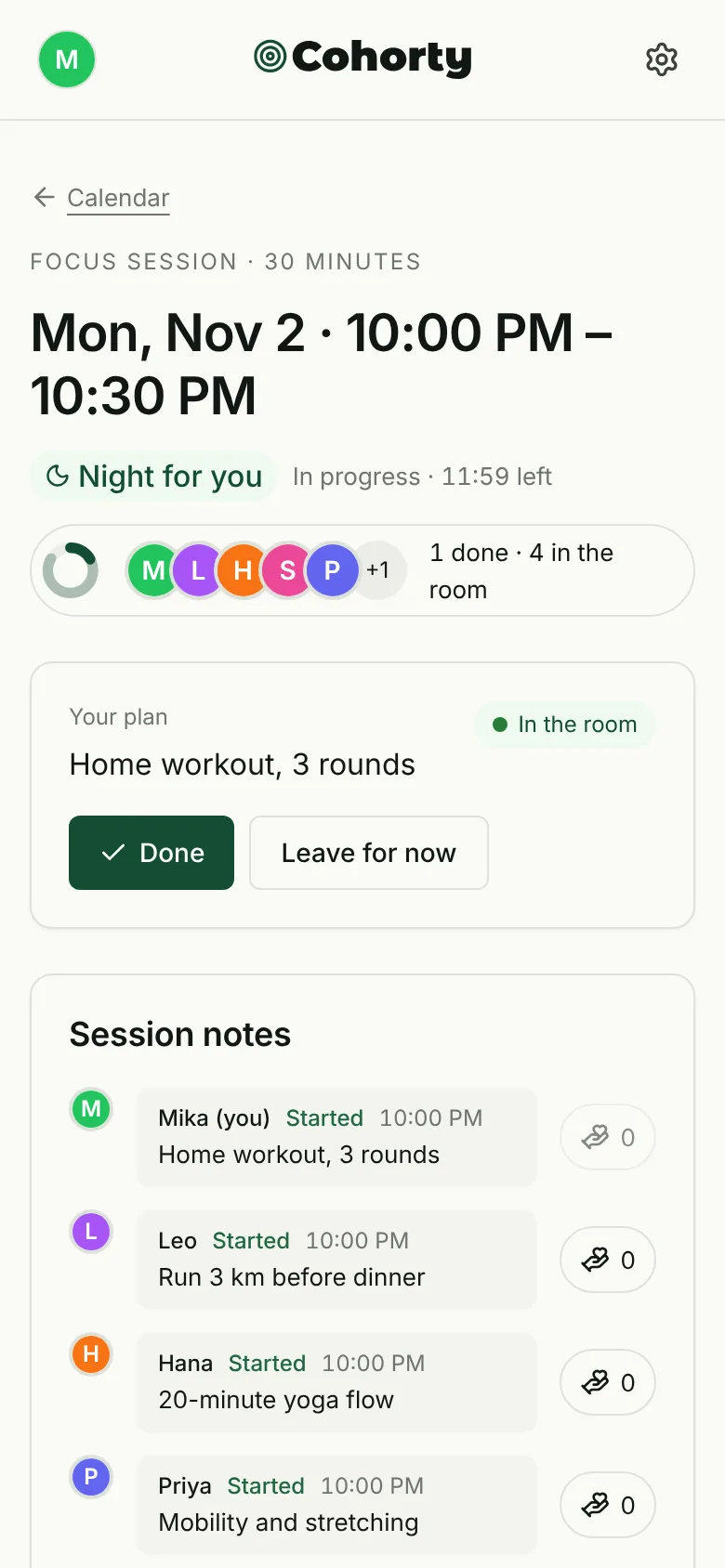
Disclosure: Cohorty publishes this journal. For home workouts or rest-day stretching, Cohorty lets you book a 30-minute session and do it alongside others at the same time, with no camera. See how to use Cohorty.
6. Track sessions, not perfection
Over time, seeing the sessions add up helps you think of yourself as someone who trains; see identity-based habits.
- Mark each session on a calendar or app. Three marks a week is the goal.
- Look at the month: 10 sessions in a month is a solid habit, even if some weeks had two.
- Note what you lifted, so you can see progress. Seeing strength improve is one of the best motivators after the first few weeks.
7. Plan for missed sessions
You’ll miss sessions: illness, travel, work. What matters is what happens next.
- Don’t try to make up two sessions in one day. Just go on the next planned day.
- Move, don’t cancel: if Monday fails, go Tuesday.
- Never miss twice in a row; see the never-miss-twice rule.
A four-week starter plan
| Week | Plan |
|---|---|
| 1 | Three sessions, 30 minutes each, light weights, learn the exercises |
| 2 | Same days and times; add a set if it feels easy |
| 3 | Increase weights slightly; keep the minimum workout for bad days |
| 4 | Review: which days were hardest? Move them if needed |
Common questions
How long does it take to make the gym a habit?
It varies, but many people need a couple of months of regular sessions before going feels automatic. Expect the first few weeks to take deliberate effort.
Is it better to go in the morning or evening?
Whichever you’ll keep. Mornings are less likely to be disrupted by work; evenings may suit people who aren’t early risers. Consistency of time matters more than the time itself.
What if I don’t know what to do at the gym?
Follow a simple full-body program like the one above, and consider booking a session or two with a trainer to check form.
How do I stay consistent with the gym when I’m busy?
Fix days and times in your calendar, keep a minimum 15-minute workout for busy days, and choose a gym on your normal route.