How to Make Exercise a Habit (and Keep It Going)
How to make exercise a habit: start smaller than you think, fix a time, pick movement you like, remove friction, train with others and restart fast.
Most people don’t need more information about exercise. They know moving is good for them. What they need is a way to keep doing it after the first enthusiastic week.
This guide is about how to make exercise a habit: small starts, fixed times, movement you actually enjoy, and a plan for the weeks when life gets in the way. It’s the starting point for our health habits guides.
Note: if you have a health condition, are pregnant, or haven’t exercised in a long time, check with a doctor before starting a new routine.
How much exercise is enough?
Public health guidelines, such as those from the World Health Organization, recommend that adults aim for at least 150 minutes of moderate activity a week (or 75 minutes of vigorous activity), plus muscle-strengthening activities on two or more days. Any amount is better than none, and benefits start well below the target.
That means a habit can start very small and still matter.
1. Start smaller than you think
The most common mistake is starting with the plan you’d follow if motivation lasted forever. It doesn’t. Start with a version you could do on a bad day:
- A 10-minute walk after lunch.
- Five push-ups and five squats after brushing your teeth.
- Putting on running shoes and going outside for five minutes.
Make it bigger once it’s automatic, usually after several weeks. See the two-minute rule.
2. Give it a fixed time and cue
“I’ll exercise when I have time” rarely happens. Choose:
- Specific days and a time: “Monday, Wednesday, Friday at 7:00.”
- A cue that already happens: after the school run, before the commute home, after the morning coffee.
Write it as an if-then plan: “When I get home from work on Tuesday, I change and walk for 20 minutes.” See implementation intentions.
3. Choose movement you like
You’ll keep doing what you enjoy, or at least don’t hate. Try a few:
| If you like… | Try |
|---|---|
| Being outside | Walking, running, cycling |
| Clear progress | Strength training at a gym or at home |
| Calm and flexibility | Yoga, stretching |
| A goal to train for | Couch to 5K |
| Company | Classes, team sports, a walking group |
4. Remove friction
Every obstacle before a workout is a reason to skip it.
- Clothes laid out the night before; bag packed by the door.
- A gym on your route, or a home routine that needs no equipment.
- A saved playlist or workout plan, so you don’t decide what to do.
- For mornings, see how to become a morning exerciser.
5. Exercise with others
Other people are one of the strongest supports for exercise habits. A friend who’s expecting you, a class that starts on time, or a group doing the same thing makes skipping harder and starting easier. See how to find a workout accountability partner.
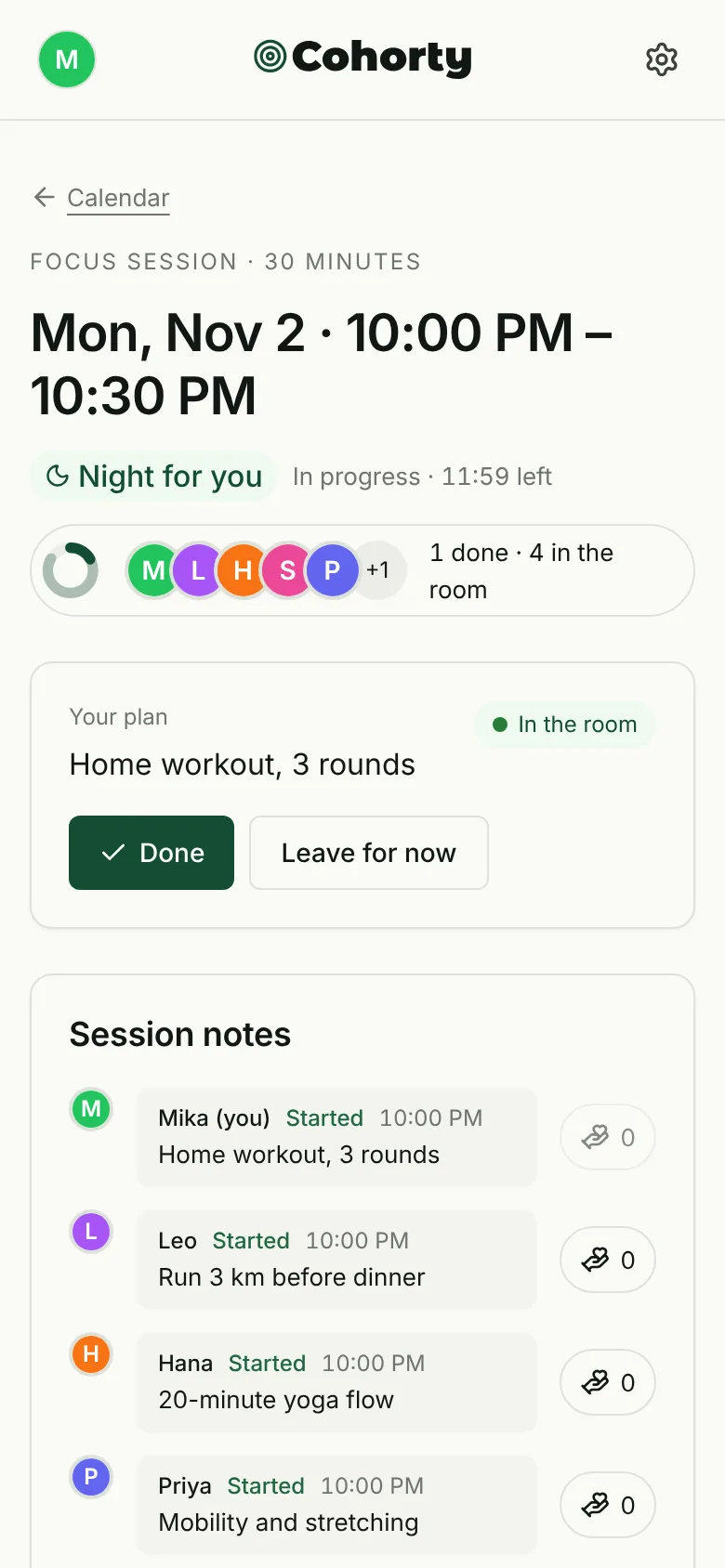
Disclosure: Cohorty publishes this journal. In Cohorty you can book a 30-minute session for a home workout, stretch or walk and do it alongside others at the same time, with no camera or chat. See how to use Cohorty.
6. Track sessions, not perfection
- Mark each session on a calendar or app.
- Look at the week or month: three sessions a week, most weeks, is a strong habit.
- Note one measure of progress (distance, weight lifted, minutes) to see improvement.
Avoid trackers that reset to zero after one miss if they make you quit; see habit trackers without streaks.
7. Plan the restart
Illness, travel and busy weeks will interrupt you. Decide now:
- A minimum version for busy weeks (one 15-minute session).
- A restart rule: after a break, start at half your usual amount.
- Never miss twice in a row when you can help it; see the never-miss-twice rule.
A four-week starter plan
| Week | Plan |
|---|---|
| 1 | Three 10-minute walks or home sessions at fixed times |
| 2 | Same times, 15 minutes |
| 3 | Add one strength session (bodyweight is fine) |
| 4 | 20–30 minutes, three times; review what worked |
Common questions
How long does it take to make exercise a habit?
It varies widely, but many people need a couple of months of regular sessions before exercise feels automatic. Starting small and keeping a fixed time helps.
What’s the best time of day to exercise?
The time you can keep consistently. Mornings are less likely to be disrupted; evenings suit people who aren’t early risers.
How do I stay motivated to exercise?
Rely less on motivation: fix a time, start small, remove friction, exercise with others and choose activities you enjoy.
What if I miss a week?
Restart with a smaller session at your next planned time. One missed week doesn’t erase your progress.