Study Habits: How to Build Good Study Habits That Last
How to build good study habits: a fixed study time, active recall and spacing, short focused sessions, a distraction-free space and studying with others.
Good grades rarely come from one heroic all-nighter. They come from study habits: small, regular sessions that use methods proven to help memory, done at a time and place that make starting easy.
This guide covers how to build good study habits that last, in two parts: how to study (the methods that work) and how to keep studying (the habits that make it happen every week). It’s the starting point for our study habits guides.
Part 1: How to study effectively
Test yourself instead of rereading
The most effective study methods are active. Reviews of learning research have found that practice testing (retrieving information from memory) is among the most effective techniques, while rereading and highlighting help much less.
- Close the book and write down what you remember.
- Use flashcards and say the answer before flipping.
- Do past papers and practice questions.
See active recall for techniques and examples.
Spread study over time
Studying the same material across several days leads to better long-term memory than cramming it into one session. This is the spacing effect, one of the most reliable findings in learning research.
- Review each topic two or three times across a week or more.
- Start each session with a few minutes of recall from the last one.
- Use flashcard apps that schedule reviews for you.
See spaced repetition for how to plan reviews.
Mix topics and problem types
Practicing different types of problems in one session (rather than 20 of the same type in a row) often feels harder but helps you learn which method to use when. This is called interleaving. Use it once you understand the basics of each topic.
Explain it in your own words
Teaching a topic, out loud or in writing, shows you quickly what you don’t understand. Try explaining a concept to a friend, or writing a one-paragraph summary from memory.
Take notes you’ll actually use
Good notes are short, in your own words, and organized for review, with questions you can test yourself on later. See note-taking methods.
Part 2: How to keep studying
Knowing how to study isn’t the hard part for most students. Doing it regularly is.
Set a fixed study time
Not sure when? See the best time to study.
“I’ll study tonight” is easy to skip. “Monday, Wednesday and Thursday at 7 PM, at my desk” isn’t. Fixed times remove the daily decision, and plans that say when and where are much more likely to happen; see if-then plans.
Study in short, focused sessions
Long, open-ended study sessions invite drifting. Short sessions with a clear goal work better:
- 25 to 50 minutes of focused work, then a short break.
- One topic and one goal per session: “chapter 6 problems 1–8,” not “chemistry.”
- Stop at a planned point and write where you’ll start next time.
The Pomodoro technique is a simple way to structure sessions.
Remove distractions
- Phone in another room, or in a bag across the room.
- Only the tabs you need. Close social media and messaging.
- Same place every time, used only for studying if possible. See workspace setup.
Study with other people
Studying alongside others, even silently, makes it easier to start and to keep going. A library, a study group that begins with 30 minutes of silent work, or an online study session all help. See study with me online and our study buddy app guide.
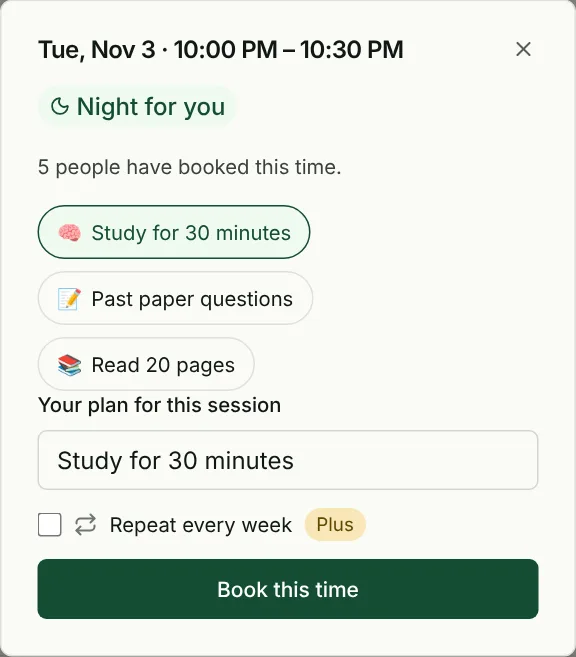
Disclosure: Cohorty publishes this journal. In Cohorty you book a 30-minute session, write what you’ll study in one line, and study alongside whoever booked the same time, with no camera or chat. See how to use Cohorty.
Protect sleep
Sleep plays an important role in consolidating what you’ve learned. Late-night cramming often costs more than it gains. Plan study so the night before an exam is for a light review and sleep. See night routine for anxiety if exam worries keep you up.
Plan for missed sessions
You’ll miss some. Don’t double up; just do the next planned session. Keep a minimum version (ten flashcards) for busy days, and follow the never-miss-twice rule.
A sample weekly study plan
| Day | Session (30–50 min) | Method |
|---|---|---|
| Mon | Biology: cell structure | Read, then blank-page recall |
| Tue | Maths: problem set | Mixed practice problems |
| Wed | Biology: review Monday | Flashcards |
| Thu | History: essay plan | Outline from memory |
| Fri | Maths: review Tuesday | Past paper questions |
| Sat | Mixed review | Teach it out loud |
| Sun | Rest |
For a full exam plan, see how to prepare for exams. If you have ADHD, see how to study with ADHD.
Common questions
What are good study habits?
Studying at fixed times, using active recall and spacing, working in short focused sessions, removing distractions, studying with others and protecting sleep.
How many hours a day should I study?
It depends on your course and goals. Several focused sessions spread through the week usually beat long, unfocused days. Quality and regularity matter more than total hours.
What is the most effective way to study?
Testing yourself (active recall) and spreading study over time (spacing) are among the best-supported methods. Rereading and highlighting are much less effective on their own.
How do I make studying a habit?
Pick fixed times, attach them to something you already do, keep sessions short with one clear goal, and study alongside others where you can.